
QCT: Bridging the Gap Between Industrial QA and Software Engineering Education
asi-crowdsourcing testing for educational projects
The paper introduces "Quasi-Crowdsourcing Testing" (QCT), a framework that utilizes software engineering students as a specialized "crowd" to perform system testing on industrial products (e.g., Baidu-Browser). It achieves high-quality test results comparable to senior industrial testers while providing students with practical, high-engagement training.
TL;DR
Quasi-Crowdsourcing Testing (QCT) transforms the traditional software testing classroom into a high-utility industrial testing lab. By allowing students to test actual commercial products from companies like Baidu, the framework provides companies with professional-grade bug reports at a low cost, while offering students a sense of achievement far beyond typical "toy" projects.
Problem & Motivation: The "Disconnected" Classroom
For years, software engineering education has struggled with a fundamental paradox:
- The Educators' Struggle: Using real industrial software is hard because it's too complex to fit into a 12-week syllabus. Consequently, students often work on "pruned" or "dead" codebases, leading to boredom and a lack of real-world intuition.
- The Industry's Struggle: In crowdsourced testing, companies struggle to find "qualified" workers. Even paid workers often submit low-quality, redundant, or nonsensical bug reports.
The authors recognized a Natural Complementarity: Students are qualified, motivated to learn, and socially accountable to their professors, making them the perfect "managed crowd."
Methodology: The Quasi-Crowdsourcing (QCT) Framework
The authors define "Quasi" crowdsourcing because, unlike traditional crowdsourcing where workers are strangers, the participants here (students) have a pre-existing social and institutional relationship with the task providers (university/instructors).
The QCT Workflow:
- Task Decomposition: Industry partners take complex products (Baidu-Input, Baidu-Browser, Baidu-Player) and break them into functionality sets or performance scenarios.
- Student Selection: Students choose tasks via a teaching support system based on their interests or available hardware (e.g., specific Android models for compatibility testing).
- Execution & Manual Inspection: Unlike automated Unit Testing (UT), QCT requires manual exploration. Students submit text descriptions and screenshots.
- Win-Win Evaluation: Results are audited by both industry professionals (for utility) and TAs (for educational grading).

Experiments & Results: Better than Professionals?
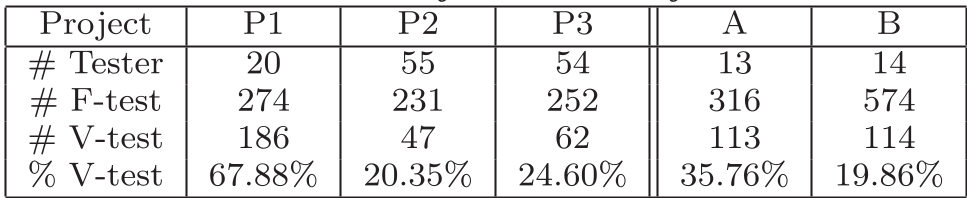
The most striking result from the paper is the Utility Comparison. The researchers compared student testers against two groups of professional crowd-testers: Group A (Seniors) and Group B (Juniors).
| Project | Students (P1) | Senior Crowd (A) | Junior Crowd (B) |
|---|---|---|---|
| Valuable Test % | 67.88% | 35.76% | 19.86% |
As the data shows, student testers in P1 were significantly more effective at providing "valuable" tests than even the senior professional crowd. Industry feedback noted that student reports were more detailed, professional, and useful.
The "Soft Skill" Discovery
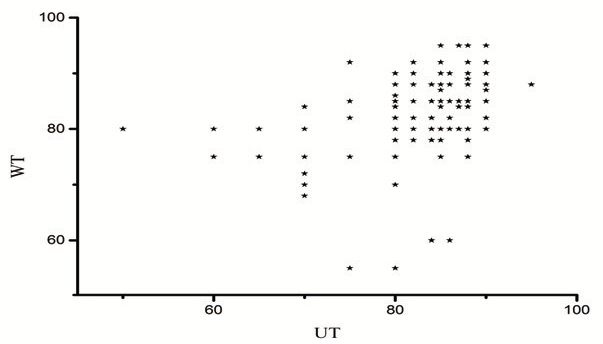
The study conducted a correlation analysis between three types of projects: Unit Testing (UT), Web Testing (WT), and QCT.
- The Finding: There was nearly zero correlation (R = -0.06) between a student's score in Unit Testing (coding scripts) and QCT (finding bugs in real software).
- The Insight: Testing is not just about writing code (hard ability); it's about understanding requirements and "breaking" software (soft ability). Traditional education misses the latter, which QCT successfully captures.
Critical Analysis & Conclusion
Takeaway
QCT is a powerful model for Software Engineering 2.0 Education. It solves the motivation problem (nearly 70% of students found QCT more interesting) and provides industry with a high-fidelity feedback loop.
Limitations & Future Work
- Scalability of Evaluation: Currently, TAs and industry actors must manually inspect screenshots. As the "crowd" grows, this becomes a bottleneck. The authors suggest using test prioritization techniques to rank the most likely-to-be-valuable reports first.
- Fairness: Testing "mature" software is harder than testing "buggy" new software. Students assigned to mature projects might find fewer bugs, potentially penalizing their grades unless the grading rubric accounts for the "difficulty of the find."
In conclusion, this paper moves software testing education from a simulated environment into the real-world "wild," proving that students are not just learners—they are an elite testing force.