
The Asian CHI Symposium: Decentralizing HCI Research and Embracing Cultural Context
Asian CHI Symposium: HCI Research from Asia and on Asian Contexts and Cultures
The "Asian CHI Symposium 2021" is a premier academic gathering focused on spotlighting Human-Computer Interaction (HCI) research within Asian sociocultural contexts. It introduces a systematic "Shepherding Process" to elevate emerging research to international publication standards, effectively bridging the gap between local Asian HCI communities and the global ACM SIGCHI ecosystem.
TL;DR
The Asian CHI Symposium 2021 represents a critical effort to diversify the Human-Computer Interaction (HCI) field by providing a high-visibility platform for Asian researchers. By combining a rigorous "Shepherding" mentorship model with a focus on local sociocultural factors, the symposium aims to transition Asian HCI work from local domestic interest to global academic influence.
Background Positioning
While the HCI field has historically been dominated by North American and European perspectives, the Asian CHI Symposium acts as a bridge and incubator. It isn't just a regional workshop; it is a strategic mechanism to integrate unique Asian interaction techniques and social contexts into the mainstream ACM Digital Library.
Problem & Motivation: The "Visibility Gap"
Despite the maturity of HCI research in countries like Japan, South Korea, and China, and the nascent growth in Southeast Asia, researchers often struggle with:
- Differing Publication Norms: Mature domestic conferences (e.g., IPSJ Interaction) have creative solutions that don't always align with Western "international" publication criteria.
- Institutional Barriers: Researchers in the Global South lack the financial and mentorship resources to reach the threshold of elite venues like the main CHI conference.
- The Representation Deficit: Research often ignores how specific Asian social and political identities shape technology use, leading to designs that lack cultural resonance.
Methodology: High-Touch Mentorship and Inclusion
The authors propose a structure that prioritizes quality enhancement over exclusion.
1. The Shepherding Model
Unlike the traditional "Accept/Reject" paradigm, the symposium identifies "near-acceptance" submissions. These authors are paired with senior mentors (Shepherds) who guide them through revisions. This ensures that valuable insights are not lost due to language barriers or formatting issues.
2. Strategic Outreach
The use of Ambassadors across various Asian sub-regions (Southern, Western, and Southeast Asia) ensures that the symposium isn't just localized to one hub but reflects the geographical diversity of the continent.
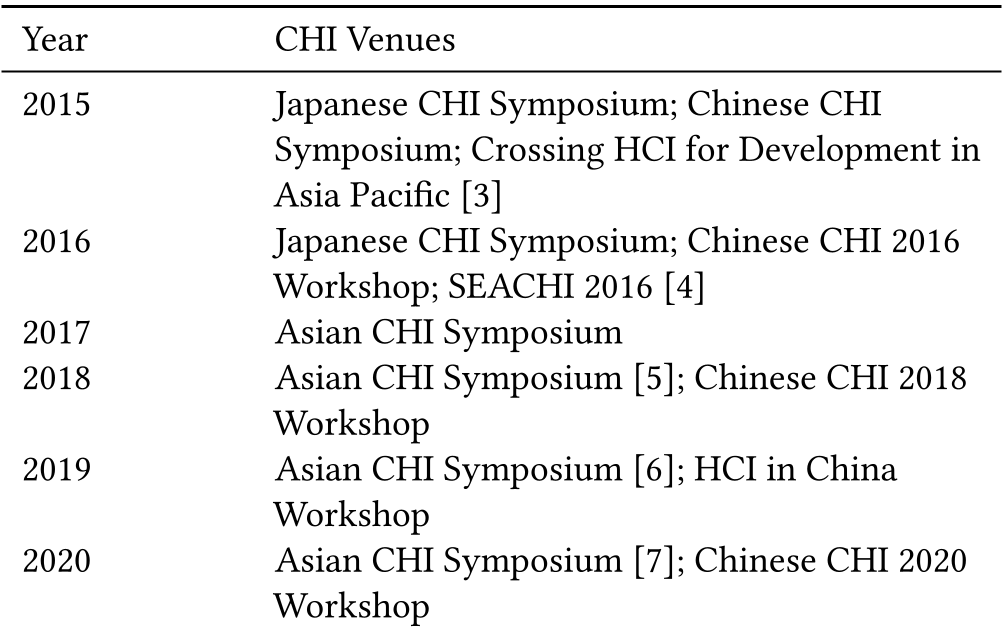 Figure 1: The evolution of Asian-focused HCI workshops and symposiums leading up to the 2021 event.
Experiments & Results: Navigating the Virtual New Normal
The 2021 symposium was designed to be "COVID-resilient," focusing on a fully virtual model that leveraged:
- Synchronous & Asynchronous Layers: Zoom for "Prime Time" presentations and Discord for persistent community networking.
- KPIs for Success: The event targeted a participant count of ~170, with a strict goal of having at least 40% young researchers (students/early-career) to ensure the longevity of the community.
Key Outcomes
- Diversity: Increased representation from Southern and Western Asia.
- Archivability: A significant portion of the "Shepherded" papers reached the quality standard required for the ACM Digital Library, providing permanent visibility to Asian research.
Critical Analysis & Conclusion
Takeaway
The Asian CHI Symposium is more than a gathering; it is a pedagogical tool. It teaches the "hidden curriculum" of international publishing to a new generation of Asian scholars while enriching the global HCI community with culturally specific insights.
Limitations
A virtual-only model, while increasing accessibility, may struggle to replicate the deep social bonding of physical "mixers" which are crucial for long-term international collaboration. Furthermore, the reliance on volunteer "Shepherds" may face scalability issues as the symposium grows.
Future Outlook
As HCI continues to move toward "Hyper-local" design, the frameworks established here—mentorship, regional ambassadors, and sociocultural focus—will likely become the blueprint for other underrepresented regions (e.g., Latin America or Africa) to claim their space in the global tech discourse.