
Ask, Don’t Judge: Rethinking LLM Evaluation with BINEVAL
Ask, Don't Judge: Binary Questions for Interpretable LLM Evaluation and Self-Improvement
The paper introduces BINEVAL, a task-agnostic evaluation framework that decomposes high-level criteria into atomic binary yes/no questions for Large Language Models (LLMs). By aggregating these verdicts, it achieves state-of-the-art correlation with human judgments on benchmarks like SummEval and QAGS, effectively mitigating the "black-box" nature of holistic LLM judges.
TL;DR
Evaluating Large Language Models (LLMs) is often more difficult than building them. While "LLM-as-a-Judge" has become the industry standard, it remains a black box. BINEVAL changes the game by breaking down complex evaluation criteria into dozens of tiny "yes/no" questions. This not only makes scores more accurate (matching human judgment better than GPT-4 based holistic judges) but also makes them extensible and debuggable.
Problem: The "Opaque Score" Bottleneck
Modern evaluators like G-Eval usually ask an LLM to "Rate this summary from 1 to 5." This approach suffers from several fatal flaws:
- Ceiling Effects: LLMs tend to give everything high scores, failing to distinguish "good" from "perfect."
- Opacity: If a model gives a "3," you don't know if it's because of a factual error, poor grammar, or missing info.
- Hallucination Blindness: Holistic judges often get "distracted" by fluent prose and miss subtle factual inconsistencies.
Methodology: The Power of Binary Decomposition
BINEVAL's core intuition is Complexity Reduction. Instead of making one big judgment, it forces the model to perform a series of "micro-audits."
The Three-Step Pipeline:
- Meta-Prompting: A task-agnostic prompt takes the original instruction and summarizes it into specific requirements (e.g., "Must mention the location," "Must not hallucinate dates").
- Binary Question Generation: These requirements are turned into atomic questions (e.g., "Does the summary mention Birmingham?").
- Aggregation: The final score is the percentage of "Yes" verdicts.
 The per-dimension score is calculated as a simple mean of binary successes, providing a linear and granular scale.
Why It Works: Visualizing the Shift
In traditional scoring, a summary with a subtle factual error might still get a 5/5 because it "looks" professional. BINEVAL's decomposition acts as a filter.
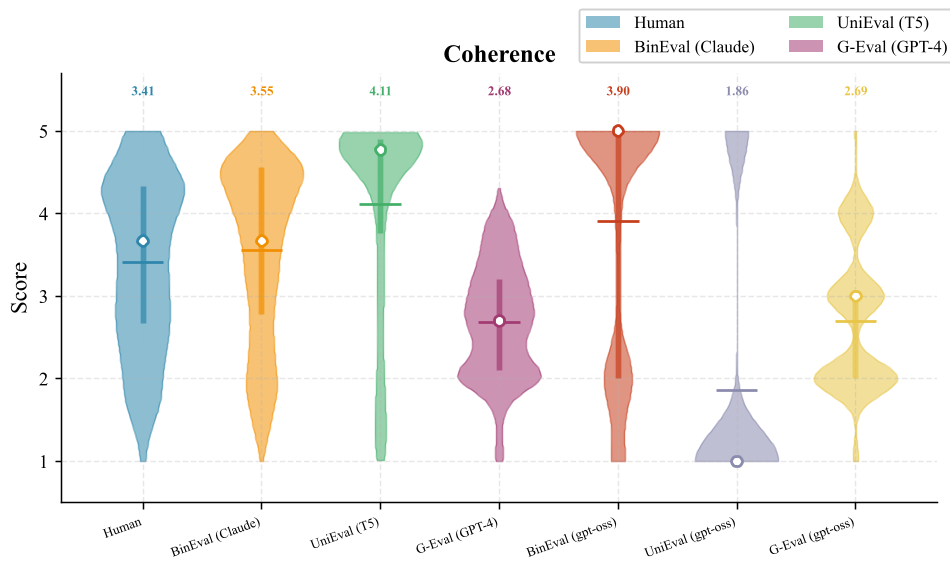 Figure 1: Notice how BINEVAL's distribution (blue) matches the human "spread" much more closely than UniEval or G-Eval, which tend to cluster at the top.
By asking seven different questions about factual consistency, BINEVAL can identify that while the entities are correct (Q4: Yes), the causal relationships are wrong (Q6: No), leading to a much more nuanced 3/7 score rather than a broad 5/5.
Iterative Self-Improvement: The Feedback Loop
One of the most exciting aspects of BINEVAL is Cross-Model Prompt Updating. If a weaker model (e.g., a local 70B model) disagrees with a stronger model (e.g., Claude 3.5 Sonnet) on a binary question, the system can extract a "lesson."
- Old Prompt: "Check for consistency."
- Lesson Extracted: "The model conflated omission of detail with factual contradiction."
- New Prompt: "Only flag statements present in the summary that are unsupported; do not penalize for missing info."
This targeted refinement led to a +0.136 improvement in rank correlation for consistency tasks.
Experimental Results
- SummEval: BINEVAL outperformed G-Eval across Coherence, Consistency, and Fluency.
- QAGS: On this difficult hallucination benchmark, BINEVAL (Claude) achieved a Spearman correlation of 0.620, compared to lower scores for almost all baseline metrics.
- System Ranking: As seen in the figure below, BINEVAL is significantly better at keeping the "order" of which model is better than which.
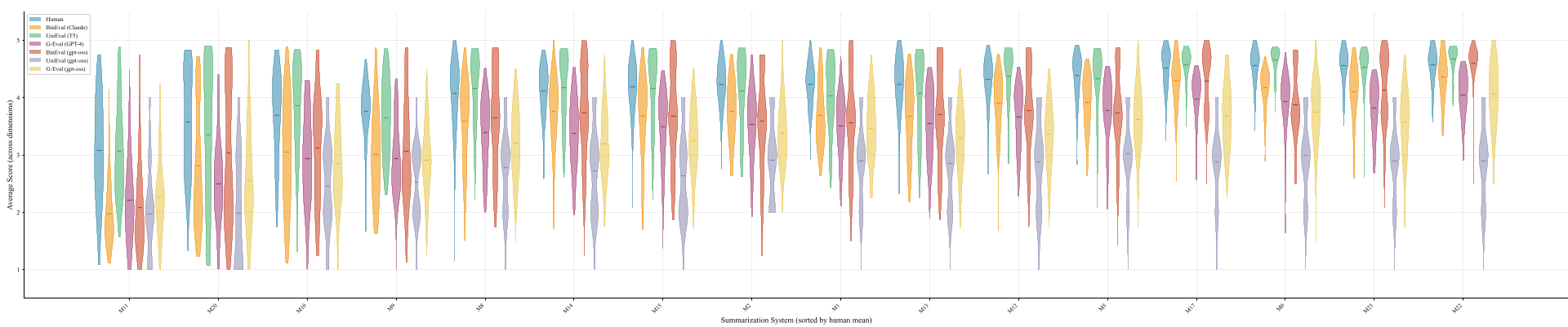 Figure 2: BINEVAL (Claude) faithfully tracks the human performance ranking across different summarization systems.
Critical Insight & Limitations
While BINEVAL is a massive step forward for interpretable evaluation, it is not a silver bullet.
- Subjectivity: For highly subjective traits like "Relevance," decomposition can sometimes make the evaluator too strict, as humans often judge relevance's "gist" holistically rather than by a checklist of facts.
- Computational Cost: Answering 20 binary questions is more expensive than one single prompt. However, for high-stakes R&D, this cost is a small price to pay for a score you can actually trust and explain.
Conclusion
BINEVAL proves that the best way to judge a complex AI output is to stop asking the AI to "judge" and start asking it to "check." By moving from holistic impressions to atomic verifications, we move closer to a version of AI evaluation that is as robust and transparent as human peer review.