
ASML: Bridging the Gap Between Real Societies and Parallel Execution
ASML: Artificial Society Modelling Language for ACP Approach Based on Organization Metaphors
This paper introduces the Artificial Society Modelling Language (ASML), a domain-specific language designed for the ACP (Artificial societies, Computational experiments, Parallel execution) approach. ASML standardizes the creation of city-scale virtual societies by using organization metaphors to simplify modeling for emergency management and social computing tasks.
TL;DR
To effectively manage unconventional emergencies like a pandemic, we need more than simple simulations; we need Artificial Societies. This paper presents ASML (Artificial Society Modelling Language), a standardized language designed to map complex human city-scale systems into computational models using the ACP approach. By leveraging social organization metaphors, ASML simplifies the description of millions of interacting agents.
The "Micro-Macro" Modeling Gap
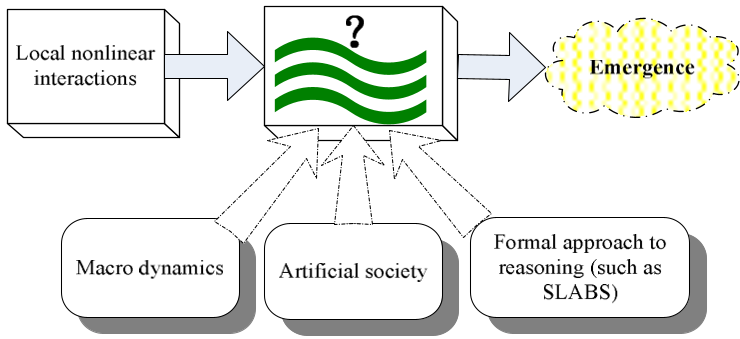
In social computing, there is a notorious "fuzzy" gap between local nonlinear interactions (how individuals behave) and macro-emergence (how a pandemic spreads across a city). While traditional macro-dynamics use differential equations and formal methods use rigid logic, neither captures the diverse, multi-level nature of human society.
The authors argue that current tools like UML are too software-centric, while MAS-ML (Multi-Agent System Modelling Language) fails to capture the "sociality" required for city-scale modeling.
Core Methodology: The Organization Metaphor
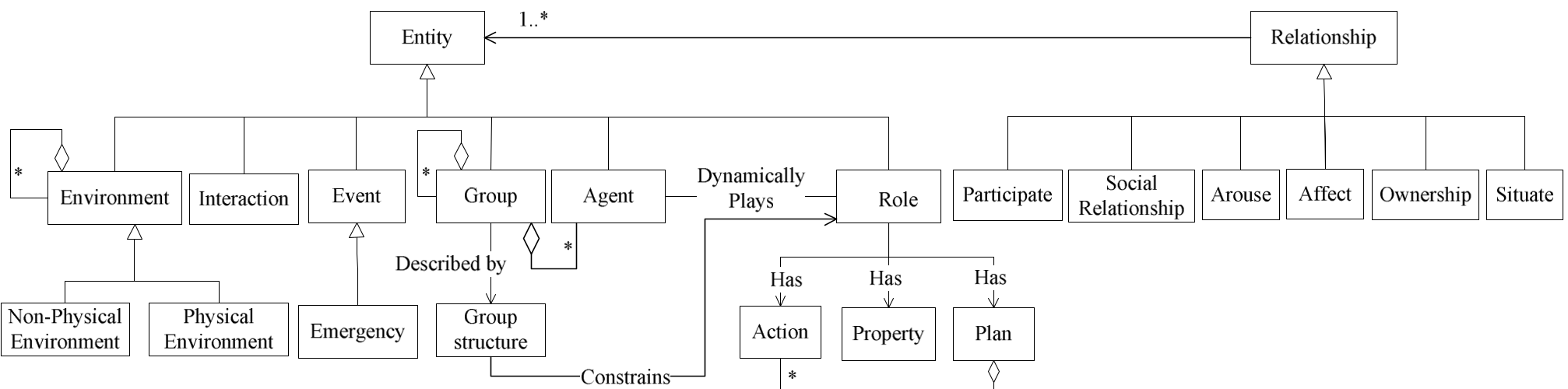
The genius of ASML lies in its meta-model. Instead of hard-coding every agent, it uses Roles, Groups, and Environments as first-class citizens:
- Agent vs. Role: An agent is the autonomous entity, but a Role is its behavioral identity. A single agent can "play" different roles (Student, Patient, Guard) over time.
- Groups & Structure: These define social relationships (Peer-to-peer or Superordinate-to-subordinate), allowing for the modeling of families, schools, or entire city departments.
- Physical & Non-Physical Environments: ASML integrates GIS data (points, polygons) with dynamic factors like weather and time.
The Formal Architecture
The meta-model defines the relationships (Arouse, Affect, Situate) that allow an emergency event to trigger changes in the system's state.
Case Study: H1N1 on a University Campus
The authors validated ASML by modeling an H1N1 outbreak at a Chinese university. The model included:
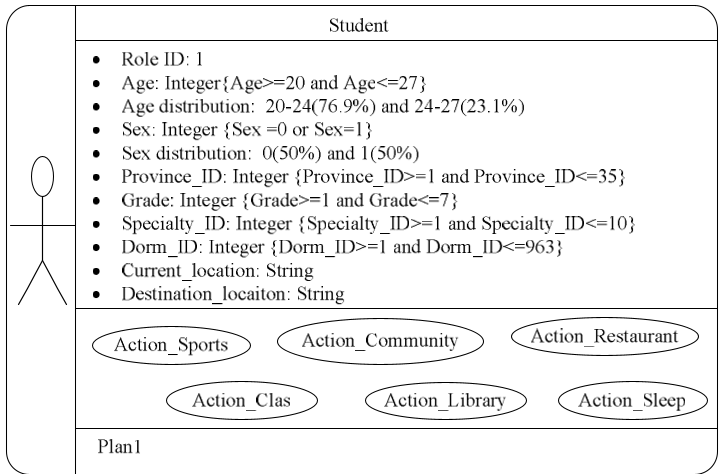
- 5,000 Agents: Distributed into roles like Students (90%), Teachers (5%), and Doctors.
- Social Fabric: Modeling roommate and friendship groups to track "close contact."
- Spatial Accuracy: Mapping buildings as "Polygon" entities with specific activity hours (e.g., Library open from 08:00 to 22:00).
The Interaction Model specifically defined how "Patient-to-Person" interactions occur based on physical proximity (distance ≤ 2 meters) and random probability, effectively formalizing the infection logic into a visual structure.
Critical Insight & Future Outlook
ASML's greatest strength is its platform-independent nature. It allows researchers to design a society conceptually before deciding whether to run the simulation in Python, Java, or a dedicated high-performance computing environment.
Limitations: While ASML is robust in structural description, its formal semantic definition and automated model transformation (taking the XML/Graphical model and turning it into executable simulation code) remain ongoing works.
The Takeaway: As we move toward digital twins of entire cities, languages like ASML will be the "blueprints" that allow sociologists and computer scientists to speak the same language.