
ASNA: Rethinking News Aggregation through the Lens of Emotional Intelligence
ASNA: An Intelligent Agent for Retrieving and Classifying News on the Basis of Emotion-Affinity
The paper introduces ASNA (Affect Sensitive News Agent), an intelligent news aggregator that automates the categorization of RSS news feeds based on emotional affinity. It leverages the OCC cognitive model of emotions and a custom linguistic tool, SenseNet, to classify news into eight distinct emotion types plus a neutral category.
TL;DR
The Affect Sensitive News Agent (ASNA) is a sophisticated news aggregator that departs from traditional topic-based clustering. Instead of grouping news by "Politics" or "Technology," ASNA uses Natural Language Processing (NLP) and the OCC cognitive model to categorize stories by their emotional impact—ranging from "Hopeful" to "Fearful"—allowing for a more intuitive and human-centric way to consume information.
Background: The Limits of Keyword Matching
Current news aggregation faces two major hurdles: Information Overload and Context Blindness. Most systems rely on static corpora and machine learning algorithms that are easily "fooled" by lexical affinity. For example, a sports headline about a "battle on the center court" might be tagged as "War" because of the word "battle."
The authors of ASNA argue that we need Emotional Intelligence in our algorithms. They posit that news is stories, and stories are meant to evoke specific emotional reactions such as suspense, curiosity, or joy.
Methodology: Decoding Emotion with SenseNet
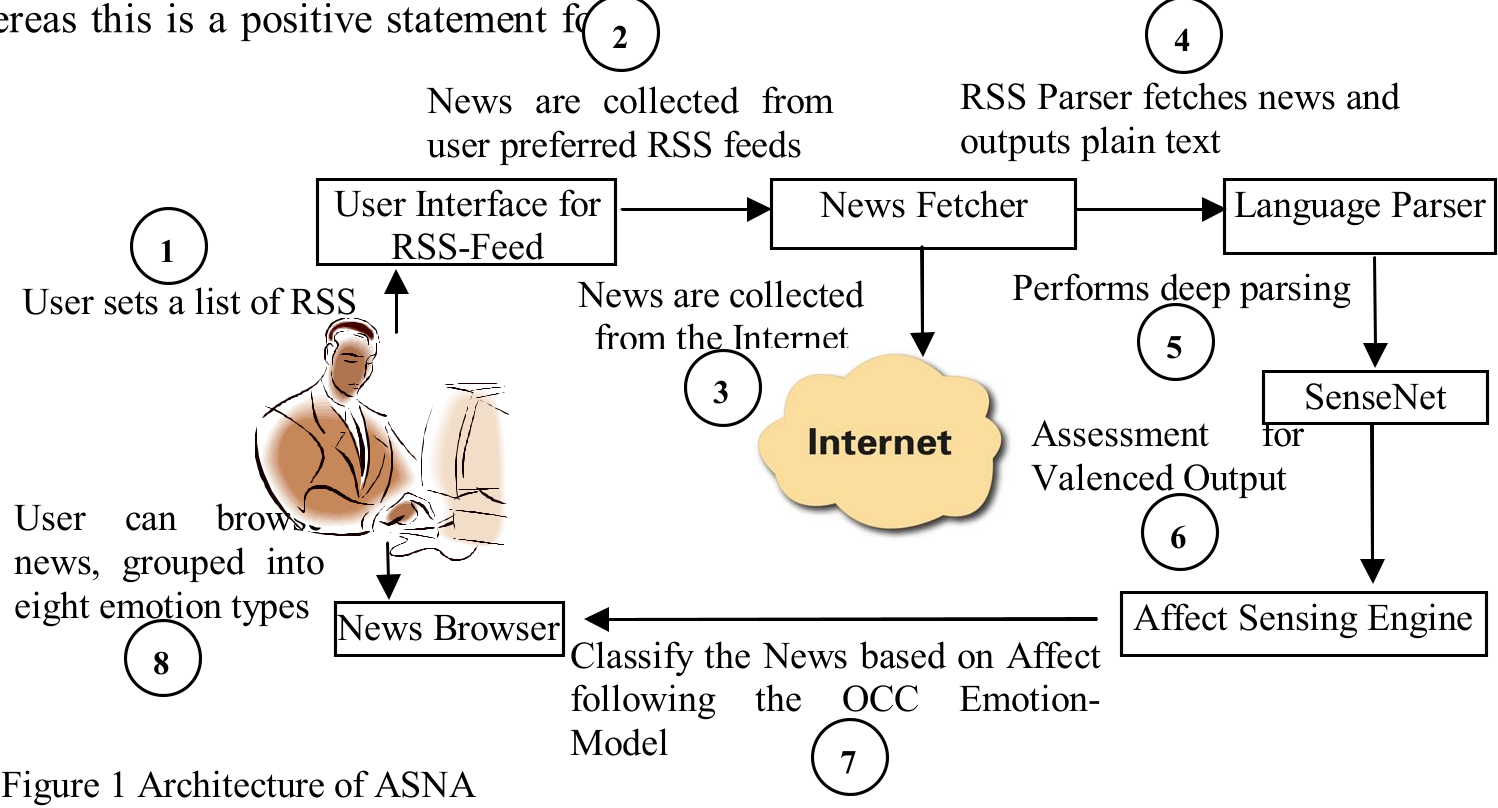
The heart of ASNA lies in its unique processing pipeline, which moves beyond simple word-bagging to deep structural analysis.
1. The OCC Model Framework
Unlike typical sentiment analysis that only looks at "Positive vs. Negative," ASNA implements the OCC (Ortony, Clore, and Collins) model. This cognitive theory treats emotions as a result of valenced reactions to events, agents, or objects.
2. SenseNet and Deep Parsing
ASNA uses a tool called SenseNet to break down sentences into "Senses"—tuples consisting of:
- Subject/Agent: Who is doing the action?
- Action/Verb: What is happening?
- Object/Concept: To whom is it being done?
- Attributes: Adjectives and adverbs that modify the intensity.
3. Common-Sense Knowledge Integration
To resolve the "valence" of a sentence, SenseNet doesn't just look at a dictionary; it queries ConceptNet and WordNet. This allows the system to understand that "quitting drugs" (Negative Verb + Negative Concept) results in a Positive Polarity, whereas "quitting a job" results in a Negative Polarity.
Results: Intuitive News Categorization
By applying these rules, ASNA can calculate a "Sense-Degree" for each news item. In the paper, the authors demonstrate how a tragic accident involving a car crash is correctly identified with a negative valence and subsequently categorized into the appropriate negative emotion group.
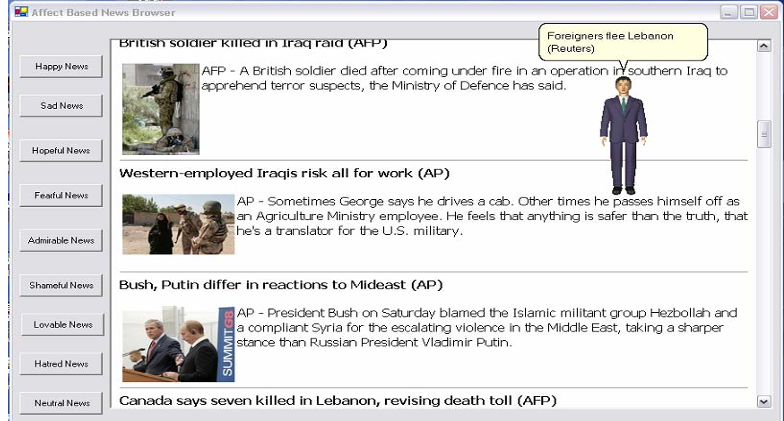
The user interface, the Affect Sensitive News Browser, presents 9 buttons (8 emotions + 1 neutral). This allows users to filter their daily intake based on their mood or the emotional weight they wish to engage with.
Deep Insight: Why This Matters
ASNA represents a shift from Statistical NLP to Cognitive NLP. While contemporary models like GPT-4 dominate the field today through massive data scale, ASNA highlights the value of explicit rule-based logic derived from psychological theory.
Limitations & Future Work
While ASNA is a breakthrough in emotional categorization, it relies heavily on the "General Sentiment" assigned to named entities (e.g., assigning a negative value to "George W. Bush" or "Bin Laden" based on current-affairs knowledge). This is inherently subjective. The authors acknowledge that future versions should include user-centric models where individual preferences and opinions can calibrate the sensing engine.
Conclusion
The ASNA system proves that news is more than just data; it is a repository of human experience. By categorizing information based on emotional affinity, we can create interfaces that are not only more efficient but also more empathetic to the user's psychological state.
Key Terminology:
- RSS (Really Simple Syndication): A web feed format used to deliver frequently updated content.
- OCC Model: A standard model for emotion synthesis in AI, focusing on the cognitive appraisal of situations.
- Valence: The intrinsic attractiveness (positive) or aversiveness (negative) of an event, object, or situation.