
AGSRec: Mastering POI Recommendations via Aspect-Aware Heterogeneous Graphs
Aspect-aware Point-of-Interest Recommendation with Geo-Social Influence
This paper introduces AGSRec, a graph-based Point-of-Interest (POI) recommendation framework that constructs an Aspect-aware Geo-Social influence Graph (AGSG). By fusing geographical constraints, social networks, and fine-grained review aspects, the method transforms POI recommendation into a node ranking problem solved via Personalized PageRank (PPR) with meta paths.
TL;DR
Choosing where to eat or visit isn't just about distance or friends; it's about specific traits like "atmosphere" or "signature dishes." AGSRec (Aspect-aware Geo-Social influence Recommendation) is a novel framework that bridges the gap between spatial data and textual reviews. By building a heterogeneous graph and using meta-path-guided ranking, it outperforms existing SOTA models by up to 25% in recommendation accuracy.
Problem & Motivation: The Fragmentation of LBSN Data
In Location-Based Social Networks (LBSNs) like Yelp, we have a wealth of data: where you went (check-ins), who you know (social), and what you thought (reviews).
Previous systems suffered from two main flaws:
- Homogeneous Over-simplification: They flattened complex relationships into a simple user-item matrix, losing the "why" behind a visit.
- Semantic Blindness: They treated "Sushi" and "Sashimi" as unrelated terms if they didn't share a physical location, failing to capture the semantic overlap of user interests.
The authors' insight was simple: Aspects (extracted from reviews) are the connective tissue between user desire and POI reality.
Methodology: The AGSG Architecture
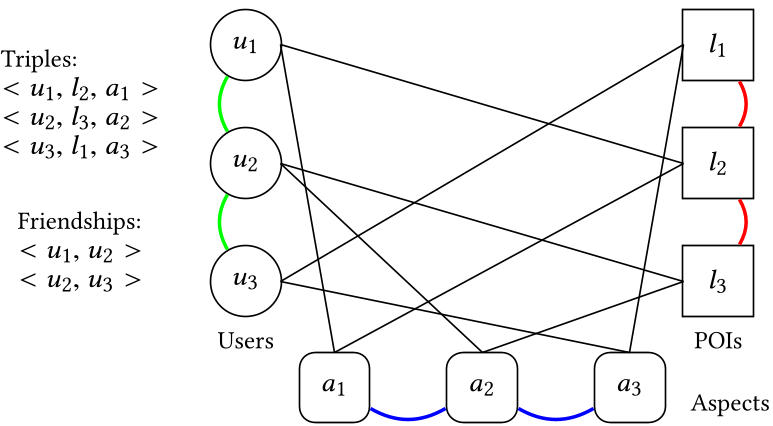
The heart of this research is the Aspect-aware Geo-Social influence Graph (AGSG). It isn't just a list of connections; it's a multi-layered ecosystem of nodes:
- Users (U), POIs (L), and Aspects (A).
- Smart Edge Weighting:
- Geographical edges use a power-law function (distance matters).
- Social edges combine friendship + similarity.
- Aspect-Aspect edges: To solve data sparsity, the authors link aspects if they frequently appear in the same POI categories (e.g., "burger" and "hamburger" share the "Fast Food" category).
Meta-Paths: The Guided Random Walk
Instead of a standard PageRank, AGSRec uses Meta-Paths to force the "random walker" to follow logical reasoning:
- Social Influence: (Your friend's favorites).
- Aspect Quality: (Places that share the same good qualities as your previous visits).
- Semantic Preference: (Places with aspects similar to what you care about).
Experiments & Results
The model was tested against 8 baselines, including traditional CF, Matrix Factorization (PMF), and graph-based models like TriRank.
Key Findings:
- Consistency: AGSRec outperformed others across all metrics (Precision and Recall) in three different cities.
- The Power of Aspects: In the Charlotte dataset, which had the richest aspect data, AGSRec saw a 25.48% improvement in Pre@10.
- Ablation Study: The inclusion of Aspect-Aspect relations was found to be the most stable performance booster, proving that semantic connections are vital.
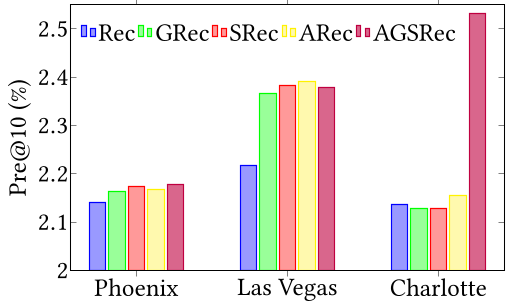
Figure: The "AGSRec" line (in color) consistently stays above variants that exclude social or geographical factors.
Critical Insight & Conclusion
AGSRec proves that Information Heterogeneity is a feature, not a bug. By explicitly modeling the semantic relationships between text aspects and physical locations, the researchers successfully mimicked human decision-making.
Limitations: The model relies on an external toolkit for aspect extraction, which can be a bottleneck. The authors also noted that over-emphasizing geography () can actually hurt performance by introducing noise—proving that "closeness" isn't everything.
Future Outlook: Integrating Sentiment Analysis (distinguishing between a mention of "bad service" vs "good service") is the next frontier for this graph-based approach.