
Deciphering Social Network Efficiency: Why Individual-Centric Systems Dominate Information Flow
Assessing the Availability of Information Transmission in Online Social Networks
This paper evaluates the availability and efficiency of information transmission in Online Social Networks (OSNs) using the concept of global efficiency. By comparing individual-centered (e.g., Sina Weibo) and group-centered (e.g., Lilac BBS) networks, the study identifies distinct topological behaviors and efficiency levels in information diffusion.
TL;DR
Not all social networks are created equal. This study reveals that individual-centered platforms like Sina Weibo are structurally superior for fast information diffusion due to their hierarchical nature, whereas group-centered platforms like BBS forums prioritize localized interaction at the cost of global efficiency. By applying concepts of "Global Efficiency" and "Centrality," the authors map out why certain architectures are more reliable than others.
Problem & Motivation
Why does a tweet go viral across the globe in minutes, while a forum post might stay buried in a specific sub-thread? Modern Social Network Services (SNS) are built on different technical philosophies.
- The Problem: Prior work often overlooks how the design intent—whether it focuses on the individual's external expansion or a group's internal discussion—shapes the physical topology of the network and its subsequent reliability.
- The Insight: The authors hypothesize that the efficiency of information exchange is rooted in the Hierarchical Structure. If a network is hierarchical, it uses "hubs" to bridge distant clusters, drastically reducing the "physical distance" information must travel.
Methodology: Measuring the "Pulse" of a Network
The authors focus on two primary metrics to dissect network performance:
1. Global Efficiency ()
Instead of just looking at the average path length, they use the inverse of the shortest path (). This allows for a more nuanced view of how easily nodes communicate, especially in fractured networks.
eq j \in G} \frac{1}{d_{ij}}$$ ### 2. Hierarchical Signatures A network is considered hierarchical if its Clustering Coefficient ($C$) is not constant but scales with the degree ($k$) of the nodes. Specifically, if $C(k) \sim k^{-\beta}$, it suggests that low-degree nodes form dense local clusters while high-degree nodes act as the "glue" between these clusters. 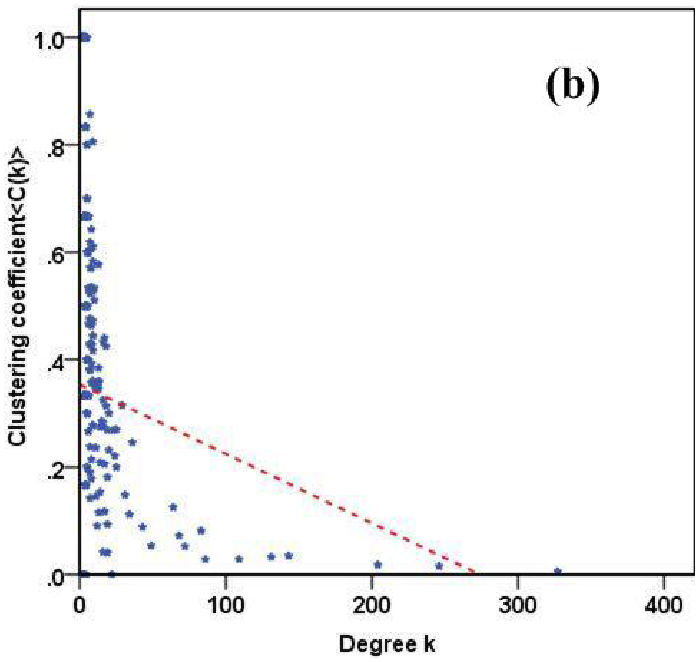 *The image above demonstrates the power-law fit for Sina Weibo, confirming its hierarchical nature.* ## Experiments & Results: Weibo vs. Lilac BBS The study compared **Sina Weibo** (Individual-centered) and **Lilac Community** (Group-centered). The quantitative results were striking: | Metric | Lilac (Group-centric) | Sina Weibo (Individual-centric) | | :--- | :--- | :--- | | **Nodes** | 3414 | 839 | | **Edges** | 10353 | 2112 | | **Global Efficiency** | **0.263** | **0.383** | ### Key Findings: * **Efficiency Gap**: Sina Weibo is roughly **45% more efficient** at transmitting information than the Lilac community. * **Structural Difference**: Weibo follows a clear power-law distribution for its clustering coefficient ($\beta = 0.733$), whereas Lilac shows no such clear hierarchical boundary. * **Centrality Correlation**: In both networks, nodes with high degree (many connections) also had high betweenness (acting as bridges). This confirms that "influencers" are not just popular—they are structurally vital for network reliability.  *Comparative statistics showing the higher global efficiency of the individual-centered Sina Weibo.* ## Critical Analysis & Conclusion ### Takeaways 1. **Topology follows Technology**: The way we design a platform's UI/UX (e.g., "Follow" vs "Join Room") directly dictates the mathematical efficiency of information flow. 2. **The Hub Paradox**: While hierarchical networks (like Weibo) are highly efficient, they are also vulnerable. The high correlation between degree and betweenness means that removing a few "central" nodes can catastrophically degrade the network's global efficiency. ### Limitations The study uses a relatively small sample size for Sina Weibo (839 nodes) compared to modern billion-user scales. Additionally, the analysis is based on static snapshots, which may not capture the temporal dynamics of how "efficiency" fluctuates during breaking news events. ### Future Outlook As we move toward decentralized social media, understanding these hierarchical trade-offs will be crucial. Can we build a network that is as efficient as Weibo but as resilient (non-hierarchical) as an old-school BBS? That remains the "Holy Grail" of network architecture.