
Validating the Crowd: A New Era for Gaming Quality of Experience (QoE) Assessment
Assessing Interactive Gaming Quality of Experience using a Crowdsourcing Approach
The paper introduces a structured framework for assessing interactive gaming Quality of Experience (QoE) using crowdsourcing. By integrating ITU-T Recommendations P.808 and P.809, it proposes a method to simulate network impairments (delay, jitter, packet loss) directly within web-based games and validates the results against traditional laboratory studies.
TL;DR
Researchers have successfully moved interactive gaming quality tests from the expensive lab to the "crowd" (Amazon Mechanical Turk). By building a framework that injects network lag and frame drops directly into web-based games and using "engagement checks" to catch lazy participants, they proved that crowdsourced results are just as reliable as traditional lab studies.
Background Positioning: Lab vs. The Real World
In the world of gaming research, the gold standard has always been the controlled laboratory environment. While labs offer precision, they are slow and often fail to represent the "wild" conditions of home gaming. This paper bridges the gap by adapting crowdsourcing (CS) for interactive gaming—a feat much harder than testing static video or audio because it requires active user participation and real-time responsiveness.
The Core Problem: The Trust Gap in Crowdsourcing
Why hasn't crowd-testing for games been standard? The authors identify three major pain points:
- Interaction Control: How do you know if the user is actually playing or just clicking randomly?
- Environment Noise: User hardware and internet speeds vary wildly, making it hard to isolate the effect of specific delays or packet loss.
- Data Reliability: Without an experimenter watching over their shoulder, "crowd workers" might rush through tasks to get paid.
Methodology: The Crowd Gaming Framework
The authors didn't just ask users to play games; they built a sophisticated "Human Intelligence Task" (HIT) workflow.
1. Artificial Impairment Injection
Instead of relying on the worker's natural internet lag (which is unpredictable), the researchers used JavaScript-based games (p5.js) and artificially simulated:
- Network Delay: Buffering input commands.
- Packet Loss: Randomly discarding keystrokes/clicks.
- Framerate Cap: Skipping the browser's
drawingfunction.
2. The Multi-Layer Validation System
To ensure data quality, they implemented three key safeguards:
- The Token System: A UUID is only generated once a user finishes the game session on a separate server, preventing users from skipping the game to reach the survey.
- Engagement Check: The game logs the number of inputs. If a user's clicks/keystrokes fall below 20% of the normal threshold, the "Engagement Check" fails, and they must replay.
- Trapping Questions: Questions like "Please select 'disagree' for this item" filter out bots and distracted humans.
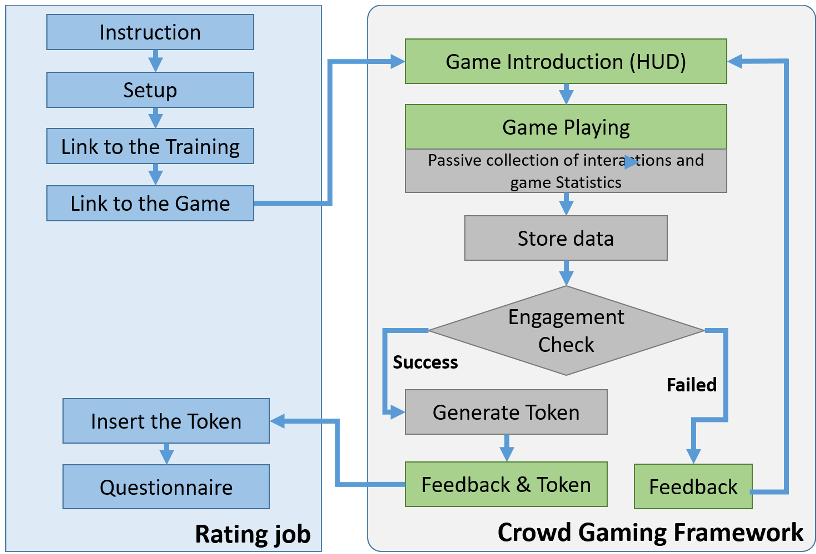 Fig 1: The architecture showing the interplay between the CS platform, the Web Server/Game, and the Validation logs.
Experimental Insights: Does the Crowd Match the Lab?
The researchers conducted five studies covering 571 workers and 1,713 ratings.
Key Findings:
- Sensitivity varies by genre: "Shooting Range" games were much more sensitive to delay than simple racing games like "Rocket Escape."
- The 10 FPS Threshold: In Study 2, users perceived 30 FPS and 60 FPS similarly, but QoE tanked dramatically at 10 FPS, identifying a clear "unplayable" floor for casual gaming.
- Statistical Parity: In a head-to-head comparison (Study 5) between lab subjects and crowd workers using the game Rocket Escape, the results for QoE, responsiveness, and controllability were statistically indistinguishable.
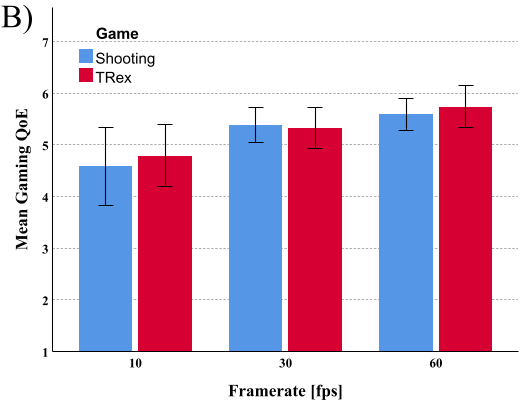 Fig 2: Bar plots demonstrating the impact of Delay (A), Framerate (B), Packet Loss (C), and Feedback Type (D) on overall QoE.
Critical Analysis & Conclusion
This work is a significant milestone for Cloud Gaming and Network Management. It proves that the industry can validate its streaming algorithms or game designs using thousands of diverse users at a fraction of the cost of lab studies.
Takeaways:
- Engagement matters more than observation: Automated input-log checks are a highly effective substitute for a human supervisor.
- The 70% Yield: Even with filtering, about 30% of crowd data is "junk" due to distractions or failed checks—researchers must plan for this dropout rate.
Limitations & Future Work
The current study focused on simple 2D web games. The next challenge is applying this to high-fidelity 3D games where the source code isn't easily modifiable to "inject" artificial lag. Additionally, integrating performance metrics (like "high scores") into the engagement check could further improve data reliability.
Final Thought: This research moves gaming QoE from a niche lab activity to a scalable, data-driven science.