
Bridging the Digital Divide: Assessing the Reality Gap in Educational Robotics Simulators
Assessing the Reality Gap of Robotic Simulations with Educational Purposes
This paper investigates the "reality gap" in the Virtual Robotics Toolkit (VRT), a LEGO Mindstorms EV3 simulator used for STEM education. By comparing physical and simulated robot performances across line-following and displacement tasks, the authors identify significant discrepancies in sensor accuracy and mechanical behavior.
TL;DR
Can a student's perfectly programmed virtual LEGO robot survive the transition to the real world? This study dives into the "Reality Gap" of the Virtual Robotics Toolkit (VRT). While VRT proves robust for general STEM education, critical discrepancies in tachometer readings and high-speed maneuvers reveal that the simulator's physics—built on a game engine—requires specific calibration (like power capping and noise injection) to be truly reliable for precision competitions.
Background: The Pandemic and the Rise of Virtual Labs
The COVID-19 pandemic accelerated the shift toward hybrid learning, making simulators like VRT indispensable for robotics education. However, the "Reality Gap"—the phenomenon where simulated success turns into real-world failure—remains a persistent hurdle. This research positions itself as a much-needed audit of VRT, specifically focusing on its interaction with LEGO Mindstorms EV3 hardware.
The Problem: When "Virtual" Doesn't Mean "Real"
Most simulators use physics engines designed for visual plausibility (like Unity's built-in engine) rather than mathematical determinism. For educators, this creates a dilemma:
- Non-deterministic behavior: Running the same code twice might yield different results.
- Sensor inaccuracies: Virtual sensors often lack the noise and environmental interference of the real world.
- Physics shortcuts: Complex interactions, like wheel slippage or track-link collisions, are often oversimplified or bugged.
Methodology: The "EXPLOR3R" vs. "EV3Meg"
The researchers selected two distinct designs to test mobility and sensor integration.
- EXPLOR3R: A classic three-point robot (two wheels + one freewheel).
- EV3Meg: A more complex four-wheel drive system.
They executed three main test batches:
- Line Following: Testing light sensor integration and control loops.
- High-Power Displacement: Testing mechanical return-to-origin at 50% power.
- Low-Power Displacement: Testing if slowing down (10% power) reduces physics errors.
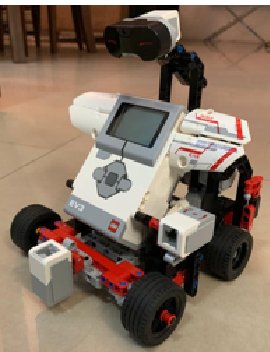 Fig 1: The EXPLOR3R robot modeled in LDD (left) and physical LEGO (right).
Key Insights: The Tachometer Trap
One of the paper’s most striking findings was in Test #2 (Displacement). In the physical world, moving a robot forward 3 rotations and then back 3 rotations results in a tachometer reading of nearly 0°. In VRT, however, the sensors accumulated significant errors (up to 3.5°), suggesting that the simulator struggles with instantaneous state tracking during direction changes.
Performance Comparison: 50% vs. 10% Power
The study discovered that the "Reality Gap" is highly sensitive to velocity. By reducing motor power to 10%, the standard deviation in angular variation dropped by over 60% in simulated environments.
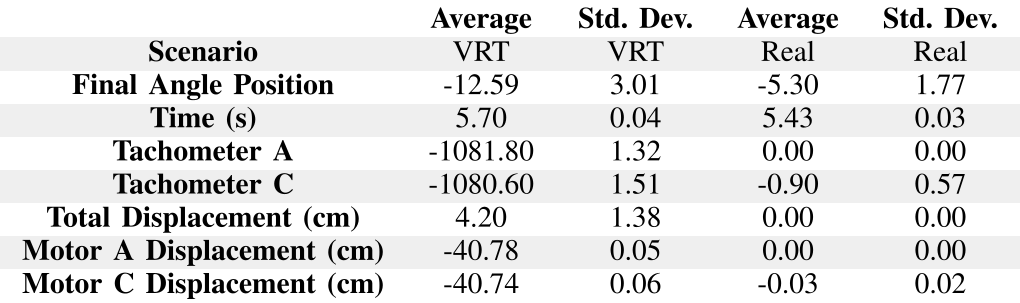 Table 1: Comparative metrics highlighting the drift in VRT's final angle and tachometer readings.
Critical Analysis & Conclusion
The authors conclude that while VRT is a powerful tool for teaching logic and STEM concepts, it is not "plug-and-play" for high-stakes competitions.
Takeaways for Educators & Researchers:
- Cap the Speed: To maintain high fidelity between VRT and physical LEGOs, keep motor power between 10% and 20%. This minimizes "slip" errors that the physics engine cannot handle accurately.
- Embrace the Noise: Since simulators are often "too perfect," researchers suggest manually inserting Gaussian noise into simulated sensor streams to force students to write more robust, error-correcting code.
- Limitations: The study noted that track-based robots (like the TRACK3R) currently fail in VRT due to collision bugs, limiting the simulator to wheeled designs.
In the grander scheme, this work serves as a reminder that as we move toward "Digital Twins" in education, we must remain vigilant about the hidden abstractions of the software we trust.
Future Work: The team plans to conduct "stress tests" to evaluate the impact of battery discharge—a major real-world variable that is currently absent from the VRT simulation.