
Crowdsourcing the Guardian of Knowledge: Assessing Wikipedia Editor Quality through Semantic Survival
Assessing the ality of Wikipedia Editors through Crowdsourcing
The paper introduces a novel Wikipedia editor quality assessment method that leverages crowdsourcing to evaluate semantic changes in article revisions. By distinguishing between simple textual deletions and actual shifts in meaning, the method calculates a quality score (approval rate) to accurately identify low-quality editors and vandals.
TL;DR
Wikipedia's open-edit nature is both its greatest strength and its Achilles' heel. While most editors act in good faith, vandals and low-quality contributors pose a constant threat. This paper presents a hybrid framework that utilizes crowdsourcing to bridge the "semantic gap"—the inability of machines to understand if an edit changed a sentence's meaning or just its wording. By tracking how long the meaning of an editor's contribution survives, the system achieves a 5% precision boost in identifying malicious users.
Problem: The Blindness of Edit Distance
Why is it so hard for a computer to tell a "good" edit from a "bad" one?
Consider these two scenarios:
- Paraphrasing: "Wikipedia has good quality articles" "Wikipedia has fine quality articles."
- Vandalism: "Wikipedia has good quality articles" "Wikipedia has no good quality articles."
Standard algorithms see both as a few-word change. To a machine using simple edit distance, these are nearly identical. To a human, the first is a stylistic improvement, while the second is a factual reversal. Traditional quality assessment tools often penalize the first editor because their specific words didn't survive, failing to recognize that their meaning did.
Methodology: The Hybrid Human-AI Loop
The authors propose a specialized four-step pipeline to solve this:
- Text Extraction: Articles are split into sentences, and a vector space model (tf-idf) identifies which sentences in a new version correspond to those in the old version based on a similarity threshold ().
- Complexity Categorization: The system splits edits into two piles:
- Group (Simple): Only additions or only deletions. These are handled automatically.
- Group (Complex): Simultaneous additions and deletions. These are sent to the Crowd.
- Semantic Crowdsourcing: Human workers answer two critical questions: How has the content changed (meaning) and how has the readability changed?
- Reputation Scoring: An editor's quality () is calculated based on the "survival" of their information. If others "delete" your meaning, your score drops.
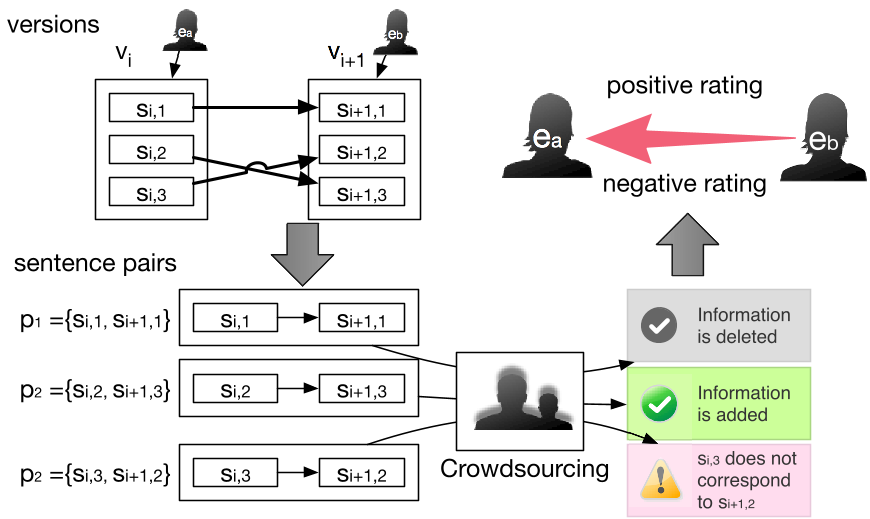
Figure 1: The proposed workflow combining automated text alignment and human-powered semantic labeling.
Experimental Results: Proving the Value of Meaning
The researchers tested their system on the Japanese Wikipedia, focusing on categories like "Sports" and "Islam." They used Wikipedia's own "blocked user" list as the ground truth for low-quality editors.
Key Findings:
- Precision Gains: The crowdsourced semantic approach consistently outperformed the baseline (automated rules only) by 5% in precision.
- Vandal Detection: Even at low recall levels, the precision of identifying vandals was nearly doubled compared to non-semantic methods.
- Cost-Efficiency: By only crowdsourcing the "complex" group, they kept costs manageable—processing 24,884 evaluations for roughly 15,000 JPY (~$150 USD).
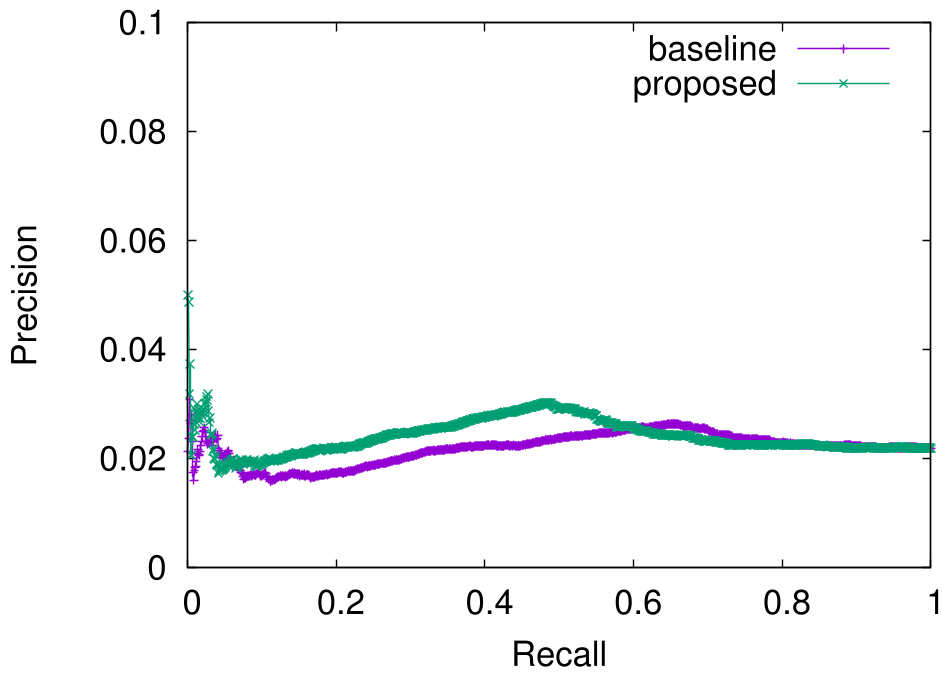
Figure 2: The Recall-Precision curve showing the 5% performance gap between the semantic (proposed) and non-semantic (baseline) methods.
Critical Analysis & Future Outlook
While successful, the study highlights a significant challenge: Domain Expertise. For specialized articles, crowd workers sometimes lacked the subject knowledge to judge if a meaning had changed correctly. This suggests that "General Crowdsourcing" has its limits.
The LLM Shift: Since this paper was published (2016), the landscape has changed. Today, the "Crowd" could potentially be replaced by LLMs like GPT-4, which can handle semantic reasoning at a fraction of the time and cost.
Future Potential:
- Identifying "Expert" Editors: The authors suggest using "positive" labels (ADD/EQUAL) to find high-quality contributors, not just vandals.
- Readability Metrics: The Q2 data (readability) could be used to score editors on their writing style, creating a more holistic "Editor Reputation" score.
In conclusion, this work justifies the shift from syntactic analysis to semantic analysis in social computing, proving that what is said matters more than how it is typed.