
Securing the Pulse: Assessing Machine Learning Security in Healthcare Systems
Assessment of Machine Learning Security: The Case of Healthcare Data
The paper titled "Assessment of Machine Learning Security: The Case of Healthcare Data" presents a security-focused evaluation of Machine Learning (ML) models in predicting gestational diabetes. Using Decision Trees and Random Forests on a localized dataset from Jordan, the authors demonstrate how algorithm tuning can mitigate vulnerabilities, achieving up to 100% accuracy in specific classes.
TL;DR
As AI becomes the backbone of clinical decision-making, its security is no longer a luxury but a "life-and-death" necessity. This paper explores the robustness of Machine Learning (ML) models—specifically Decision Trees and Random Forests—against data vulnerabilities. By analyzing a dataset of pregnant diabetic patients, the researchers demonstrate that Algorithm Tuning and Ensemble Methods are not just for performance, but serve as vital shields against system exploits.
Background Positioning
In the landscape of AI research, most papers focus on maximizing Accuracy. However, this work sits at the intersection of Healthcare Cybersecurity and Model Robustness. It treats the ML model not as a static black box, but as a dynamic target that requires specific defensive configurations (like increasing tree depth and quantity) to withstand adversarial pressure.
Problem & Motivation: The Danger of "Simple" AI
Most healthcare data is migrating to the cloud or wearable IoT devices. The authors identify a critical gap:
- Physical Risk: In healthcare, a data error isn't just a digital glitch—it can lead to erroneous clinical management and bodily harm.
- The Simplicity Trap: Using a single algorithm or a single tree (e.g., a basic Decision Tree) makes the system predictable. An attacker can easily guess the model logic and inject malicious data or exploit missing values to bypass detection.
Methodology: Building the Defensive Wall
The authors utilized a dataset of 769 records for pregnant diabetics from a government hospital in Jordan. Their approach to securing this data involved a transition from traditional programming logic to a robust ML pipeline.
Architecture & Mitigation Strategy
The core insight is the use of a Misuse Case Diagram to model how an attacker might exploit the system. To counter this, they proposed a hierarchy of treatments:
- Data Density: Adding more data to prevent "under-trained" models that are easy to fool.
- Refined Scaling: Testing
StandardScalerandMin-MaxScalerto handle outliers (though they found their specific dataset was already clean). - Complexity as Defense: Moving from a single tree to a "Random Forest" with multiple estimators.
 Figure: The proposed methodology workflow, integrating threat identification with model improvement.
Experiments & Results: The Power of Tuning
The most dramatic improvement came from Algorithm Tuning. By increasing the n_estimators (the number of trees in the forest) from 1 to 30, the researchers reached a "Root Tree" state where classification detail was maximized.
Key Performance Metrics:
- Initial State: ~89% accuracy.
- Tuned State (Training): 100% Accuracy, with False Negatives and False Positives effectively reduced to zero.
- Tuned State (Testing): Accuracy stood at 100% for Class 0 (non-infected) and 75% for Class 1 (infected).
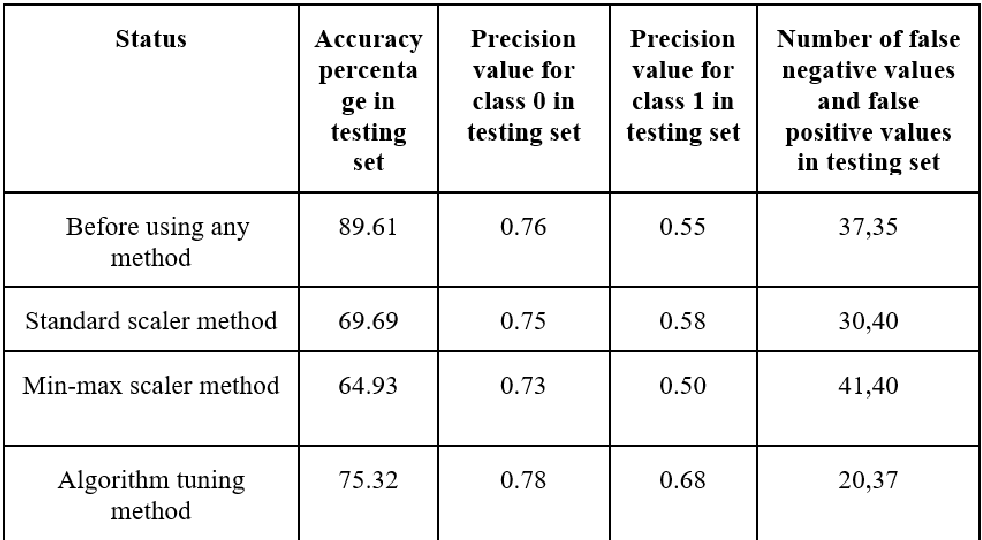 Table: Comparison of accuracy and precision before and after applying security-focused tuning.
The study also showcased how an attacker’s ability to "guess" model behavior is significantly hindered when multiple algorithms are used simultaneously, as the complexity of the decision boundary increases.
Critical Analysis & Conclusion
Takeaways
The paper successfully validates that security in AI-driven healthcare is a multidimensional problem. Algorithm Tuning is highlighted as the most effective "low-cost, high-reward" defensive strategy. It effectively deepens the "moat" around patient data by making the classification logic too complex for simple external manipulation.
Limitations
- Class Balance: While the model performed flawlessly for Class 0, Class 1 (infected) still requires more training data to reach the 100% accuracy threshold.
- Data Digitization: The authors noted that Jordan's reliance on paper records is a bottleneck for building larger, more secure datasets.
Future Perspective
The researchers plan to integrate Cross-Validation and Feature Engineering to further stabilize the model. The ultimate goal for the industry is to move toward models that are not only accurate but inherently "adversarial-aware," particularly when handling sensitive genomic or diagnostic data.