
Safeguarding the Crowd: How to Outsmart Collusion in Sensitive Crowdsourcing
Assignment Techniques for Crowdsourcing Sensitive Tasks
This paper investigates task privacy in crowdsourcing, specifically for sensitive jobs like medical form digitization. It proposes a component-splitting strategy and introduces three assignment mechanisms—PUSH, PULL, and Tug-Of-War (TOW)—to minimize information leakage even when workers collude.
TL;DR
Crowdsourcing sensitive tasks (like transcribing medical records) often risks leaking private data to workers. This paper introduces a framework to split tasks into "safe" components and provides assignment algorithms (PUSH, PULL, and TOW) that provide theoretical privacy guarantees, even when workers actively collude via social networks.
Background Positioning
While worker privacy (anonymity) has been well-studied, Task Privacy—protecting the requester's data—is a critical bottleneck for industries like healthcare. This work moves beyond simple "shredding" of data by introducing rigorous mathematical bounds and a new hybrid assignment model that outperforms existing industry standards like Amazon Mechanical Turk (AMT).
The Problem: The Collusion Threat
Traditional data protection methods are useless here:
- Encryption: You can't encrypt a form if you need a human to read and type it.
- Differential Privacy: This typically modifies data, but in crowdsourcing, we are still acquiring the data.
- The Collusion Network: Workers aren't isolated. They talk. If Worker A has the "First Name" and Neighbor B has the "Medical Condition," the "Gem" (private info) is lost.
Methodology: Splitting the "Gems"
The authors define a Gem as a unit of private information. Their core insight is the Reliable Information Ratio (RIR): By maximizing the "noise" (false positives from similar-looking tasks from different sources), they ensure that even if a worker tries to pieced together data, they cannot be sure of the result.
Three Assignment Paradigms
- PULL (The Status Quo): Workers pick tasks randomly. Privacy is hard to guarantee, but randomizing the queue helps.
- PUSH (The Ideal): The requester assigns specific parts to specific workers. If the worker graph is known, the authors prove you can reach zero privacy loss.
- TOW (The Hybrid): Workers arrive online, but the system decides which task they get based on their social position.
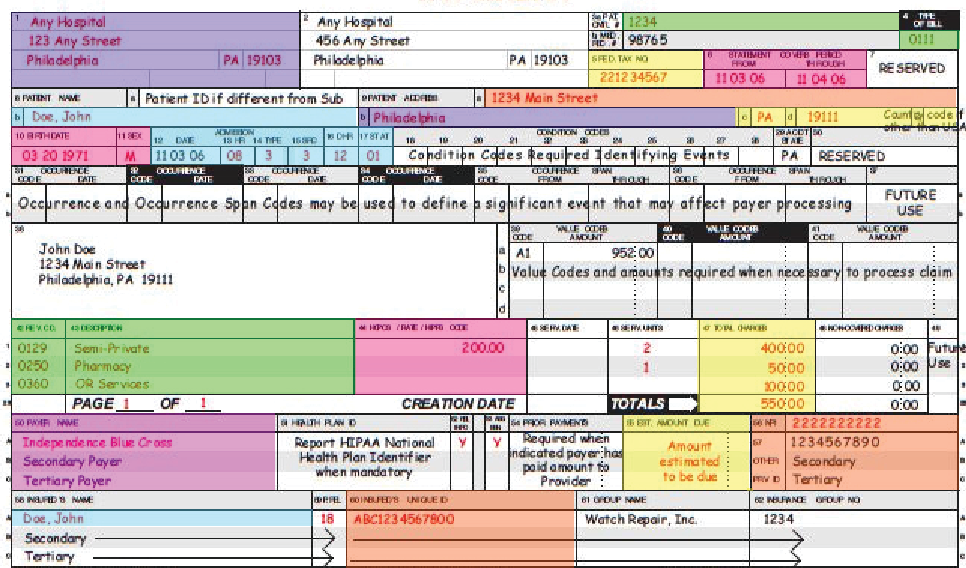 Figure 1: Decomposing an insurance form into safe, independent color-coded components.
Experiments & Results
The authors tested their algorithms on real-world social networks (UC Irvine student data) and synthetic Watts-Strogatz "small-world" graphs.
Constant vs. Linear Leakage
The most striking result is that in the Tug-Of-War (TOW) setting, the number of leaked gems stays nearly constant as the number of tasks increases. In contrast, the standard PULL method (used by platforms like AMT) sees a linear explosion in privacy risk.
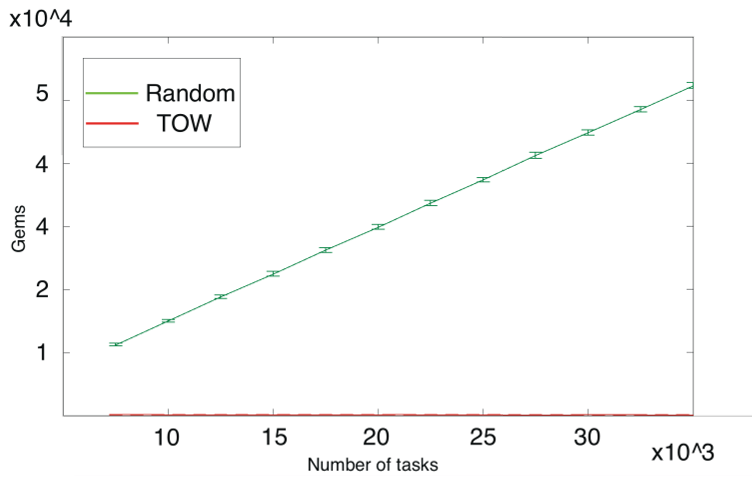 Figure 2: Performance comparison showing TOW (stable) vs PULL (escalating risk).
PUSH Efficiency
For the PUSH model, they found that efficiency depends on the average degree of the worker's social network rather than the maximum degree, making it much more practical for real-world deployment than the theoretical worst-case suggested.
Critical Analysis & Conclusion
Takeaway
This paper demonstrates that "task shredding" is not just a heuristic but a theoretically sound method for high-stakes crowdsourcing. The TOW mechanism specifically offers a viable path for crowdsourcing platforms to implement "Privacy-as-a-Service."
Limitations
The primary hurdle is the collusion graph. In an open platform like AMT, mapping every worker's social connection is difficult. However, in "vetted" crowdsourcing environments or those using LinkedIn/Social logins, this model is immediately applicable.
Future Outlook
As AI continues to struggle with high-accuracy transcription of "messy" human data, these human-in-the-loop privacy safeguards will be essential for the next generation of healthcare and legal tech.