
Echoes of the Feed: Decoding Selective Exposure and Political Attitudes on Twitter
Association between Selective Exposure and Attitude on Twitter
This study investigates the phenomenon of selective exposure on Twitter by linking private activity logs with survey-based psychological attitudes. Using machine learning to classify the political leanings of over 300,000 contactees, the research identifies that retweeting behavior exhibits the strongest echo-chamber effect compared to following or direct mentions.
TL;DR
Is Twitter truly a "digital town square," or just a collection of refined echo chambers? This study analyzes the link between real-world psychological attitudes and Twitter behavior. It reveals that while we might follow people with diverse views, we predominantly retweet those who agree with us. Furthermore, distrust in traditional media and a high level of political participation actually increase our tendency to hide within ideological bubbles.
Problem & Motivation: The Gap Between Log and Mind
The "fragmentation of opinions" is a major threat to democratic decision-making. If users only consume information that validates their existing biases—a phenomenon known as Selective Exposure—social tolerance withers.
However, most existing research faces a "missing link" problem. Scholars usually have access to either behavioral logs (what people do) or survey data (what people think), but rarely both. This study bridges that gap by connecting the private activity logs of 1,276 users with their self-reported attitudes toward nuclear power—a highly polarizing issue in post-Fukushima Japan.
Methodology: Mapping the Social Matrix
The researchers categorized social interactions into three distinct types to see where selective exposure lives:
- Followees: Who you listen to (Information acquisition).
- @Tweetees: Who you talk to (Communication).
- Retweetees: Who you support (Endorsement/Countenance).
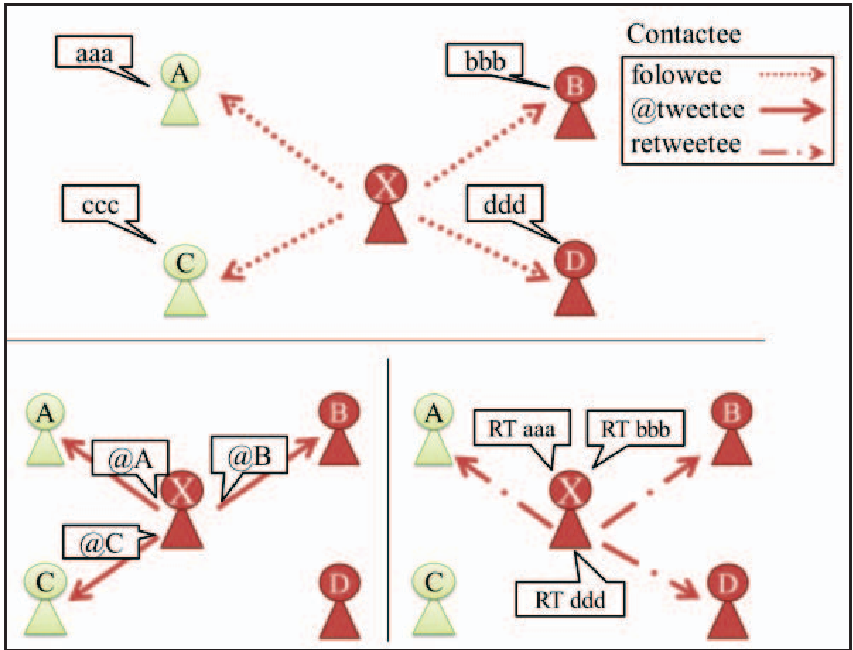
Using a RandomForest machine learning model trained on human-labeled data, the team estimated the stances (Pro-Nuclear vs. Anti-Nuclear) of hundreds of thousands of accounts in these users' networks. They then calculated a Selective Exposure Index: the ratio of "homogeneous" contacts within a user's network.
The Core Finding: Retweets are the Strongest Echoes
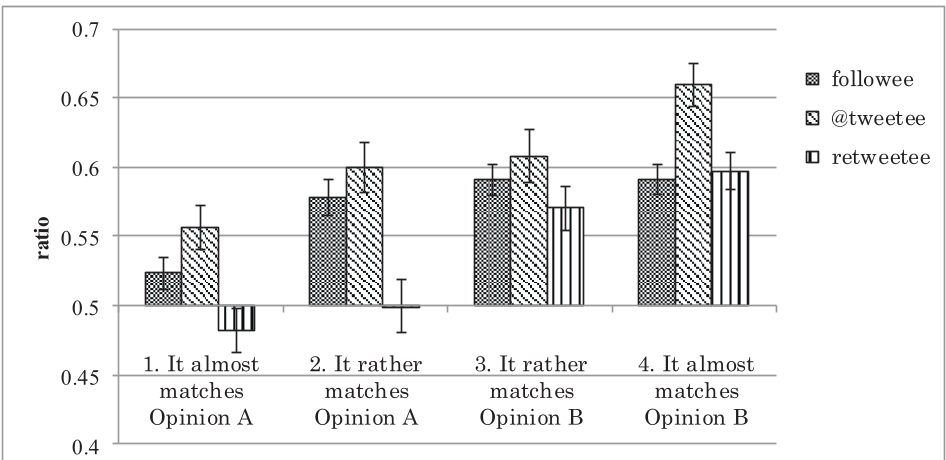
The data suggests that we are surprisingly tolerant in who we follow, but highly partisan in what we broadcast.
- Following & Mentioning: For these categories, the selective exposure was relatively weak. Users frequently follow and mention people with heterogeneous (opposing) views.
- Retweeting: This is where the echo chamber solidifies. Users with anti-nuclear views almost exclusively retweet anti-nuclear content, and vice versa.
Psychological Drivers of Polarization
The study’s unique value lies in identifying who is most susceptible to selective exposure. According to the partial correlation analysis (Table 2), several psychological traits stand out:
- Distrust in Traditional Media: Users who do not trust television news are significantly more likely to engage in selective exposure on Twitter. They likely view Twitter as a "corrective" source, leading them to seek out only the "truth" that aligns with their bias.
- Perception of Majority: If a user believes their opinion is the majority view on Twitter, their selective exposure increases. This creates a "false consensus" effect.
- Political Participation: Paradoxically, the more a user participates in politics, the stronger their selective exposure becomes. High engagement often leads to stronger tribalism.
Critical Analysis & Conclusion
Takeaway
The study proves that the "Retweet" is a tool of reinforcement, not just information sharing. While we might be exposed to diverse views in our feed, our active choices of what to amplify are deeply biased.
Limitations & Future Work
The study focuses on a specific historical window in Japan (2012). Since then, Twitter’s "Algotaritm" has changed significantly, moving from a chronological feed to an interest-based one, which likely exacerbates the selective exposure found here. Future research needs to investigate if these psychological triggers (like anxiety and media distrust) hold true across different cultures and newer platform architectures.
Ultimately, this work warns us that simply "following" the other side isn't enough to break the echo chamber—we must change how we interact with and amplify information.