
The Family of Assortativity Coefficients: Decoding Hidden Structures in Signed Social Networks
The Family of Assortativity Coefficients in Signed Social Networks
This paper introduces the "Family of Assortativity Coefficients," a comprehensive framework of six measures designed to quantify degree-degree correlations in signed social networks. By accounting for both link signs (positive/negative) and node degree types, the method effectively maps complex mixing patterns that traditional assortativity metrics overlook.
TL;DR
Signed social networks—where links represent either trust (+) or distrust (-)—are far more complex than their unsigned counterparts. This paper addresses a critical gap in network science by proposing the Family of Assortativity Coefficients. Unlike previous methods that just looked at "friends of friends," this framework explores six unique degree mixing patterns, proving that "enemies of popular people" follow distinct, statistically significant connection rules.
Problem & Motivation: The One-Dimensional Trap
In standard network analysis, Assortativity measures the "birds of a feather" effect: do high-degree nodes (hubs) link to other hubs? While this is well-understood for simple graphs, signed networks (like Epinions or Wikipedia voting) present a challenge.
Previous researchers typically split the network into a "positive subnetwork" and a "negative subnetwork." However, this creates a blind spot. A node in a signed network isn't just "popular" or "unpopular"; it has a positive degree (how many people trust it) and a negative degree (how many people distrust it). Existing statistics couldn't measure the correlation between a node's positive degree and its neighbor's negative degree.
The authors' insight is that these "mixed" signals are key to understanding the endogenous complexity of social systems.
Methodology: The Complete Family
The researchers refined the traditional Pearson correlation-based assortativity into a set of six measures. These are categorized by the sign of the link and the signs of the degrees being compared:
- Positive Link Correlations:
- Negative Link Correlations:
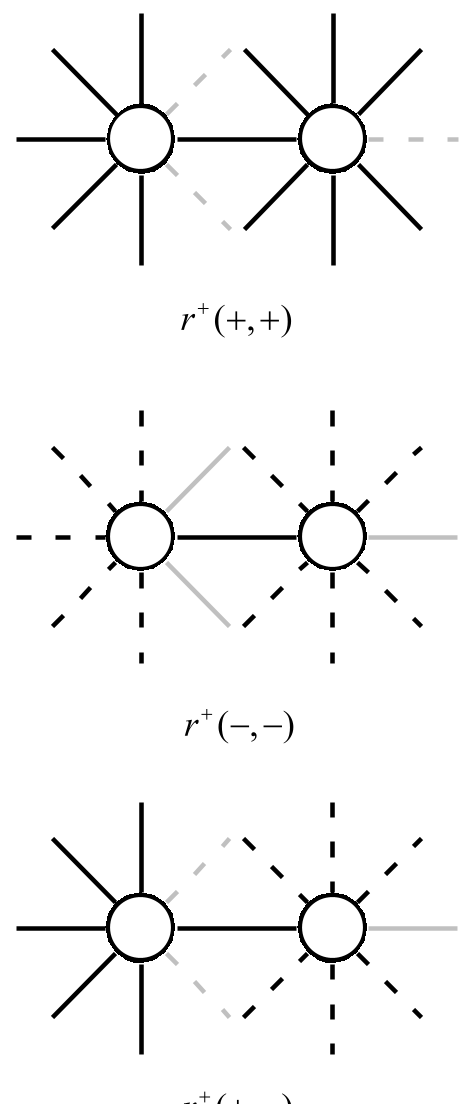 Fig 1: Visualization of complex mixing patterns where link signs and node degree types interact.
To ensure these weren't just random artifacts, they compared real-world data against Null Models (randomized versions of the networks). They introduced the Assortativity Significance Profile (ASP), a normalized vector of Z-scores that allows for apples-to-apples comparisons across networks of different sizes.
Experiments & Results: Beyond the Surface
The team tested their "Family" on four major datasets: Epinions, BitcoinAlpha, Wiki-RfA, and Slashdot.
Key Findings:
- Universal Significance: All six patterns were statistically significant across all datasets, meaning these aren't random occurrences but fundamental structural properties.
- The Trust-Distrust Divergence: Generally, positive links showed assortative patterns (popular people befriend popular people), while negative links often showed disassortative patterns.
- Hidden Strengths: In many cases, the newly proposed "mixed" measures (like ) showed stronger signals than the classical ones, suggesting that negative degree distributions are highly organized.
 Fig 2: The ASP results showing how different mixing patterns dominate in various social networks.
Comparison with Classical Metrics
The authors compared their work against Excess Average Degree and Embeddedness. They found that while classical metrics might show if a network is assortative, they often fail to provide a clear signal when the network structure is sparse or complex. The Family of Assortativity Coefficients provided a much clearer, quantifiable "fingerprint" of the network.
Critical Analysis & Conclusion
Takeaway: This paper successfully expands the toolkit for social network analysis. By providing a "Family" of metrics, it allows researchers to see the "social texture" of a network—understanding not just who is connected, but the reputational logic behind those connections.
Limitations: The study focuses on undirected versions of these networks. In reality, trust is often directional (A trusts B, but B might not trust A). Extending this "Family" to directed-signed networks would be the next logical step in technical complexity.
Future Outlook: This framework has massive potential for Sign Prediction (predicting if a new link will be positive or negative) and Community Detection. If we know the assortativity profile of a network, we can better predict how information—or toxicity—will spread through it.