
Asymmetric Strength: Breaking the Symmetry to Maximize Information Diffusion
Asymmetric normalization aided information diffusion for socially-aware mobile networks
This paper introduces Asymmetric Normalization forms for partial and value strengths to optimize information diffusion in socially-aware mobile networks. By redefining node influence through asymmetric calculations, the authors achieve significantly higher information coverage rates compared to traditional symmetric tie-strength models in both static social networks (Flickr, CA-GrQc) and dynamic D2D environments.
TL;DR
To maximize how quickly and widely information spreads in mobile social networks, we usually look at "how close" two people are. This paper argues that asymmetry—treating the influence of node A on B differently than B on A—is the secret sauce. By using Asymmetric Strong Value and Weak Partial strengths, the researchers outperformed traditional methods, significantly reducing the "local traps" that cause information to stop spreading prematurely.
Background: The Socially-Aware Network
Mobile networks are increasingly "socially-aware," meaning they leverage human interaction patterns to route data. For years, the academic gold standard was based on Tie Strength: if you have many mutual friends with someone, your tie is "strong." However, this creates a paradox: strong ties are great for trust but terrible for spreading news far, as everyone in a tight-knit group already knows the same information.
The Problem: The Symmetry Trap
Most existing models use symmetric formulas (e.g., Jaccard similarity), where . The authors identify two major flaws here:
- Heterogeneity: Real-world degrees follow a power-law distribution. Symmetrical metrics get skewed by "hub" nodes.
- Information Local Traps: Symmetry often encourages information to circle back into clusters where it's already been seen, rather than jumping the gap to new, uninformed communities.
Methodology: The Power of Asymmetry
The authors propose shifting from symmetric ties to Asymmetric Normalization. The core idea is to look at the neighborhood of the potential relay node relative to the source.
1. Asymmetric Partial Strength (AP)
Focuses on the proportion of common friends relative to the individual node's degree, rather than the union of both.
2. Asymmetric Value Strength (AV)
This is the "discovery" metric. It measures how many new neighbors a node can reach that the current source cannot see.
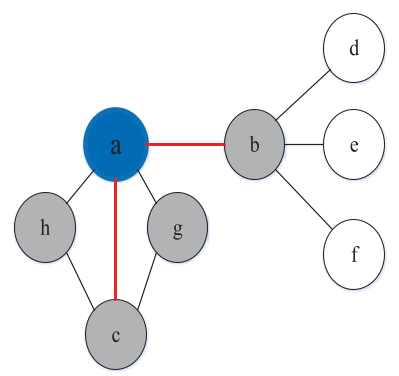 Figure: Visual comparison of why asymmetric value (b) and partial (c) strengths help navigate complex topologies compared to symmetric versions.
Experimental Evidence
The authors tested their hypothesis using the Flickr dataset (massive social interaction) and CA-GrQc (Arxiv collaboration network).
- Finding 1: Asymmetric Strong Value Strength consistently hit the highest coverage ratio.
- Finding 2: Asymmetric Weak Partial Strength proved the famous "Strength of Weak Ties" theory—it effectively bridges separate groups.
- Finding 3: In mobile D2D networks, mobility actually helps "lucky" asymmetric contacts spread information across disconnected pieces of the graph.
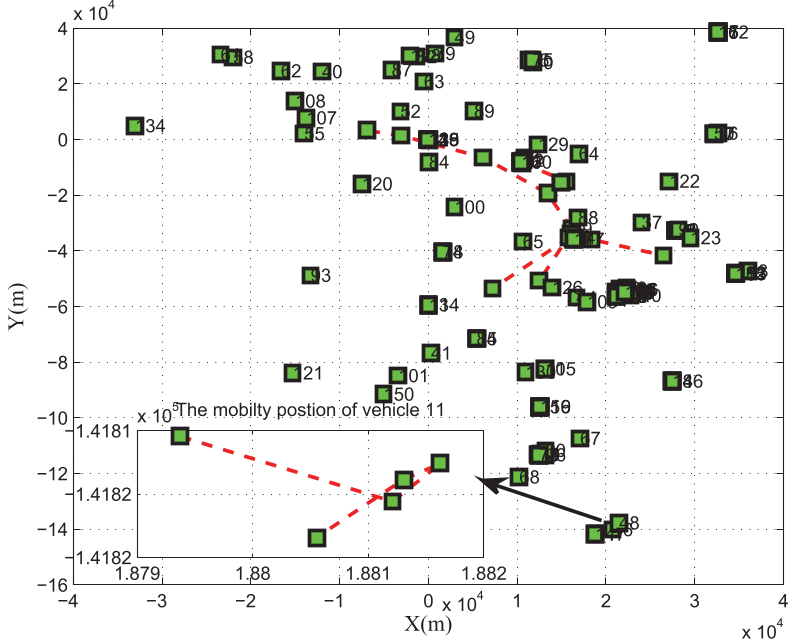 Figure: Coverage ratio in the Flickr network. Note the superior performance of asymmetric variants over traditional random or tie-strength methods.
Escaping the "Local Trap"
Why does it work? The authors performed a "Local Trap" analysis. A local trap occurs when a node has no new neighbors to forward to. As shown in the statistics below, asymmetric algorithms fall into these traps significantly less often because they explicitly seek out nodes with "frontier" neighbors.
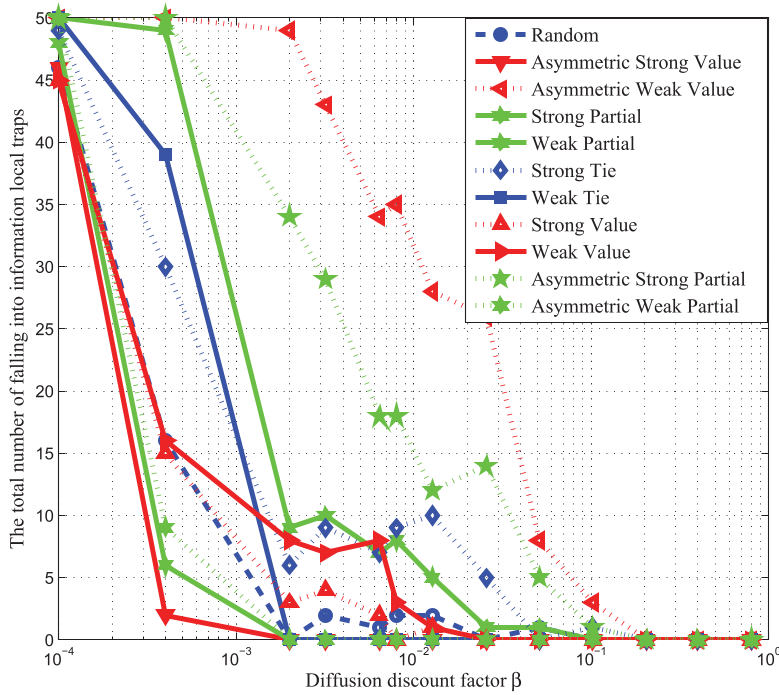 Figure: As the diffusion discount factor (β) changes, asymmetric methods maintain a lower frequency of diffusion failure (local traps).
Conclusion & Insights
This work shifts the focus of socially-aware networking from similarity to complementarity. In a world of echo chambers (local traps), an asymmetric strategy that values "what you have that I don't" is far more effective for information coverage than finding "who is most like me."
For researchers in viral marketing or public opinion control, the takeaway is clear: don't just target the most connected nodes; target the ones that provide the most asymmetric access to new audiences.