
Efficient Task Pricing in Crowdsourcing-Based IoT: An Asynchronous Optimization Approach
Asynchronous Finite Sum Optimization for Task Pricing in Crowdsourcing-Based Internet of Things
This paper addresses the platform utility maximization problem in Crowdsourcing-based IoT by optimizing task pricing through a finite sum optimization framework. The authors employ the NESTT-E (Nonconvex Primal-Dual Splitting with Exact Minimization) algorithm, an asynchronous SGD-type method, to achieve global pricing consensus across large-scale, intermittently active IoT nodes.
TL;DR
In the hyper-connected world of IoT, crowdsourcing platforms must price tasks optimally to balance user satisfaction and system costs. This paper proposes using the NESTT-E algorithm to solve the resultant large-scale task pricing problem. Unlike traditional methods that require every device to stay awake and sync up, this approach allows for asynchronous, local updates, significantly reducing computation time as the network grows into the thousands of nodes.
The Bottleneck of Synchronization in IoT
Crowdsourcing (CS) utilizes the collective sensing and computing power of "the crowd"—in this case, smart IoT devices. A central challenge for the platform is Task Pricing:
- Underpricing leads to low income and low worker participation.
- Overpricing increases service costs and deters customers.
While this can be modeled as a finite sum optimization problem, standard solvers like the Alternating Direction Method of Multipliers (ADMM) are synchronous. In an IoT network with 2,000+ nodes, waiting for every single temperature sensor or smartphone to report back before shifting the price is a recipe for system paralysis. Nodes fail, enter sleep modes, or have varying latencies.
The Methodology: NESTT-E and Asynchronous Consensus
The authors define a utility function that captures the "diminishing marginal returns" of worker contributions via a logarithmic term, minus the linear system costs (energy/transmission).
Instead of a centralized solver, they implement NESTT-E (Nonconvex Primal-Dual Splitting with Exact Minimization). The mathematical intuition hinges on:
- Variable Splitting: Each node maintains a local copy of the price, while a global variable ensures consensus.
- Stochastic Updates: In each iteration, only one randomly selected node is activated to update its local price and the global consensus variable.
- ** Lipschitz Continuous Gradients**: The authors prove the utility function satisfies this condition, ensuring that the algorithm will eventually converge to an optimal price despite the randomness.
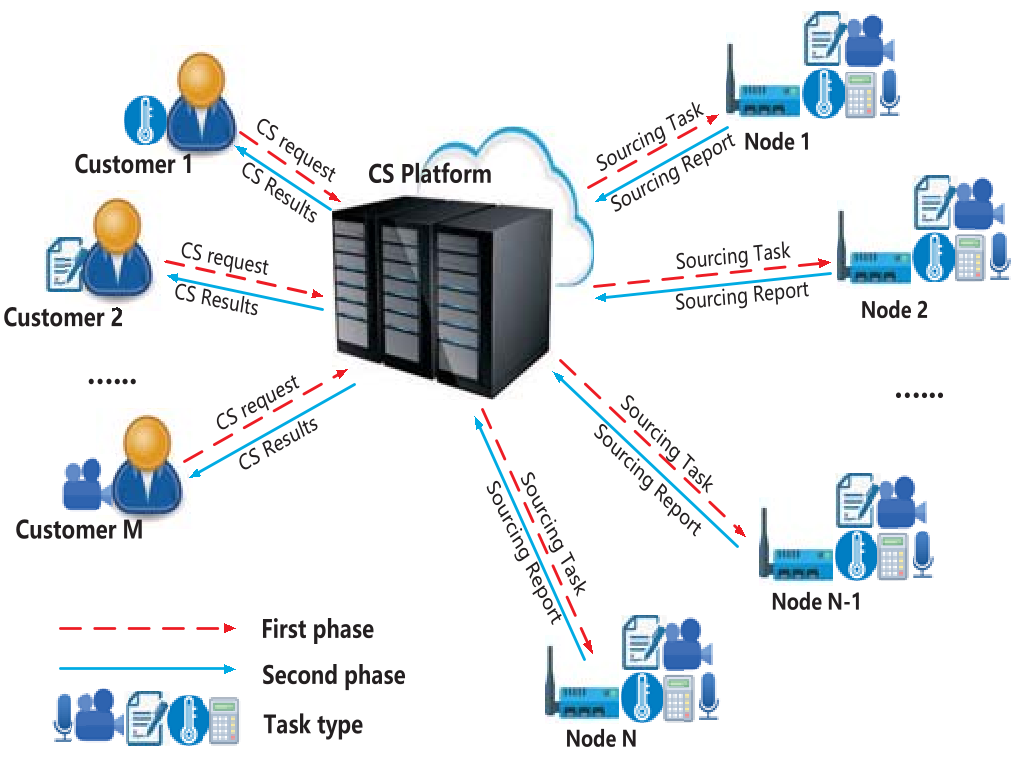 Fig 1. The Crowdsourcing-based IoT Paradigm showing the flow between Customers, Platforms, and heterogeneous IoT Nodes.
Experimental Insights: Scaling Beyond ADMM
The paper’s results validate the shift toward asynchronicity:
- The "Large-Scale" Pivot Point: When the number of nodes is small (e.g., 100), Synchronous ADMM is fast. However, as scales to 2,000, the "waiting time" for ADMM grows exponentially, while NESTT-E remains efficient because it only processes a single sample per step.
- Convergence Stability: NESTT-E exhibits much smoother convergence compared to conventional SGD, which often suffers from drastic jitters in high-dimensional pricing spaces.
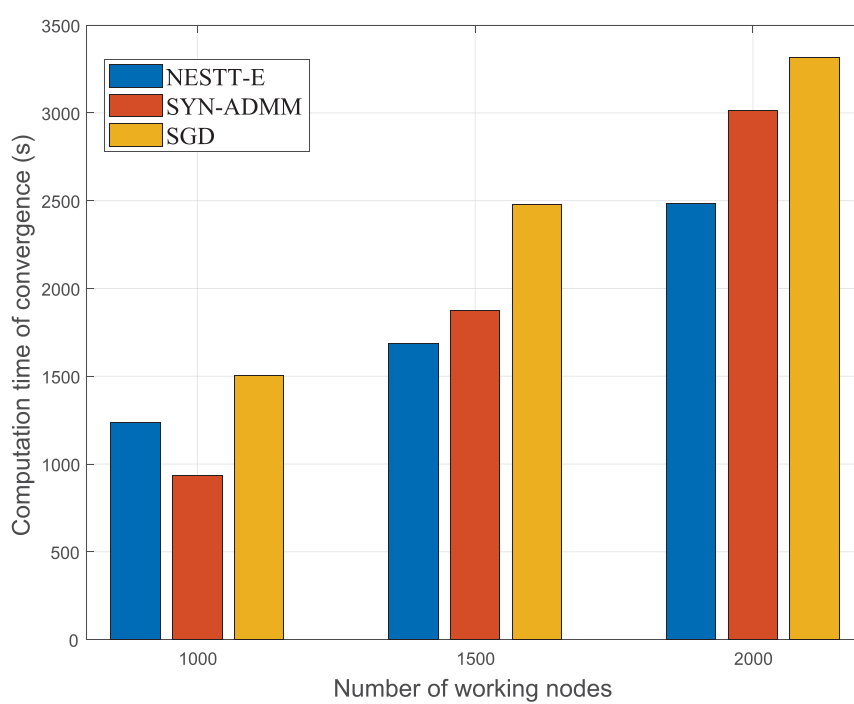 Fig 2. Convergence time comparison. Note how NESTT-E (blue) scales better than Synchronous ADMM (red) as the network size increases.
Critical Analysis & Conclusion
This work provides a robust theoretical foundation for decentralized pricing. By moving away from full-gradient methods, the authors acknowledge the physical reality of IoT—that networks are messy, asynchronous, and massive.
Takeaway: Effective IoT management requires algorithms that treat "node unavailability" as a feature, not a bug. NESTT-E offers a path to global consensus through local, stochastic actions.
Future Outlook: While the paper focuses on unit pricing, future research could integrate Dynamic Pricing where weights () change in real-time based on immediate server loads or battery levels, potentially requiring an even more adaptive version of the NESTT-E framework.