
AtNE-Trust: Decoding Dual Roles and Multi-View Attributes for Trust Prediction
AtNE-Trust: Attributed Trust Network Embedding for Trust Prediction in Online Social Networks
The paper introduces AtNE-Trust, an attributed trust network embedding model designed for trust prediction in social networks. It integrates directed network structures, connectivity properties (in/out links), and rich user attributes (ratings, reviews, items) into a unified deep representation learning framework.
TL;DR
Trust is rarely a two-way street. Unlike friendships, trust relationships are directed, asymmetric, and deeply influenced by user behaviors like product reviews and ratings. AtNE-Trust is a novel embedding framework that bridges the gap between complex network structures and heterogeneous user attributes, outperforming state-of-the-art models by treating users as both trustors and trustees while fusing their behavioral "digital footprints" through deep auto-encoders.
Problem & Motivation: The Asymmetry of Trust
In platforms like Epinions or Ciao, trust is not just a link; it's a statement of credibility. Previous methods often treated social networks as undirected graphs, ignoring the directional nature of trust (A trusts B B trusts A).
Moreover, real-world trust networks are notoriously sparse. Most users only have a handful of links, making it nearly impossible for structure-only methods (like DeepWalk or LINE) to learn robust representations. The authors' insight is twofold:
- Dual Roles: A user acts as a trustor (one who gives trust) and a trustee (one who receives it). Their connectivity profile (e.g., a celebrity having many in-links) defines their "social status."
- Attribute Homophily: Users who share similar interests (reviewed the same items or gave similar ratings) are statistically more likely to trust each other.
Methodology: The Architecture of AtNE-Trust
The model architecture consists of a sophisticated pipeline designed to capture "Why" and "How" users connect.
1. Structure and Attribute Embedding
Instead of a single vector, AtNE-Trust starts by generating:
- Structural Embeddings: Using a modified Skip-Gram model that accounts for in-link/out-link biases, ensuring that the "power-law" distribution of connectivity is preserved.
- Rich Attribute Views:
- Ratings: Factorized into latent preference vectors.
- Reviews: Processed via Doc2Vec to capture semantic sentiment.
- Items: Using the categories of items reviewed as a proxy for user expertise.
2. Deep Multi-View Representation Learning
To prevent one information source from overwhelming the others, the authors implement a Feature Fusion Unit.
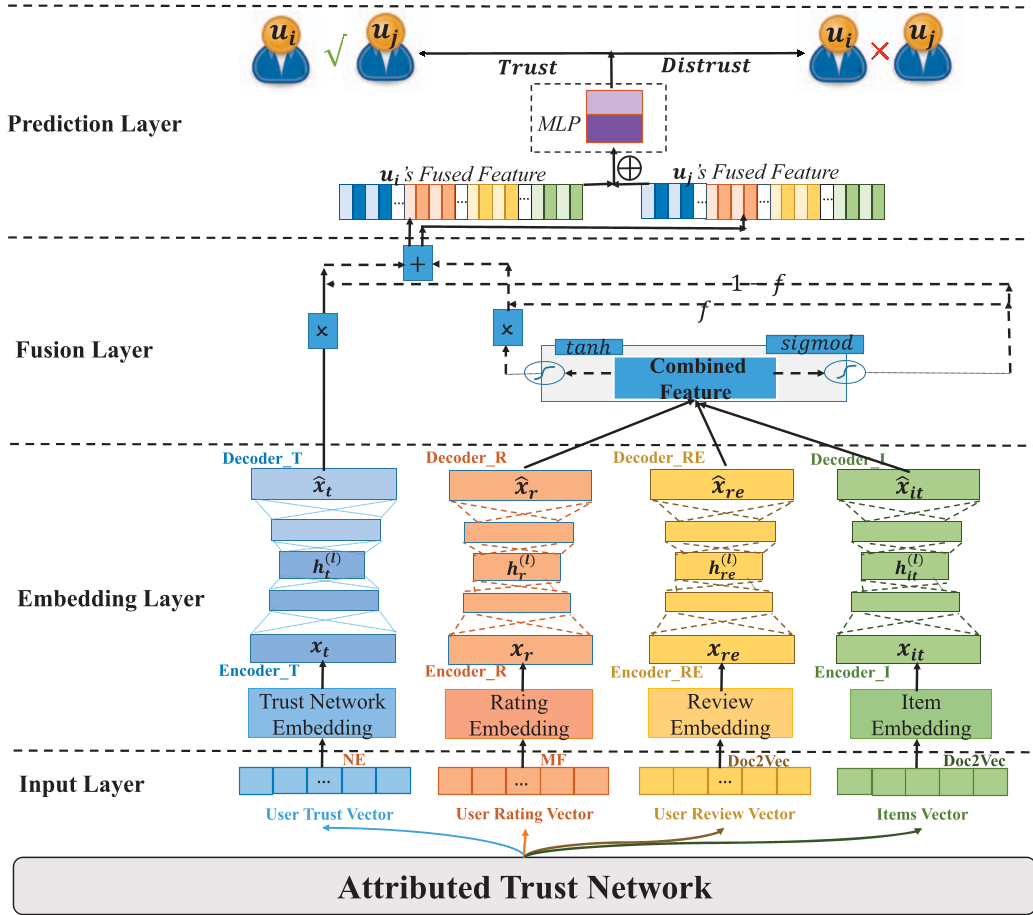
The fusion unit uses a gating mechanism (similar to GRUs) to decide how much information from the "Attribute Views" should flow into the "Structural View." This ensures that the global network position is refined, not replaced, by local behavioral data.
Experiments & Results: SOTA Performance
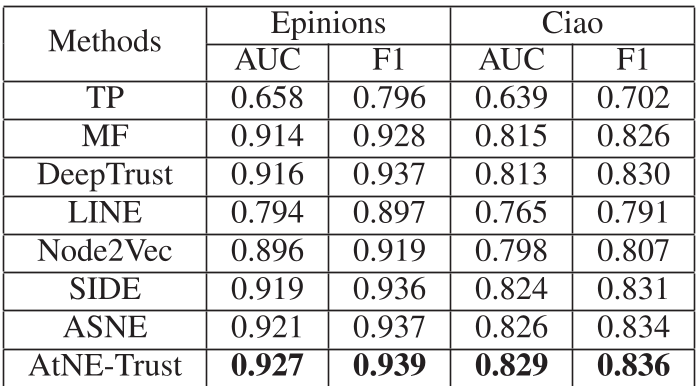
The model was tested against two heavyweights: Epinions and Ciao.
- Competitive Edge: AtNE-Trust surpassed ASNE (an attributed social embedding) and SIDE (a directed network embedding), proving that the fusion of directions and multi-view attributes is superior to using either in isolation.
- Sparsity Resilience: Even when training on only 50% of the data, the model maintained high AUC scores, where traditional methods like Trust Propagation (TP) failed significantly.
Ablation Study Insights
The authors performed an ablation study by isolating structural embedding (AtNE-Trust_tr) and attribute embedding (AtNE-Trust_at). The results confirmed that network structure is the primary driver for trust, but attributes provide the essential "fine-tuning" that pushes the model to SOTA levels.
Critical Analysis & Conclusion
Takeaway: AtNE-Trust successfully demonstrates that trust is a multi-dimensional construct. By modeling the dual roles of users and their behavioral history, we can predict relationships even when the graph itself is sparse.
Limitations: While powerful, the model relies on Doc2Vec for text processing, which may not capture the nuances of modern social media as well as Transformer-based models (like BERT or RoBERTa). Additionally, the joint optimization of four auto-encoders and an MLP is computationally intensive for massive-scale graphs.
Future Outlook: Integrating Temporal Dynamics (how trust changes over time) and using Graph Neural Networks (GNNs) for deeper message passing could be the next logical evolution of this work.