
Digital Bonds: How Your Attachment Style Determines Your Role in Social Media
Social relationships and information dissemination in virtual social network systems: An attachment theory perspective
This research investigates the validity of Attachment Theory within the context of Virtual Social Networks (VSNs). By conducting three distinct studies involving 354 participants, the paper demonstrates that psychological internal working models (anxiety and avoidance) significantly predict user behavior, social connectivity, and information dissemination patterns on platforms like Facebook.
TL;DR
Is your Facebook behavior a reflection of your childhood? This research confirms that Attachment Theory—a cornerstone of psychology—seamlessly extends to the virtual world. Whether you are a "social hub," a silent observer, or a selective sharer depends heavily on your levels of attachment anxiety and avoidance.
Background: From Face-to-Face to Interface
For decades, psychologists have used Attachment Theory to explain how our early relationships with caregivers shape our adult social lives. However, the rise of Web 2.0 raised a critical question: Does this theory survive the transition to the digital realm, where physical cues are absent and anonymity is high? This paper argues that our "internal working models" are not just for physical rooms; they are the code that runs our digital interactions.
The Problem: The Mystery of the Digital Hub
Why do some people have thousands of followers and constantly initiate conversations, while others remain on the periphery? Previous sociotechnical research often focused on "Big Five" personality traits, but lacked the depth to explain the emotional regulation behind these choices. The authors theorized that the drive for proximity (Anxiety) and the fear of intimacy (Avoidance) are the hidden engines of information dissemination.
Methodology: Testing the Virtual Bond
The researchers conducted three studies to dissect these dynamics:
- The Mapping (Study 1): Self-reports to correlate attachment styles with the quantity of web-based social ties.
- The Simulation (Study 2): A controlled Facebook experiment measuring how long it takes different profiles to initiate a "non-emotional" friendship request.
- The Information Flow (Study 3): Measuring the willingness to spread "High-Threat" vs. "Neutral" news.
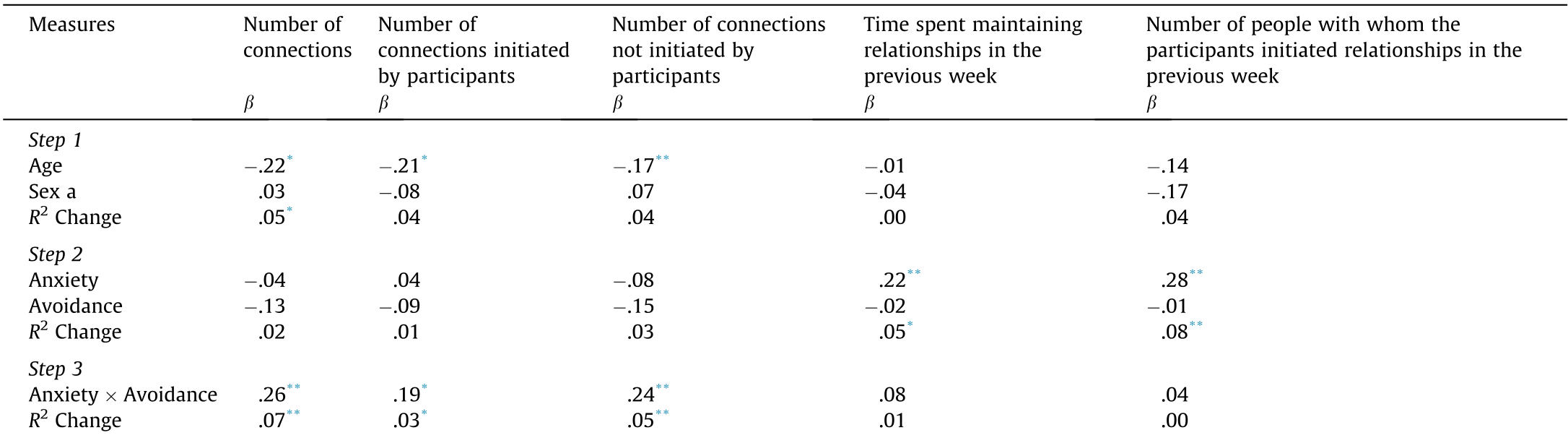 Table 1: Hierarchical regression showing how Anxiety and Avoidance predict the number of social connections and time spent maintaining them.
Key Insights: Who Runs the Network?
1. The Secure Social Hub
The study found that Secure individuals (low in both anxiety and avoidance) are the "hubs" of social systems. They possess the highest number of ties and are the most willing to initiate relationships. Their constructive emotional regulation makes them ideal transmitters for any kind of information.
2. The Anxious Sharer
Anxious individuals spending significantly more time "maintaining" relationships. However, a fascinating paradox emerged: they are eager to share neutral information (like a good movie) to seek proximity, but they "freeze" when it comes to high-threat information (like company layoffs). Why? Because they fear that delivering bad news might lead to rejection or social abandonment.
3. The Avoidant Gatekeeper
Avoidant individuals generally have fewer ties and show lower willingness to deliver any information. Interestingly, their resistance to initiating relationships was reduced in Study 2 when the interaction was framed as "non-emotional" and anonymous, suggesting that the digital medium can occasionally bypass traditional social barriers for the avoidant.
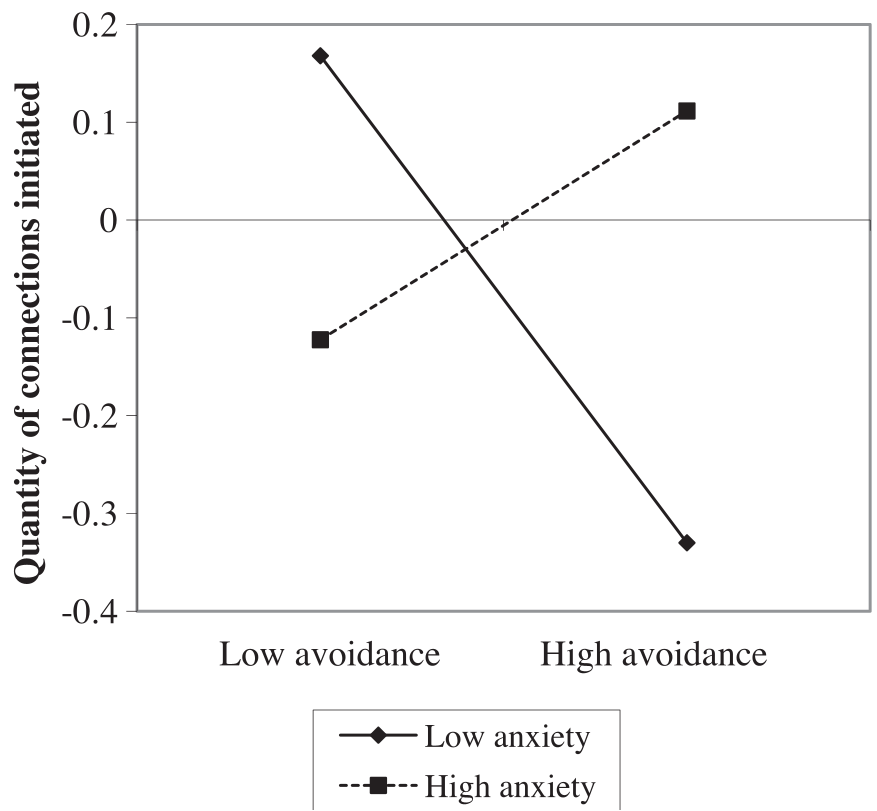 Figure 2: The quantity of initiations based on the interplay of attachment dimensions.
Critical Analysis & Conclusion
The Takeaway: This research proves that social networks are not just mathematical structures—they are emotional ones. If you want to understand how information goes viral, you must understand the psychological security of the nodes in that network.
Limitations:
- Self-Reporting: Study 3 relied on intentions rather than observed "sharing" behavior.
- Platform Specificity: The research was conducted during the Facebook-dominant era; modern "algorithmic" feeds (like TikTok) might alter these dynamics by reducing the need for manual relationship initiation.
Future Outlook: This work opens the door for psychologically-aware AI. By understanding a user's attachment orientation, platforms could tailor support systems or identify key influencers who are not just "popular," but psychologically predisposed to be trustworthy "hubs" in times of crisis.