
ATTDC: Reinforcing Smart City Security via UAV-Active Trust Traceability
ATTDC: An Active and Traceable Trust Data Collection Scheme for Industrial Security in Smart Cities
The paper proposes ATTDC (Active and Traceable Trust-based Data Collection), a novel industrial security scheme for smart cities that integrates Unmanned Aerial Vehicles (UAVs) with an active trust acquisition framework. By leveraging UAVs to verify sensor data and trace malicious routing paths through digital signatures, the system achieves a 91.2% identification accuracy for malicious nodes.
TL;DR
In the evolving landscape of Smart Cities, the reliability of IoT data is the bedrock of intelligent decision-making. The ATTDC scheme introduces a proactive security layer using UAVs to not only collect data but actively audit sensor trustworthiness. By combining digital signatures with optimized trajectory planning, it identifies malicious nodes 26.1% faster and improves data quality by 35.6% compared to traditional passive methods.
Problem & Motivation: The Mirage of Passive Trust
For years, Wireless Sensor Networks (WSNs) have relied on Passive Trust Acquisition. Nodes would "watch" their neighbors, reporting those who dropped packets. However, this is fundamentally flawed in industrial settings:
- Indistinguishable Failures: Did a node drop a packet due to a "Black Hole" attack or simply poor signal?
- Intelligent Adversaries: Small-scale selective forwarding attacks (SFA) remain hidden under the noise of normal network congestion.
- The "Truth" Problem: Even if a node forwards data perfectly, the content might be fabricated.
The authors argue that we need an external "Auditor"—the UAV—to provide a Ground Truth against which sensor reports can be measured.
Methodology: Active Verification and Traceability
The ATTDC scheme operates on three pillars of innovation:
1. Active Trust Acquisition
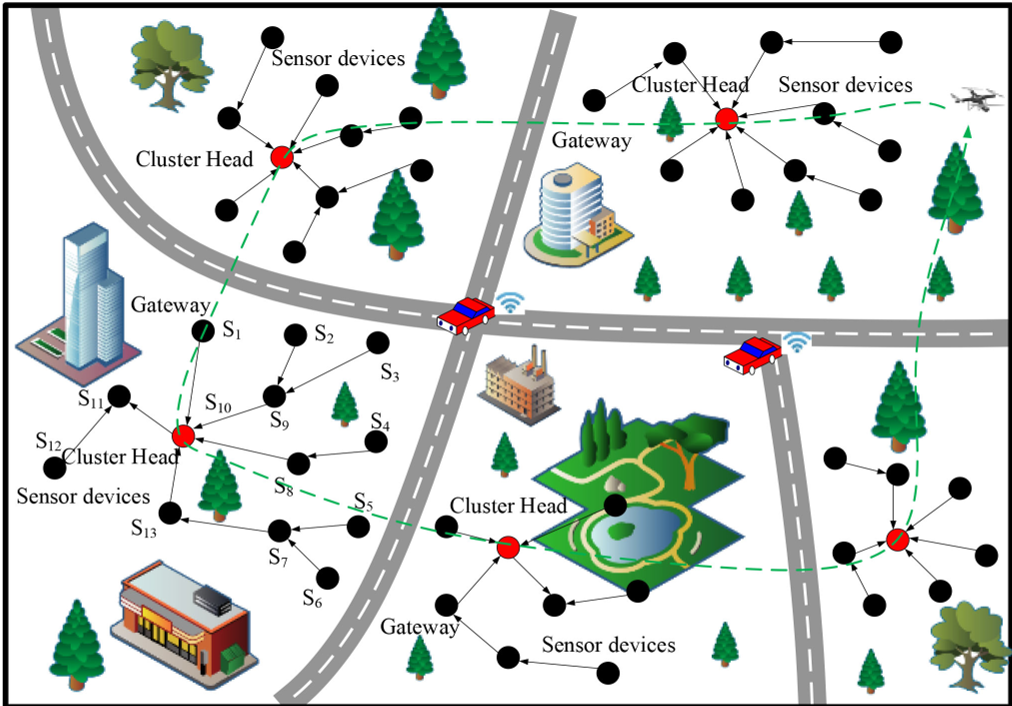
Instead of waiting for reports, the UAV acts as a mobile validator. It senses the environment directly and compares its findings () with the data reported by Cluster Heads (). If the variance exceeds a threshold (calculated via the Three-Sigma Rule), the node's trust score is immediately penalized.
2. Digital Signatures & Traceback
By enforcing digital signatures on every packet, the scheme creates an immutable "paper trail." When the UAV detects missing data at a Cluster Head, it doesn't just guess where the failure happened. It flies in the reverse routing direction, querying nodes for the specific signed packets they should have handled. If a node cannot produce the packet, it is marked as suspicious.
3. AUTO: Optimized UAV Trajectory
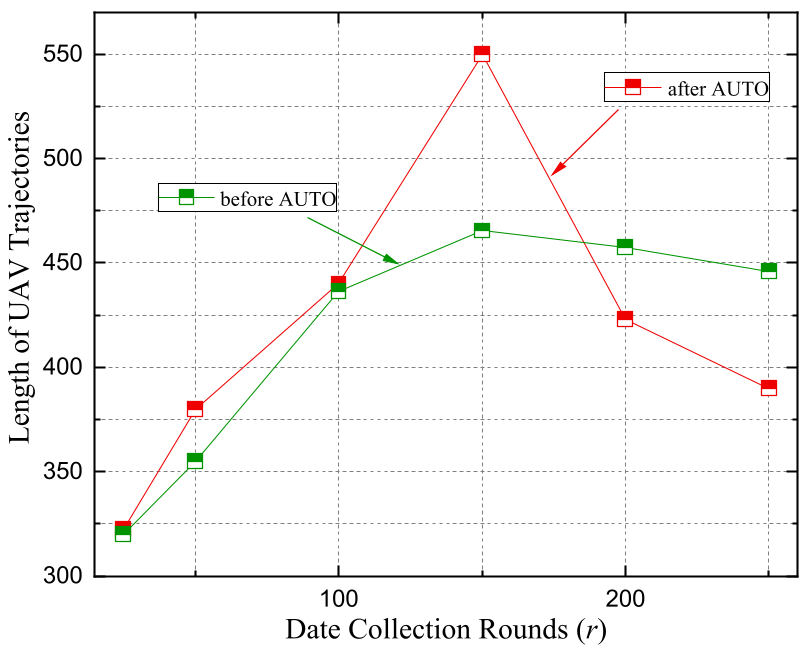
Flying to every suspicious node is costly. To solve this, the authors developed the AUTO (ACO-based UAV Trackback Optimization) algorithm. It uses an enhanced Ant Colony Optimization (ACA) to minimize flight distance while maximizing trust evaluation coverage.
- 2-opt Search: Eliminates path crossovers to flatten zig-zag routes.
- Neighbor Exchange: Dynamically swaps the order of node visits to shave off unnecessary mileage.
Experiments & Results: Precision in Motion
The scheme was tested in a simulated environment. The results confirm a paradigm shift in detection speed and accuracy.
- Malicious Node Detection: Accuracy reached 83.09% within 1,000 rounds and scaled to 91.2% by 5,000 rounds.
- Efficiency: The AUTO algorithm significantly reduced the flight trajectory compared to standard TSP solvers, ensuring that the "Active Trust" overhead doesn't drain the UAV's battery.
- Stability: The Comprehensive Trust Evaluation () proved much more stable than instantaneous trust scores, effectively smoothing out temporary network fluctions.
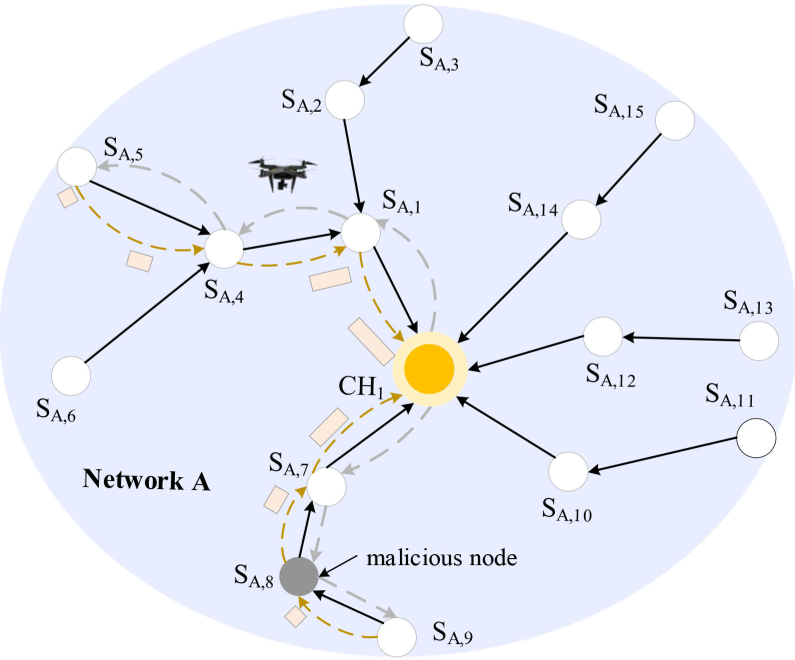 Figure: The dynamic trust evolution of a high-trust vs. low-trust node over 10 collection rounds.
Critical Insight & Conclusion
The true value of ATTDC lies in its Piggybacking Method. By treating trust verification as a secondary task performed during routine data collection, it provides "traceable security" without requiring a dedicated, expensive security patrol.
Limitations: Currently, the model assumes a single-UAV environment. In massive smart cities with thousands of clusters, a multi-UAV cooperative swarm would be necessary to maintain detection latency.
Takeaway: In the future of industrial IoT, trust will not be something we "assume" or "observe"—it will be something we "verify" through mobile, autonomous auditing.