
ALUNI: Decoding Uncertainty on Chinese Social Media via Attention-based LSTM-CNNs
Attention-based LSTM-CNNs for uncertainty identification on Chinese social media texts
This paper introduces ALUNI, an attention-based LSTM-CNN architecture designed for uncertainty identification in Chinese social media and news texts. By combining the sequential modeling of LSTM with the feature extraction capabilities of CNNs and an attention mechanism, ALUNI achieves SOTA performance, reaching F1-scores of 78.19% on Weibo and 73.95% on news datasets.
TL;DR
Identifying whether a statement is "certain" or "uncertain" is critical for filtering rumors and ensuring the factuality of information in news and social media. This paper presents ALUNI, a deep learning framework that moves beyond limited "cue-word" dictionaries. By leveraging LSTMs with Attention and CNNs, it captures the implicit semantics of uncertainty, achieving a significant 11% lead over previous methods on Chinese Weibo data.
Problem & Motivation: The "Casual" Challenge
In formal biological papers or Wikipedia entries, uncertainty is usually signposted by specific words like "suggests," "possible," or "likely." However, Chinese social media (like Sina Weibo) is a different beast. Users speak informally, use slang, or omit keywords entirely.
The Pain Point: Current SOTA methods rely on "cue-phrases." If a user expresses doubt without using a standard "doubt word," these systems fail. The authors realized that uncertainty is often a global semantic property of a sentence rather than a local lexical one.
Methodology: Simulating Human Intuition
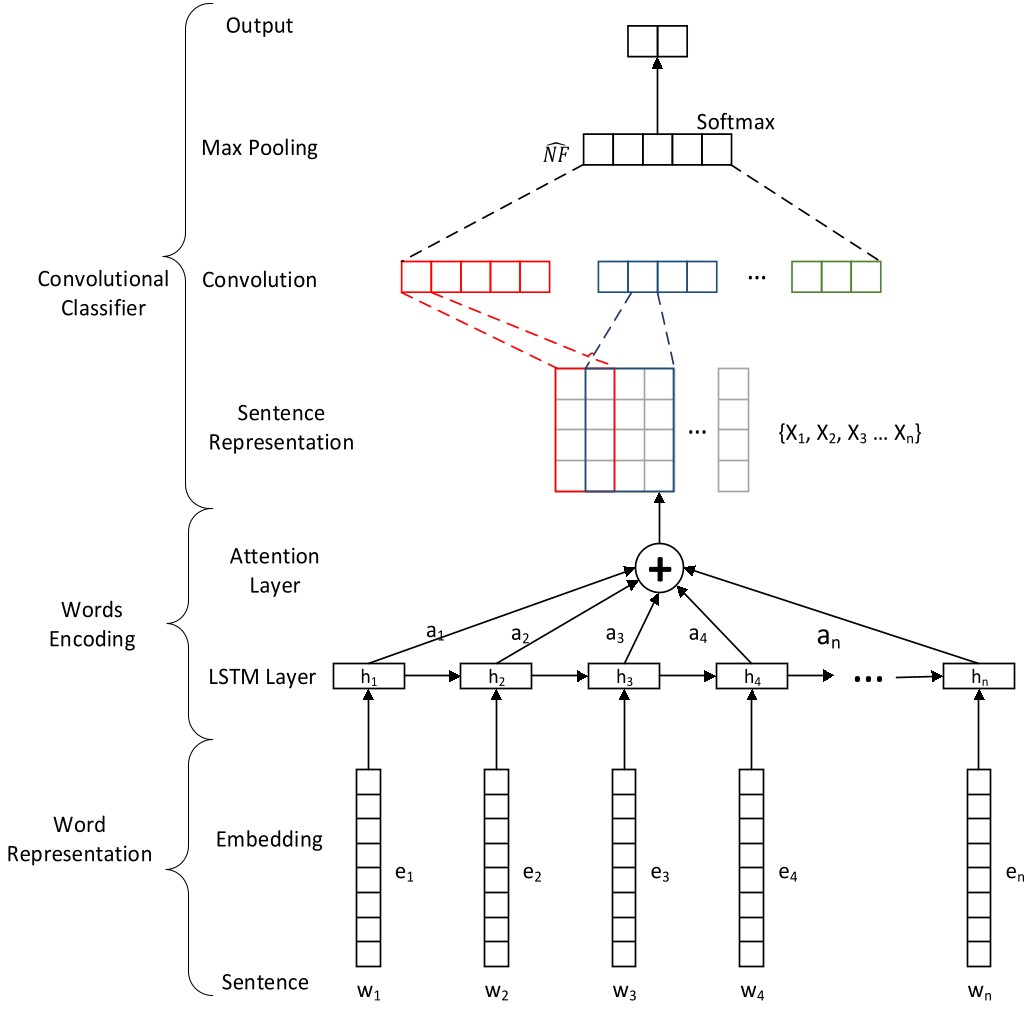
The authors designed the ALUNI (Attention-based LSTM-CNNs for Uncertainty Identification) architecture to mimic how humans process text:
- Contextual Understanding (LSTM): Reading the sentence to understand the specific meaning of each word given its neighbors.
- Focusing (Attention): Identifying which words carry the most weight for making a judgment, even if they aren't "standard" cues.
- Local Pattern Recognition (CNN): Identifying key short-range semantic patterns (N-grams) that indicate a lack of factual certainty.
The Secret Sauce: Attention over Hidden States
Unlike some models that "collapse" a sentence into a single vector, ALUNI uses the attention mechanism to generate weight vectors () for every hidden state. This highlights subtle indicators. For example, in the sentence "Under the similar odds...", the word "odds" carries implicit uncertainty. While a lexicon-based model would ignore it, ALUNI's attention layer flags it as a high-weight feature.
Experiments & Results
The researchers tested ALUNI against two baselines (Ji et al. and Veronika) across two datasets: a News dataset and a newly curated Weibo dataset.
Key Findings:
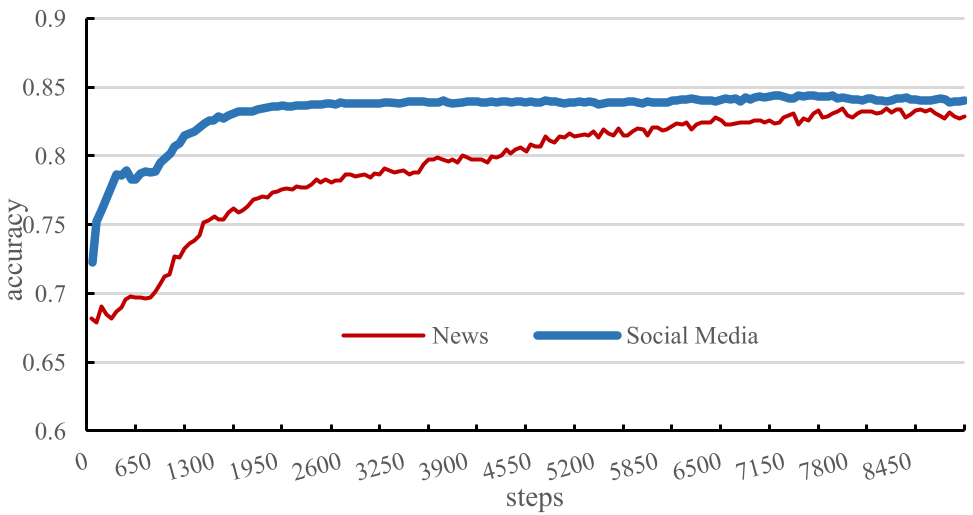
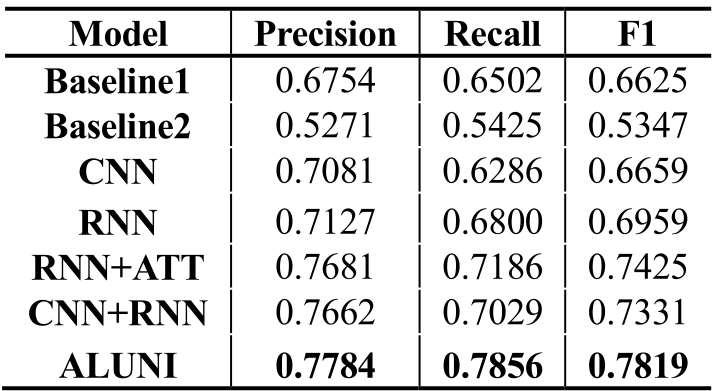
- Performance Jump: On Weibo, ALUNI reached an F1-measure of 78.19%, outperforming the baseline by 11%.
- Robustness to Length: Traditional models often lose their way in long sentences. ALUNI remains stable even as word count grows, thanks to the LSTM's memory and CNN's feature selection.
- The Synergy Effect: The ablation study showed that while RNNs have high recall (understanding the general idea), combining them with CNNs and Attention provides the high precision needed to correctly classify "uncertainty."
Critical Analysis & Conclusion
Takeaway: ALUNI proves that for "noisy" data like social media, the structure of the model matters more than the size of the dictionary. By allowing the model to "learn" what uncertainty looks like through attention and multi-scale convolution, the authors successfully bypassed the limitations of manual feature engineering.
Limitations: While ALUNI is powerful, it still relies on pre-trained word embeddings (Word2Vec). In the era of LLMs, exploring how dynamic embeddings (like BERT) or zero-shot reasoning could improve results on even more obscure "substandard" language would be the logical next step.
Conclusion: This work is a vital step toward automated rumor detection and fact-checking in the fast-paced world of Chinese social media, providing a robust tool for identifying the "fog of information."