
AttitudeBuzz: Decoding the Pulse of Urban Sentiment through Linguistic Reclamation
AitudeBuzz: Using Social Media Data to Localize Complex Aitudes
AttitudeBuzz is a social media analytics platform that utilizes geolocated Twitter data and a customized SVM classifier to localize complex social attitudes. It specifically addresses the challenge of linguistic reclamation in the context of homophobia to distinguish between pejorative use and identity-affirming reappropriation of terms.
TL;DR
AttitudeBuzz is an intelligent mapping platform that moves beyond superficial sentiment analysis to tackle the complexity of "reclaimed language." By training an SVM classifier to understand that the same words can mean very different things depending on where and by whom they are used, the system successfully localizes authentic social attitudes in urban environments, significantly outperforming standard keyword-based models.
The "Context" Problem in Sentiment Analysis
In the realm of social media analytics, slurs and identity terms represent a massive stumbling block. A standard lexical approach—which scores words as "good" or "bad"—inevitably fails when it encounters linguistic reclamation. This is the phenomenon where a community reappropriates a pejorative term as a badge of identity.
If a system cannot distinguish between a hate crime and a community celebration because they use the same vocabulary, the resulting "heat map" of social attitudes is not just inaccurate—it's misleading. Current tools often flag "gay-friendly" neighborhoods as hubs of homophobia simply because they lack the cultural nuance to recognize reappropriated terms.
Methodology: Geography as a Proxy for Intent
The core insight of the AttitudeBuzz research team is that location often encodes intent. Instead of relying on manual labeling alone, they used geographic "ground truths" to train their model.
1. Training Strategy
The researchers constructed a training corpus using two distinct streams:
- The Reclaimed Set: Tweets containing specific identity terms originating from historically gay-friendly neighborhoods. These were labeled as non-pejorative.
- The Pejorative Set: Tweets deemed universally and objectively homophobic from arbitrary geographic origins.
2. The SVM Architecture
The team utilized the LibLinear package to train a Support Vector Machine (SVM) on 600,000 geolocated tweets. This allowed the model to find the hyperplane that best separates "hate speech" from "identity-affirming speech" based on linguistic patterns that frequently co-occur with reclaimed terms.
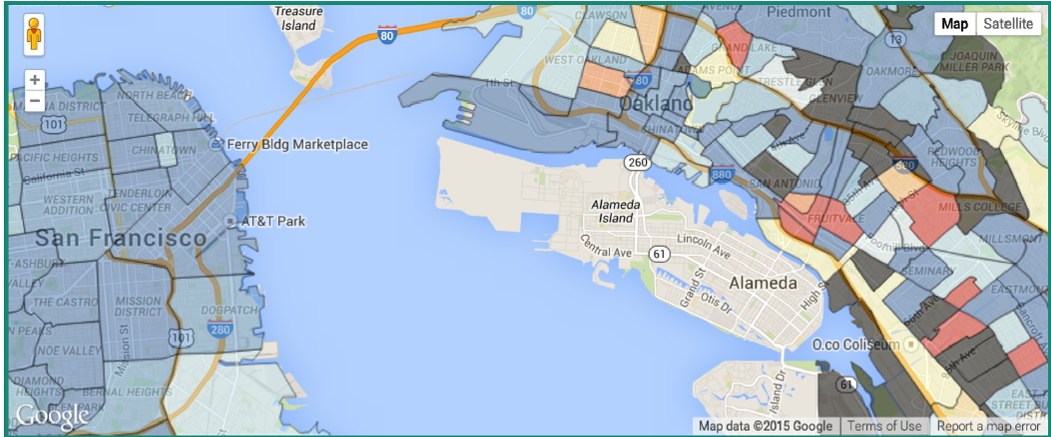 Figure 1: The AttitudeBuzz interface, mapping aggregate attitudes onto urban shapefiles to visualize social sentiment across different neighborhoods.
Experimental Results: Nuance Matters
To validate the system, the authors compared AttitudeBuzz against a standard lexicon-based baseline across 26 known gay-friendly neighborhoods.
- Consistency: While the baseline model produced wild variations (essentially treating friendly neighborhoods no differently than random ones), AttitudeBuzz consistently assigned positive ratings to known inclusive areas.
- Statistical Significance: The difference in average rating was over 16%, with a p-value of .0003, proving that the model successfully filtered out "false positive" hate speech.
Note: The performance analysis shows a normal distribution for random neighborhoods but a marked positive shift for the AttitudeBuzz model in targeted areas.
Critical Insight: Beyond the Keyword
The significance of AttitudeBuzz lies in its recognition that social media data is not just a stream of text, but a spatially-indexed cultural artifact.
Advantages:
- Subjectivity Handling: It acknowledges that sentiment analysis on "fraught topics" cannot be objective; it must be informed by the community's own linguistic evolution.
- Scalability: By using geolocated "safe zones" to generate training data, the model can be updated as language evolves without purely manual annotation.
Limitations:
As a 2015 study, the tool uses linear classification (SVM). In a modern context, Large Language Models (LLMs) with few-shot prompting would likely handle this nuance even better. Furthermore, the reliance on "gay-friendly neighborhoods" as a training proxy might miss nuances in areas where such neighborhoods are not clearly defined or are in transition.
Conclusion
AttitudeBuzz serves as a vital case study in applying machine learning to sociolinguistics. It proves that by integrating geographic context and an awareness of social phenomena like linguistic reappropriation, we can build intelligent systems that truly understand the "buzz" of our cities.