
Beyond "Who You Know": How Behavior Integration Shatters Social Media Privacy
Attribute Inference Attacks in Online Social Networks
The paper introduces a novel Social-Behavior-Attribute (SBA) network model and the Vote Distribution Attack (VIAL) to infer private user attributes (e.g., location, occupation) in online social networks. By integrating social graph structures with user behavioral records (e.g., app reviews), VIAL achieves state-of-the-art accuracy, significantly outperforming methods that rely on only one data source.
TL;DR
Researchers have developed a potent new privacy attack called VIAL (Vote Distribution Attack) that combines your social circle with your digital footprints (like app ratings) to guess your private information with alarming accuracy. By mapping these onto a unified Social-Behavior-Attribute (SBA) network, the attack can correctly identify the home city of 90% of targeted users when the system is confident, far exceeding previous "friend-only" or "behavior-only" methods.
The "Blind Spot" in Modern Privacy
For years, privacy research followed two separate intuitions:
- "You are who you know": If your friends are all software engineers in San Francisco, you probably are too (Social Homophily).
- "You are how you behave": If you review specific local transit apps and niche technical tools, your location and job can be guessed (Behavioral Inference).
The Achilles' heel of these methods is sparsity. Many users have few public friends, or few public reviews. This paper bridges that gap, arguing that while your friend list might be private, your "innocent" app reviews—combined with the public friend lists of others—can reconstruct your profile.
Methodology: The Social-Behavior-Attribute (SBA) Network
The core innovation is the SBA Framework. Instead of treating social links and behaviors as separate tables, the authors transform them into a massive, heterogeneous graph.
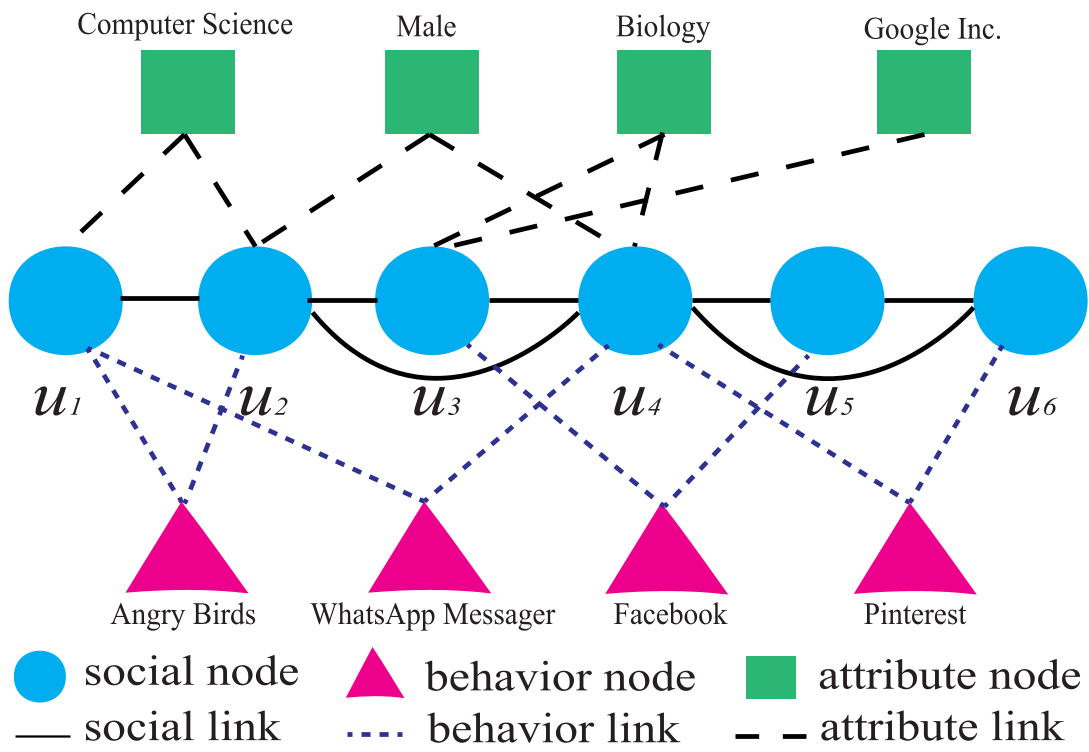 Figure 1: The SBA model integrates Social Nodes (users), Behavior Nodes (apps/items), and Attribute Nodes (locations/majors).
How VIAL Works
The Vote Distribution Attack (VIAL) operates in two distinct phases:
- Phase I (Capacity Distribution): It starts with a "vote capacity" at the target user. This capacity flows through the graph. It doesn't just go to friends; it flows through behavior-sharing neighbors (people who use the same apps). A critical component here is Backtracking (similar to the restart probability in PageRank), which ensures the votes stay concentrated around the target user's local neighborhood.
- Phase II (Attribute Voting): The users who received "capacity" in Phase I now "vote" for their own attributes. If many of your "behavioral twins" and "social friends" live in New York, New York receives a high vote count.
The Power of Multi-Dimensional Data
The results confirm that the "sum is greater than the parts." Simply concatenating features (the typical machine learning approach) often leads to worse performance due to different scales and noise. VIAL’s graph-based propagation handles this gracefully.
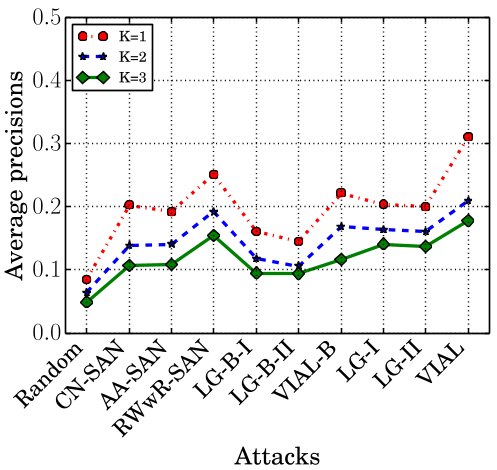 Figure 2: Performance metrics across different attributes. Note how VIAL consistently stays above friend-based (RWwR-SAN) and behavior-based (LG-B) baselines.
Key Findings:
- Precision Boost: VIAL achieves up to 100% relative improvement over behavior-only models.
- Data Hunger: The more items a user reviews, the more accurate the attack becomes. Even 5-20 reviews provide a significant signal.
- Confidence Matters: By using a "Clusterness" estimator, an attacker can identify which 50% of users they are most likely to be right about, achieving 90%+ precision in those cases.
Critical Insight: The "Backtracking" Necessity
The paper provides a fascinating mathematical proof (Theorem 5.2): without backtracking, the attack predicts the same attributes for every single user in the network (converging to a global stationary distribution). Backtracking is what makes the attack "personalized," proving that your privacy is most vulnerable to those in your immediate digital vicinity.
Conclusion & Future Outlook
This research is a wake-up call for Social Network Providers. Privacy settings that allow users to hide their "Friend list" but leave "App reviews" or "Page likes" public are fundamentally leaky.
Future Directions: The authors suggest that the next frontier is learning edge weights—determining exactly which apps (e.g., a period tracker vs. a calculator) are most predictive of specific attributes. As attackers move toward supervised learning on these SBA networks, the "privacy wall" our profiles currently live behind will only get thinner.
Takeaway for users: Your digital footprint is more than just the sum of its parts. Every "Like" and "Review" is a thread that connects you to others, eventually weaving a portrait that you might have intended to keep hidden.