
StreamingTalker: Real-Time 3D Digital Humans via Autoregressive Diffusion
StreamingTalker: Audio-driven 3D Facial Animation with Autoregressive Diffusion Model
StreamingTalker is an audio-driven 3D facial animation framework that utilizes a novel Autoregressive (AR) Diffusion Model to generate realistic, synchronized facial motions in a streaming manner. It achieves state-of-the-art performance on BIWI and VOCASET datasets while maintaining real-time inference speeds (40 FPS).
Executive Summary
StreamingTalker represents a significant shift in how we approach generative 3D facial animation. While diffusion models have recently dominated the field by providing unmatched naturalness and "one-to-many" expression diversity, they have been historically plagued by high latency and the "training horizon" problem—where the model fails if the audio is longer than what it saw during training.
StreamingTalker solves this by introducing an Autoregressive (AR) Diffusion framework. It processes audio in segments, using past motions to inform future frames. The result? A model that can generate infinite-length facial animations in real-time (40 FPS) with superior lip-sync accuracy, establishing a new SOTA on benchmark datasets like BIWI and VOCASET.
The "Training Horizon" & Latency Bottleneck
Previous SOTA models (e.g., DiffSpeaker, FaceDiffuser) operate on the "Full-Sequence Denoising" paradigm. This creates two fatal flaws for production-ready digital humans:
- Temporal Drift: Since they are trained on fixed-length clips (e.g., 4-5 seconds), their internal attention mechanisms struggle to maintain coherence when the audio lasts minutes.
- Inference Lag: You have to wait for the entire audio clip to be processed before the first 3D frame is rendered. For a 30-second response from an LLM, this is unacceptable for interactive agents.
Methodology: How StreamingTalker Works
The system utilizes a two-stage pipeline designed for both efficiency and expressiveness.
1. The Discrete Latent Space (VQ-VAE)
To make diffusion tractable, the authors first compress raw 3D mesh vertices into a compact, discrete latent space using a VQ-VAE. This filters out geometric noise and allows the diffusion model to focus on high-level motion dynamics.
2. The AR Condition Predictor
This is the "brain" of StreamingTalker. It takes three inputs:
- Historical Context: A fixed-length window (60-120 frames) of previous motion latents.
- Audio Features: Extracted via a pre-trained HuBERT model.
- Speaker Identity: A learnable style embedding.
These are fused using a Transformer decoder with ALiBi (Attention with Linear Biases) to provide the perfect "guidance" for the next frame.
3. Lightweight Diffusion Head
Unlike heavy U-Net or Transformer denoisers, StreamingTalker uses a single-layer MLP as its diffusion head. Because the AR condition is so rich, the denoising task becomes much simpler, allowing for 50-step DDIM sampling that runs in milliseconds.
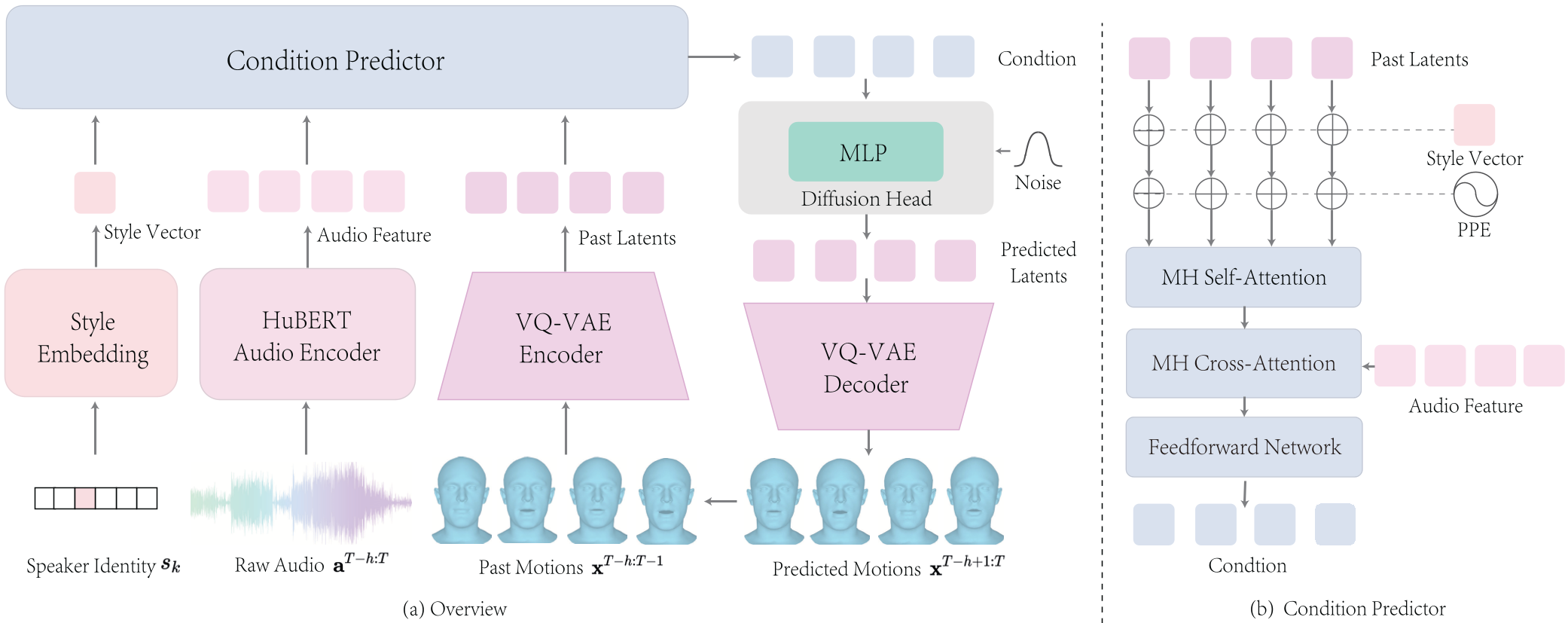 Figure 1: The StreamingTalker pipeline, featuring the AR Condition Predictor and the Diffusion Head.
Performance and Results
StreamingTalker outperforms existing deterministic and diffusion-based baselines across all major metrics.
- Lip Synchronization: On VOCASET, the Lip Vertex Error (LVE) dropped to 2.7206, significantly lower than DiffSpeaker's 3.1478.
- Latency Stability: As shown in the graph below, while Full-Sequence models see their latency explode as audio length increases, StreamingTalker's latency remains flat at 25ms.
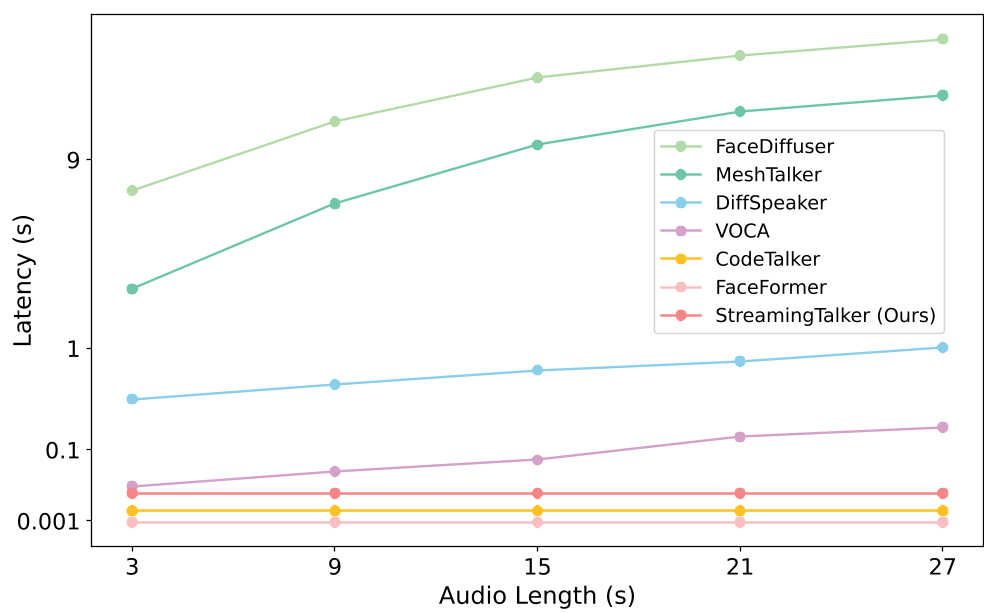 Figure 2: Latency analysis showing StreamingTalker's consistent performance compared to full-sequence diffusion models.
Visual Fidelity
Qualitatively, the model excels at "bilabial consonants" (sounds like /m/, /p/, /b/ that require full lip closure) and rounded vowels. Most previous models suffered from "over-smoothing," where the mouth never quite closes or opens fully. StreamingTalker’s diffusion process captures these fine-grained articulations with much higher fidelity.
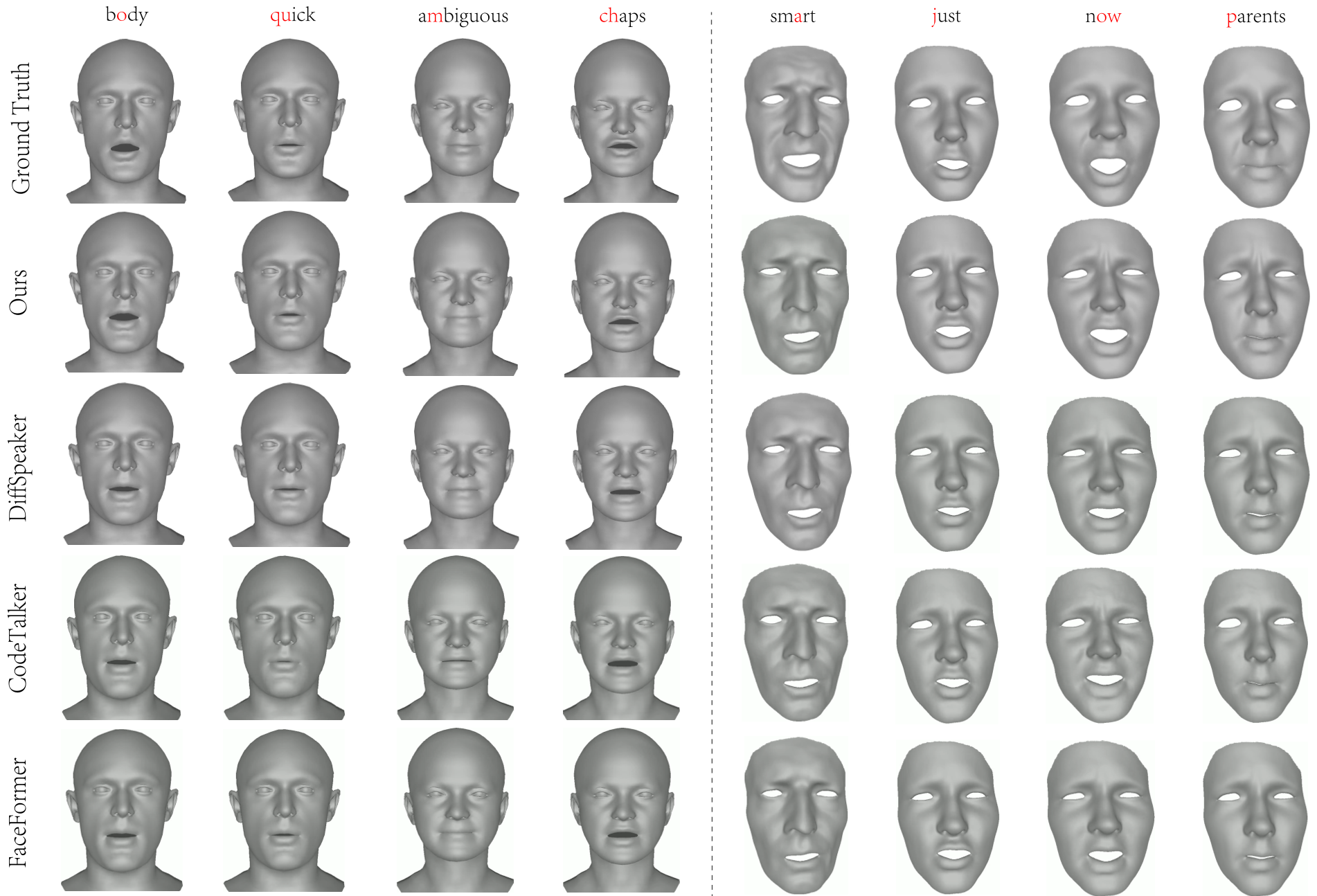 Figure 3: Qualitative comparison highlighting superior lip closure and vowel articulation.
Critical Analysis & Future Outlook
Strengths:
- Streaming Ready: The first diffusion model for this task that truly supports real-time, interactive applications.
- Robustness: The fixed-window history strategy effectively solves the generalization problem for long audio.
Limitations:
- Identity Coupling: The style embeddings are still tied to the training set, meaning zero-shot generalization to new faces is limited.
- Expression Depth: The model focuses heavily on speech-related lip movements; rich emotional micro-expressions (like subtle brow furrows) are not yet fully modeled.
Conclusion
StreamingTalker proves that Autoregression and Diffusion are not mutually exclusive but are actually complementary for temporal tasks. By using AR for global structure and Diffusion for local detail, the authors have created the first high-fidelity, real-time 3D talking head framework suitable for the next generation of AI avatars.