
StreamingTalker: Enabling Real-Time, Infinite-Horizon 3D Facial Animation via AR Diffusion
StreamingTalker: Audio-driven 3D Facial Animation with Autoregressive Diffusion Model
StreamingTalker is an audio-driven 3D facial animation framework that utilizes a novel Autoregressive (AR) Diffusion Model. It achieves state-of-the-art lip-synchronization and temporal stability on BIWI and VOCASET datasets while enabling real-time, streaming synthesis for arbitrary-length audio.
TL;DR
StreamingTalker introduces an Autoregressive (AR) Diffusion Model designed for streaming 3D facial animation. By leveraging a fixed history window and a lightweight diffusion head, it overcomes the latency and duration limits of traditional full-sequence diffusion models, achieving high-fidelity lip-sync at a constant 25ms latency.
Background & Positioning
Generating realistic 3D facial motion from speech is a cornerstone of digital human technology. While recent Diffusion Models have brought unprecedented "one-to-many" expressiveness to this field, they have largely been "batch processors"—limited by the length of the window they were trained on and suffering from mounting latency as audio grows longer. StreamingTalker shifts the paradigm from global denoising to a streaming AR framework, making it an "on-device ready" SOTA solution.
The Problem: The "Long Audio" Wall
Prior SOTA works like DiffSpeaker or FaceDiffuser denoise the entire sequence at once. When these models face audio significantly longer than their training samples, the global temporal consistency breaks down. Furthermore, users must wait for the entire audio to be processed before the first frame appears—a dealbreaker for real-time virtual assistants.
Methodology: The AR Diffusion Loop
The core innovation lies in the AR Condition Predictor. Instead of looking at the whole timeline, the model maintains a sliding window of historical motion.
1. Latent Space Compression
The system uses a VQ-VAE to map high-dimensional vertex movements into a compact discrete latent space. This simplifies the diffusion task from "sculpting a mesh" to "predicting a latent code."
2. The Condition Predictor
A Transformer decoder acts as the brains, fusing:
- Past Motion Latents: A fixed window (60-120 frames).
- Audio Embeddings: Features extracted via a pre-trained HuBERT model.
- Speaker Identity: One-hot style embeddings.
3. Lightweight Diffusion Head
Unlike heavy U-Nets, StreamingTalker uses a single-layer MLP diffusion head. Since the AR condition is so strong, a lightweight head is sufficient to denoise the current frame's latent code, ensuring the speed remains under the real-time threshold (40 FPS).
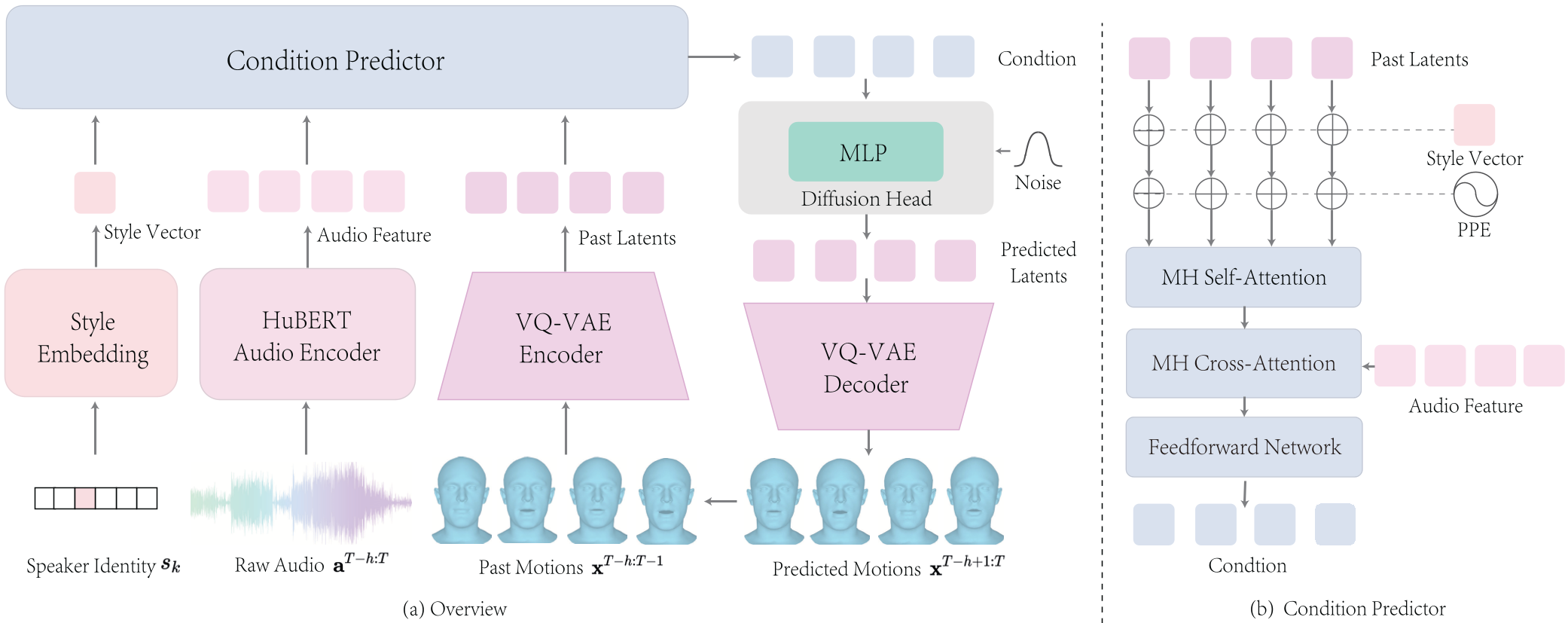 Figure 1: The model architecture showing the AR loop where past motions guide the diffusion of the next frame.
Experiments & SOTA Performance
StreamingTalker was tested on BIWI (emotional/rich expressions) and VOCASET (standard lip-sync).
Quantitative Edge
The model secures the lowest Lip Vertex Error (LVE) across both datasets. In long-sequence tests (2000+ frames), while other models' accuracy plummeted, StreamingTalker’s performance remained stable due to its AR local-consistency design.
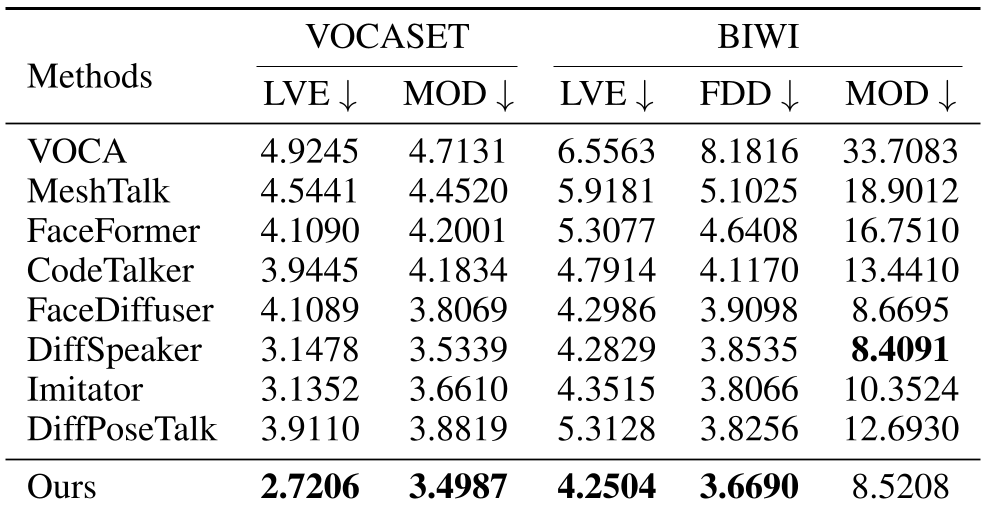 Table 1: Competitive analysis against SOTA baselines like DiffSpeaker and FaceDiffuser.
The Latency Breakthrough
Inference latency is where StreamingTalker truly shines. Traditional methods see latency scale linearly with audio duration. StreamingTalker remains flat at 25ms, fulfilling the needs for interactive LLM-driven avatars.
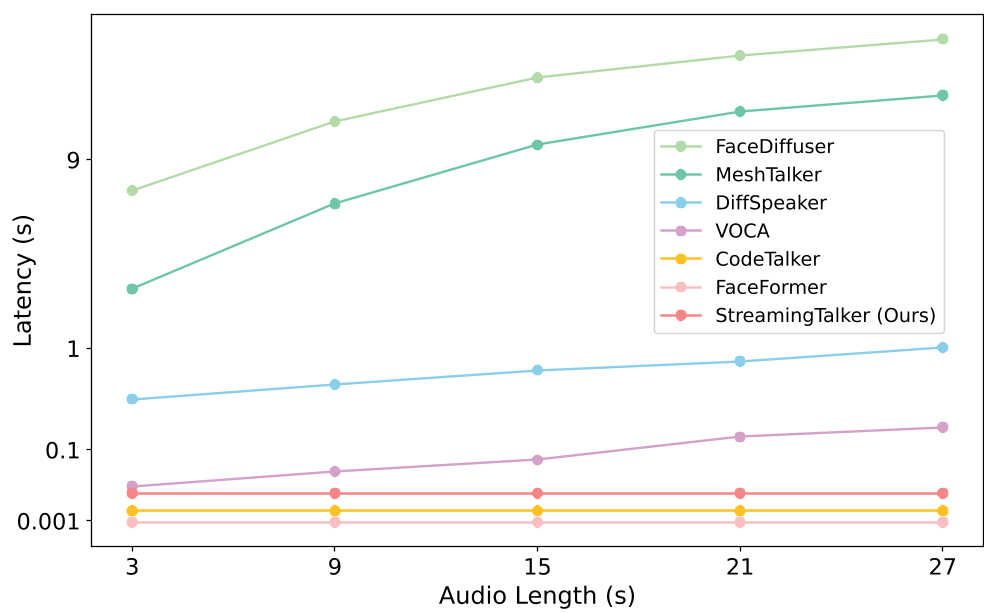 Figure 2: Latency vs. Audio Length. StreamingTalker is the only diffusion-based method that provides constant-time response.
Critical Analysis & Conclusion
Takeaways
- Physical Intuition: Speech and motion are locally causal. By focusing on a "historical window," the model mimics human speech production more naturally than global optimizers.
- Efficiency: Moving the complexity into the AR Condition Predictor allows the Diffusion Head to be extremely light (MLP), facilitating 40 FPS rendering.
Limitations
Despite its speed, the model's identity embeddings are closed-set; it cannot perfectly zero-shot a completely new person's facial structure without some fine-tuning. Additionally, while lip-sync is perfect, the "upper-face" expressions are still relatively subtle due to dataset constraints.
Future Outlook
The integration of an LLM + Audio-Streaming pipeline (as demonstrated by the authors' demo) marks the next step for Conversational AI. Future iterations will likely incorporate emotional "style-tags" to make these digital humans not just talk, but feel.