
StreamingTalker: Breaking the Latency Barrier in 3D Facial Animation
StreamingTalker: Audio-driven 3D Facial Animation with Autoregressive Diffusion Model
StreamingTalker is a novel audio-driven 3D facial animation framework that utilizes an Autoregressive (AR) Diffusion Model to generate realistic, synchronized facial motions in a streaming manner. It achieves SOTA performance on VOCASET and BIWI datasets while enabling real-time synthesis for arbitrary-length audio inputs.
TL;DR
StreamingTalker introduces an autoregressive diffusion framework designed for real-time, audio-driven 3D facial animation. By shifting from full-sequence denoising to a streaming approach, it eliminates the latency and performance degradation typically associated with long audio inputs, achieving SOTA results with a mere 25ms inference latency.
Background: The Long-Sequence Struggle
Generating lifelike 3D facial movements from speech is a cornerstone of digital human technology. Recently, Diffusion Models have dominated this space due to their ability to capture the stochastic, one-to-many relationship between audio and expression (e.g., the same sound can result in different facial nuances).
However, existing SOTA models like FaceDiffuser or DiffSpeaker are "holistic": they require the entire audio clip to be fed into a Transformer or U-Net denoiser before they can output the first frame. This creates a massive bottleneck:
- Latency: You can't start the animation until you've processed the whole clip.
- Horizon Drift: Training on 4-second clips makes the models "clueless" when faced with 1-minute audio, leading to unnatural jitter or frozen expressions.
The StreamingTalker Insight: Autoregression Meets Diffusion
The authors' core insight is that we don't need the future to predict the present. By reformulating full-sequence generation as an Autoregressive (AR) Diffusion process, they generate the next frame based on a sliding window of historical motion.
1. Model Architecture
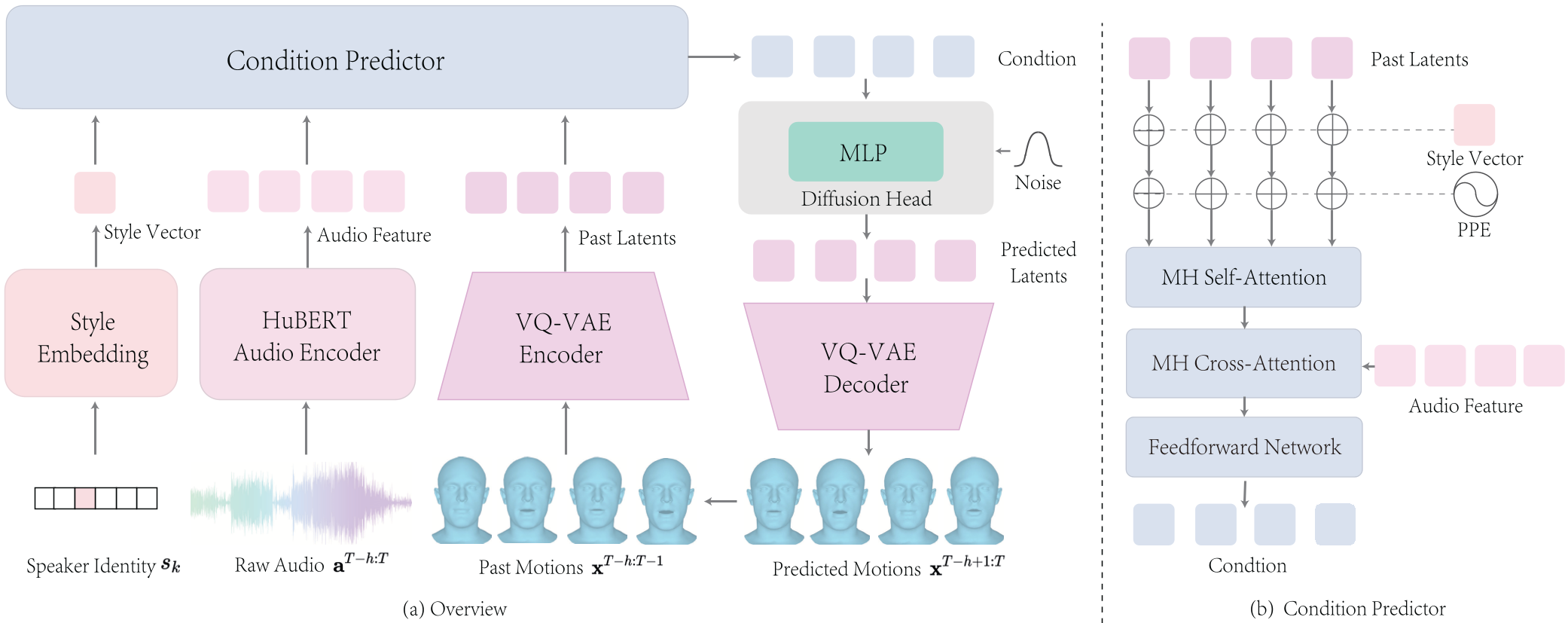
The pipeline consists of three vital components:
- VQ-VAE Latent Space: Instead of operating on thousands of raw 3D vertices, the model works in a compressed, discrete motion latent space.
- AR Condition Predictor: This is the "brain." It uses a Transformer Decoder to fuse historical motion latents with audio features (extracted via HuBERT). It uses ALiBi (Attention with Linear Biases) to ensure it can handle sequences much longer than those seen during training.
- Lightweight Diffusion Head: Unlike heavy Transformers, the denoiser here is a simple, efficient MLP. It takes the condition from the predictor and "denoises" a Gaussian noise sample into the next facial motion latent.
Experiments: Real-time and Robust
The model was tested on two benchmarks: VOCASET and BIWI.
Quantitative SOTA
On VOCASET, StreamingTalker achieved a Lip Vertex Error (LVE) of 2.7206, a notable improvement over the previous SOTA (DiffSpeaker at 3.1478). Critically, in "Long-Sequence" tests (2000+ frames), StreamingTalker's lead widened, proving that its autoregressive nature successfully mitigates drift over time.
Latency Efficiency
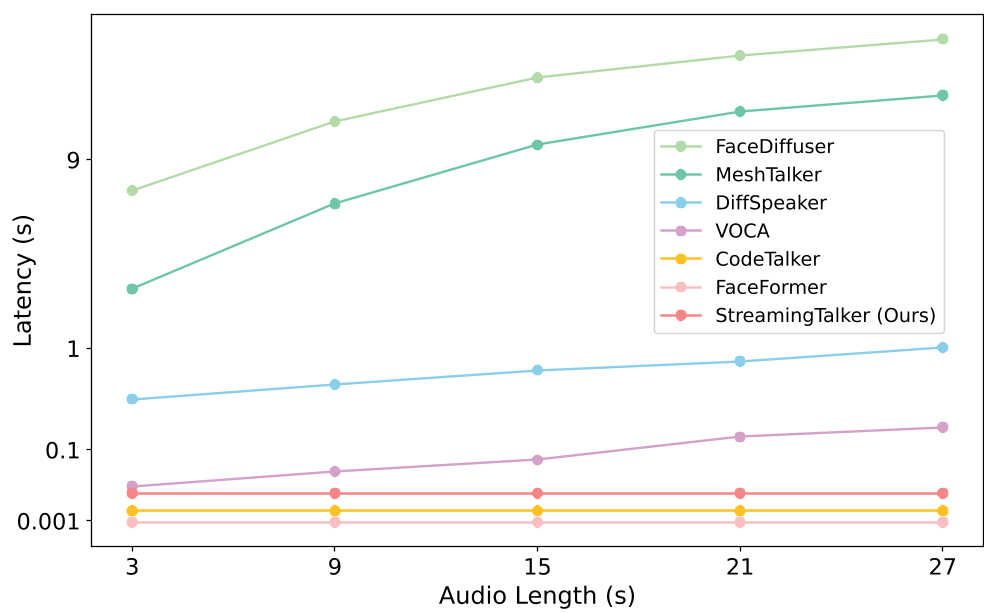
The most striking result is the latency profile. Traditional diffusion models see latency spike exponentially as audio length increases. StreamingTalker remains flat at 25ms, regardless of whether the audio is 3 seconds or 30 seconds long.
Qualitative Superiority
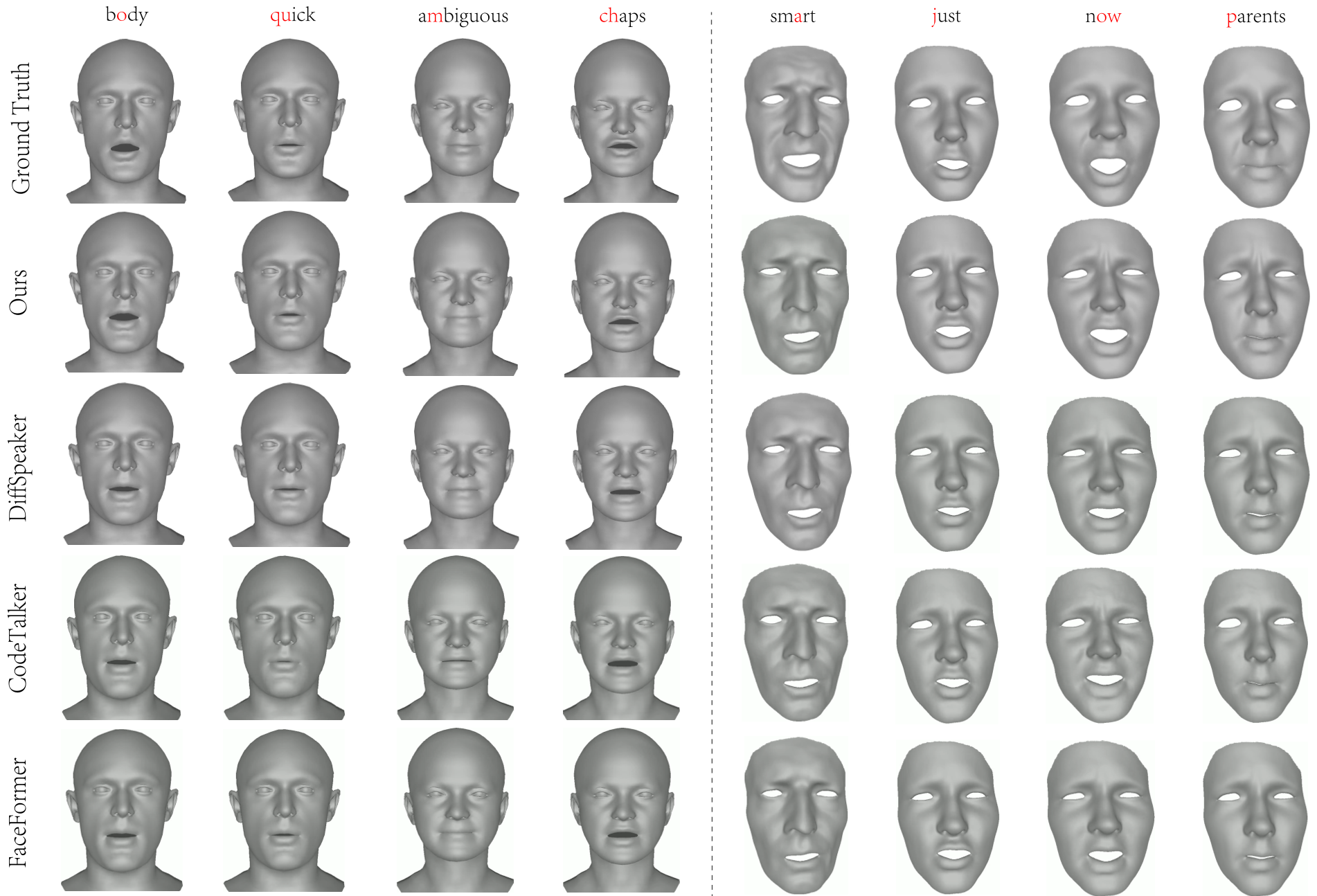
Visual inspections reveal that StreamingTalker captures finer "articulatory details." For words like "body" or "now," the model produces rounder, more natural vowel shapes. For consonants like "m" and "p," it achieves precise lip closure—a common failure point for earlier models that often look "mushy."
Critical Analysis & Conclusion
StreamingTalker is a significant step toward truly interactive digital humans. By swapping heavy global attention for a causal, autoregressive window, the authors solved the "Real-Time vs. Quality" trade-off.
Takeaway: The success of the MLP-based diffusion head is particularly interesting—it suggests that once a strong enough historical condition is provided, the denoising task itself is relatively simple, allowing for massive speedups without losing visual fidelity.
Limitations: Currently, the model focuses on lip-sync and basic facial dynamics. It lacks a dedicated emotional control module (e.g., it might struggle to speak "angrily" if the audio doesn't inherently contain that cue). Future work integrating EMOCA-style emotion priors could make this the definitive tool for game NPCs and virtual assistants.