
[NVIDIA 2026] Audio Flamingo Next: Scaling the Frontier of Open Audio Intelligence
Audio Flamingo Next: Next-Generation Open Audio-Language Models for Speech, Sound, and Music
Audio Flamingo Next (AF-Next) is a state-of-the-art open large audio-language model (LALM) designed for unified understanding of speech, sound, and music. Leveraging 1 million hours of data and a Qwen-2.5-7B backbone, it achieves SOTA results across 20+ benchmarks, specifically outperforming Gemini 2.5 Pro on long-audio tasks (LongAudioBench: 73.9 vs 60.4).
TL;DR
Audio Flamingo Next (AF-Next) represents a massive leap for open-source audio-language models. By scaling training to 1 million hours of diverse audio and introducing Temporal Chain-of-Thought (CoT), NVIDIA and UMD researchers have built a generalist agent capable of reasoning over 30-minute audio files, transcribing multi-talker meetings, and classifying complex music—often outperforming much larger closed models like Gemini 2.5 Pro.
Positioning: This is not just a benchmark "hill-climber"; it is a robust industrial-strength recipe for building general-purpose auditory intelligence.
The "Long-Audio" Problem: Why Prior Models Failed
Most existing LALMs are "short-sighted." They are trained on academic snippets and struggle when the audio exceeds 30 seconds. In the real world, audio is messy: 20-minute podcasts, overlapping speakers in meetings, and background noise.
The authors identified two fatal flaws in prior SOTAs:
- Data Bias: Models were "overfitted" to clean academic sets like AudioSet.
- Reasoning Divorce: Standard "Thinking" steps in models weren't tied to when events actually happened in the audio, leading to hallucinations.
Methodology: The AF-Next Architecture
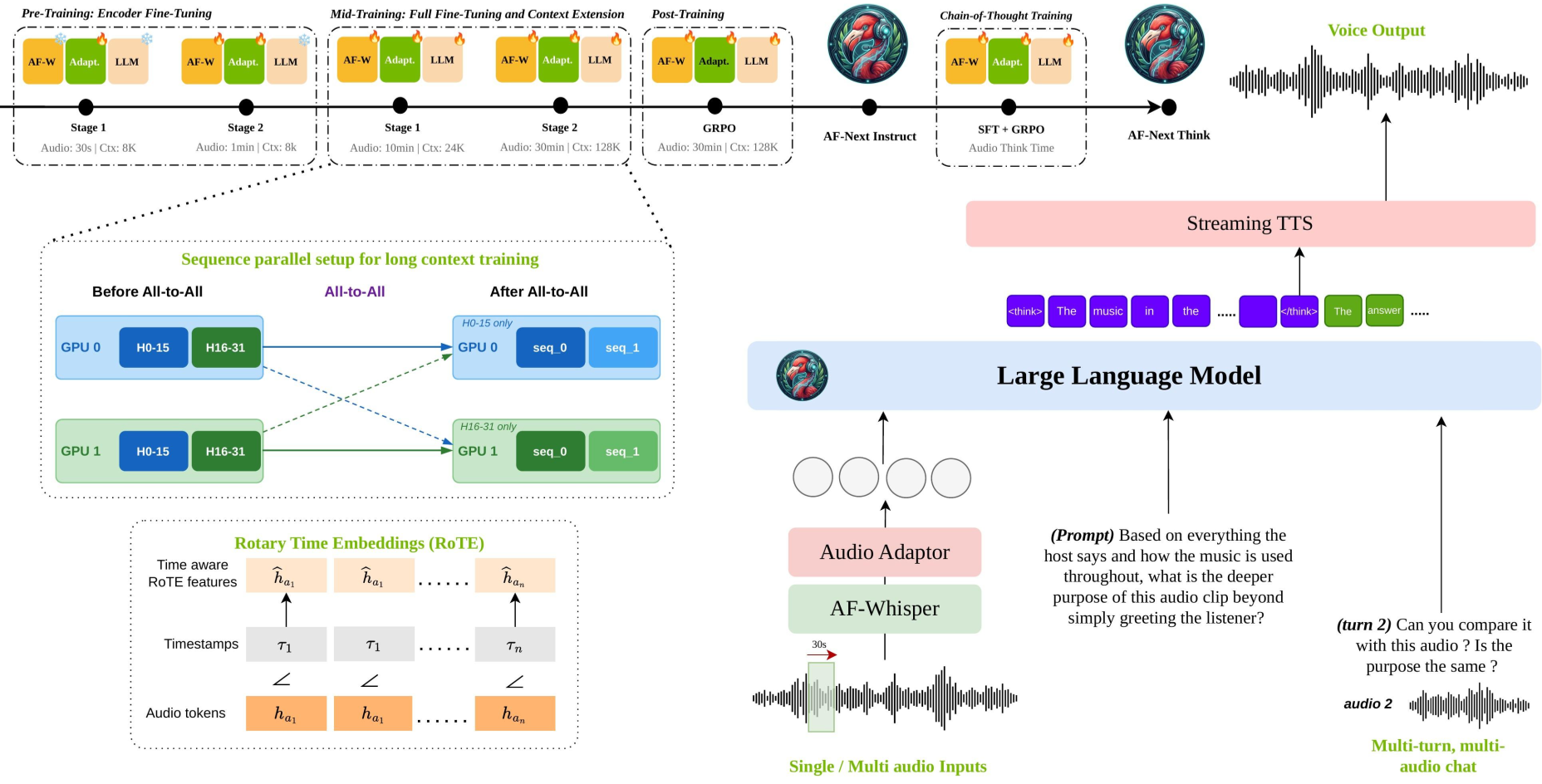
AF-Next utilizes a Qwen-2.5-7B backbone, but with a critical twist. Instead of standard Rotary Positional Embeddings (RoPE) which use discrete indices, it uses Rotary Time Embeddings (RoTE). This allows the model to understand the absolute temporal distance between two sound events, which is vital for long-context tasks.
The Thinking Paradigm: Temporal Audio CoT
Unlike previous R1-style "thinking" traces that can be rambling and expensive, AF-Next's Temporal CoT forces the model to ground its logic:
- Standard Model: "I hear a dog barking, then a siren."
- AF-Next: "At [02:15], a dog barks. At [04:40], a siren begins. Therefore, the dog was startled by the siren."
Training at Scale: The 4-Stage Curriculum
Scaling to 1M hours of data is computationally terrifying. To manage this, the team used a Hybrid Sequence Parallelism strategy combining:
- DeepSpeed Ulysses: Distributing heads across GPUs (low latency).
- Ring Attention: Distributing KV blocks across nodes (high scalability).
The training stages moved from basic audio-text alignment to complex Mid-training (broadening skills) and finally to GRPO-based Post-training for safety and instruction following.
Experiments & SOTA Results
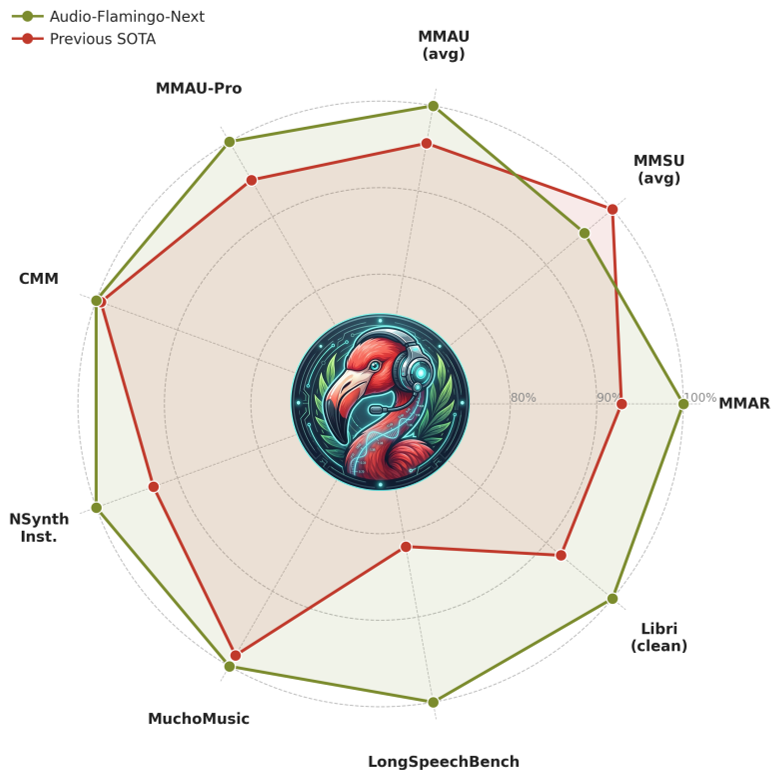
AF-Next-Instruct proves that "more data + better reasoning" wins. On LongAudioBench, which tests the ability to find "needles" in long audio haystacks, AF-Next scored 73.9, crushing Gemini-2.5-Pro's 60.4.
Performance Highlights:
- ASR: 1.54% WER on LibriSpeech (setting a new open record).
- Music: Huge gains in instrument and source classification (NSynth).
- Safety: Included 386k samples to ensure the model refuses to extract PII or suggest harmful activities.
Critical Insight & Future Outlook
The release of three specialized variants—Instruct (QA), Think (Reasoning), and Captioner (Detailed descriptions)—shows a move toward "Ensemble of Specialists."
The Takeaway: Audio is no longer a second-class citizen in the LLM world. AF-Next proves that with sufficient scale and temporally sensitive architecture (RoTE + Temporal CoT), open models can navigate the auditory world as well as, if not better than, the most powerful proprietary systems.
Limitations
Despite its power, AF-Next still faces "evidence sparsity." When a critical sound event is only 0.5s long in a 30-minute file, even 128k context windows can struggle with retrieval. Solving this "micro-needle in a macro-haystack" remains the next frontier.