
NADA: Can We "Hear" a Virus? Detecting Android Malware via Audio Signal Processing
Audio signal processing for Android malware detection and family identification
The paper introduces NADA (aNdroid AuDio mAlware detection), a novel framework that treats Android executables as audio signals for security analysis. By converting .dex files to .wav format, it leverages audio signal processing and Neural Networks to achieve 95.2% accuracy in malware detection and 92.2% in family identification.
TL;DR
What if code wasn't just text or instructions, but a symphony? Researchers have developed NADA (aNdroid AuDio mAlware detection), a system that converts Android application binaries into audio files. By applying Digital Signal Processing (DSP) typically used for music recognition, the system identifies malware with 95.2% accuracy and categorizes its family with 92.2% accuracy, proving that malicious intent has a distinct "sound."
The Problem: The Cat-and-Mouse Game of Obfuscation
The traditional antimalware industry relies heavily on signatures—specific strings of bytes that act as a digital fingerprint. However, malware authors use obfuscation (code reordering, variable renaming, and encryption) to change the fingerprint without altering the malicious behavior.
Static analysis usually requires "unpacking" or reverse engineering the app, which is slow and often defeated by packers. The researchers behind NADA asked a radical question: Can we treat the raw byte distribution of a file as a signal and detect patterns that bypass traditional code-matching?
Methodology: From Bytecode to Bitstream
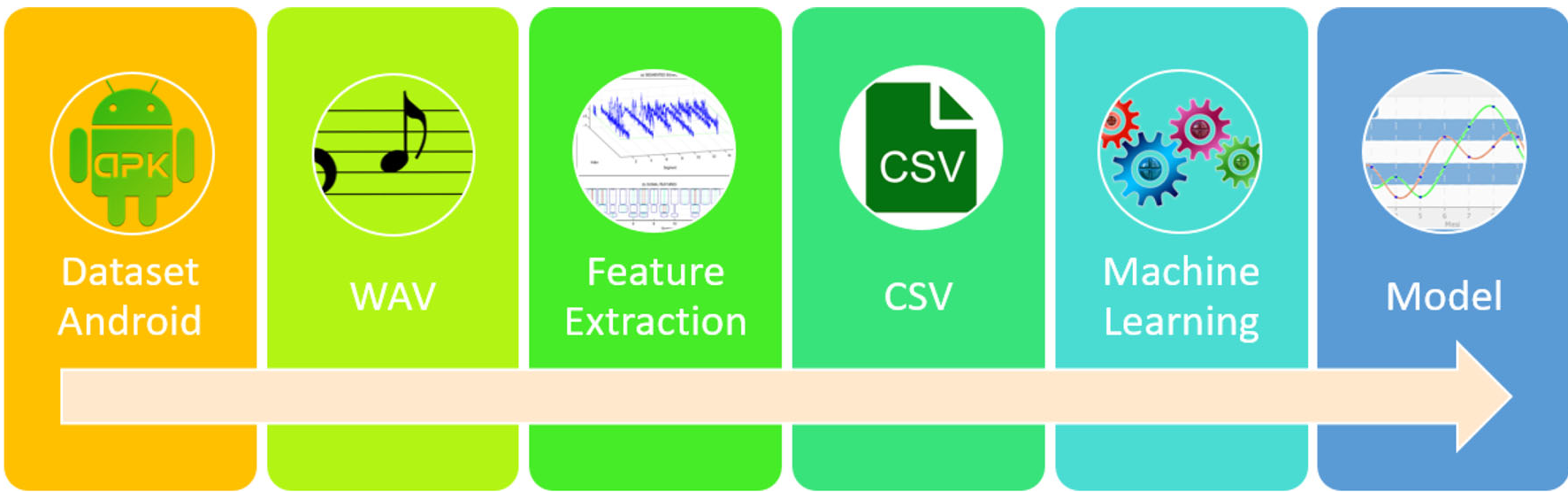
The NADA pipeline follows a sophisticated transformation process:
- Binary-to-Audio Conversion: The
.dex(Android executable) file is treated as a digitized raw signal. It is wrapped in a.wavheader with a specific frame rate (32768 Hz) and mono channel settings. - Acoustic Feature Extraction: Instead of looking for "API calls," the system extracts features used in Speech Recognition and Music Information Retrieval (MIR):
- MFCC (Mel-Frequency Cepstral Coefficients): Describes the spectral envelope of the "sound."
- Chromagram: Captures harmonic characteristics.
- Spectral Centroid: Locates the "center of mass" of the sound frequencies.
- Zero Crossing Rate: Measures how rapidly the signal fluctuates.
The Architecture of Intelligence
The extracted features are fed into a four-layer Neural Network. The first model performs binary classification (Malware vs. Legitimate). If a sample is flagged as malicious, a second multi-label model identifies which of the 71 malware families it belongs to.
Visual Evidence: The "Spectrum" of Malice
One of the most compelling aspects of the research is the use of Spectrograms. When visualizing the frequencies of different malware families, the researchers found that apps within the same family (like Opfake or Fobus) produced nearly identical visual patterns, while looking significantly different from legitimate apps.
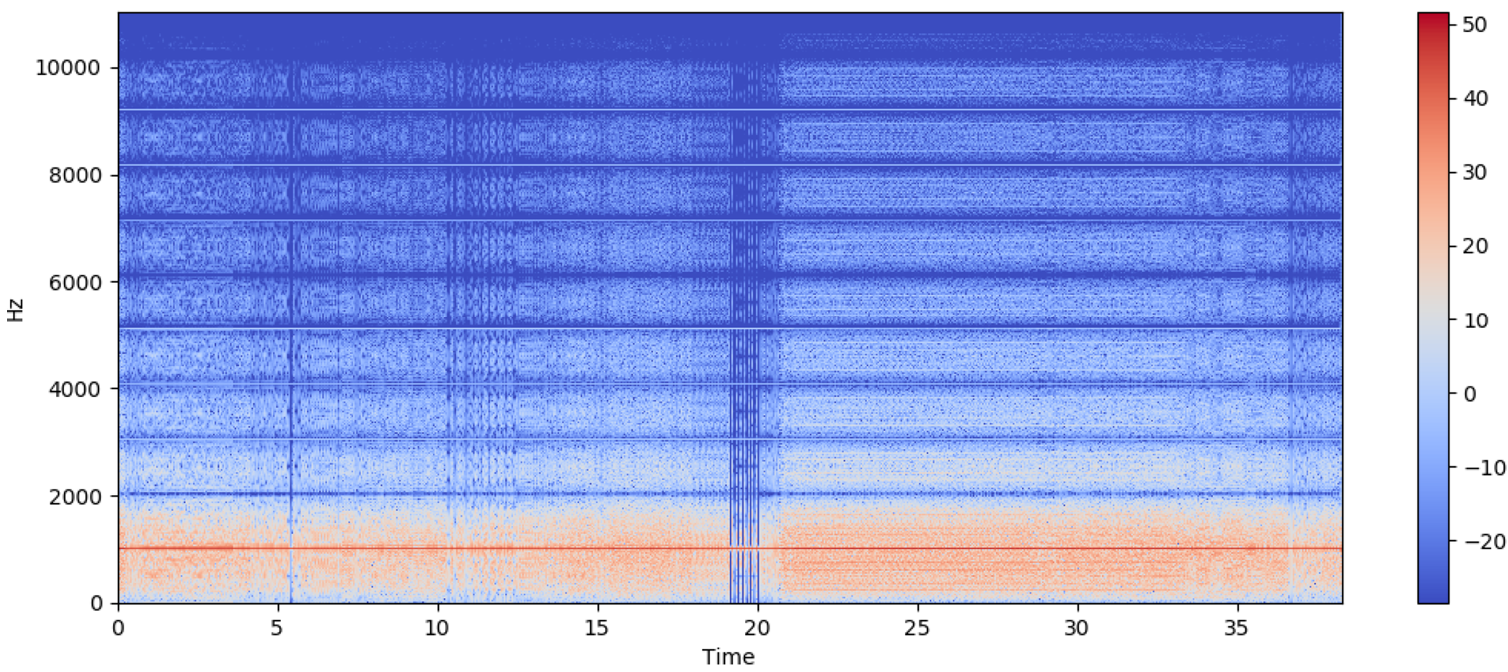 Figure: The visual patterns of two different samples from the Opfake family show striking structural similarity.
Benchmarking Performance
NADA was tested against 50,000 apps. The Neural Network approach significantly outperformed traditional classifiers like Logistic Regression and SVM.
| Metric | Malware Detection | Family Identification |
|---|---|---|
| Accuracy | 95.2% | 92.2% |
| Precision | 0.948 | 0.911 |
| Recall | 0.947 | 0.913 |
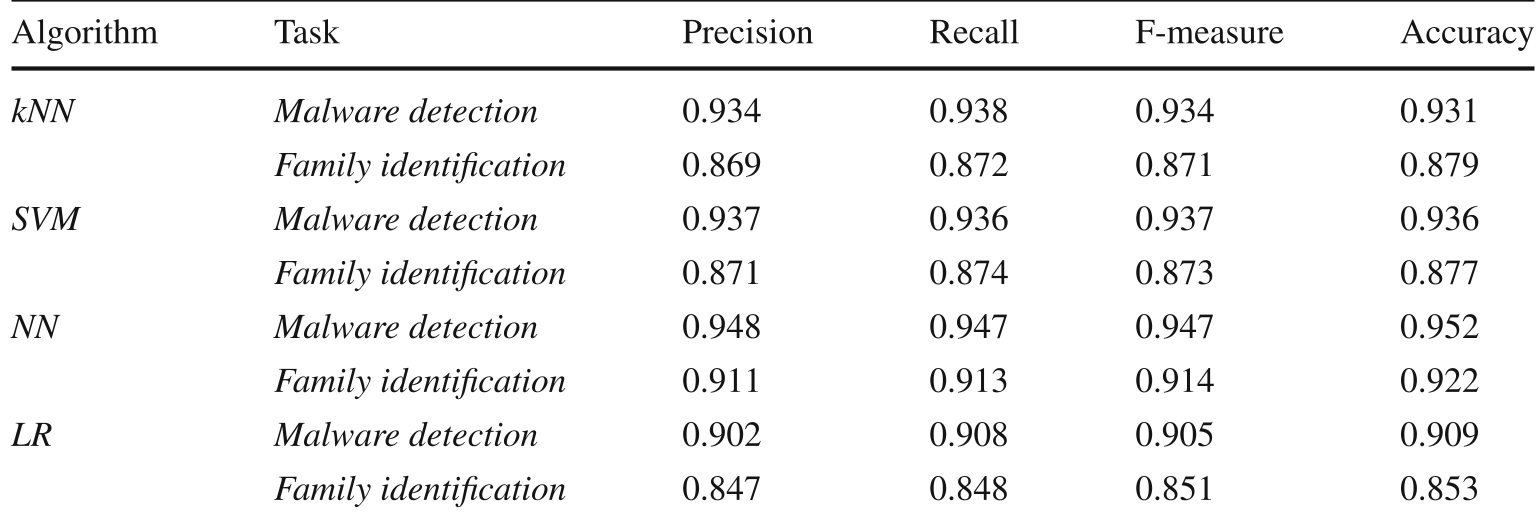
The high ROC area (0.941 for detection) indicates that the model is extremely robust at distinguishing between malicious and benign patterns, regardless of the app's original function.
Critical Insights & Future Outlook
Why does this work?
Malware families often share code templates or are generated by the same "builder" tools. While attackers can easily change specific instruction sequences (obfuscation), the statistical distribution of bytes—the textures of the file—remains consistent. Signal processing is naturally suited to pick up these "textures" in a way that line-by-line code analysis is not.
Limitations
As with all supervised learning, NADA's family identification is limited by its training data. A brand-new malware family might be detected as "generic malware" but could be misclassified at the family level.
The Roadmap Ahead
The authors suggest that future iterations will combine this acoustic approach with Formal Methods to achieve even higher precision. This research marks a significant shift away from "reading" code to "observing" its signal, opening a new front in the battle for mobile security.