
Hybrid Deep CNNs: Leveraging Census Transform for Robust Multimodal Emotion Recognition
Audio-Visual Emotion Recognition Using a Hybrid Deep Convolutional Neural Network based on Census Transform
This paper introduces a hybrid deep convolutional neural network (CNN) for multimodal emotion recognition, utilizing log Mel-spectrogram images for audio and a novel Census-Transform (CT) based CNN for visual features. Combining these deep features with PCA+LDA dimensionality reduction, the approach achieves state-of-the-art performance, notably reaching 59.70% accuracy on the spontaneous BAUM-1s dataset.
TL;DR
Recognizing human emotions from video requires balancing the nuances of vocal tone with the dynamics of facial expression. This paper presents a hybrid CNN framework that transforms audio into image-like Mel-spectrograms and utilizes a Census-Transform (CT) preprocessing step for facial images. By fusing these deep features and applying a rigorous PCA+LDA reduction, the authors achieved an impressive 59.70% accuracy on the spontaneous BAUM-1s dataset, setting a new benchmark for realistic emotion detection.
Background & Motivation: Moving Beyond "Acted" Emotions
Most emotion recognition research focuses on acted datasets (like RML or eNTERFACE05), where subjects exaggerate feelings. However, real-world "spontaneous" emotions—like those found in the BAUM-1s dataset—are subtle and easily obscured by lighting changes or individual variability.
The authors identify two major roadblocks in current SOTA:
- Feature Quality: Hand-crafted features like LBP or Gabor wavelets lack the discriminative power of deep features.
- Fusion Strategy: Simply concatenating high-dimensional vectors leads to the "curse of dimensionality," where noise overwhelms the signal.
Methodology: The Hybrid Deep Architecture
The proposed system treats both audio and video as visual problems, allowing the use of powerful 2D-CNN architectures.
1. The Audio-Network (AlexNet)
Instead of using raw waveforms, the audio is converted into Log Mel-spectrograms. To capture temporal dynamics, the authors calculate "Delta" and "Delta-Delta" coefficients, stacking them into a 3-channel image (227x227x3). This allows a pre-trained AlexNet to "see" the rhythm and pitch shifts of an emotion.
2. The Visual-Network (CT-based VGG)
The real innovation lies here. Before feeding frames into a VGG-Face model, the authors apply the Census Transform (CT).
- Why CT? It compares center pixels to their neighbors, creating a bit-string based on relative intensity. This makes the model incredibly robust to illumination changes (shadows, varying brightness) while emphasizing the structural "holistic" representation of the face.
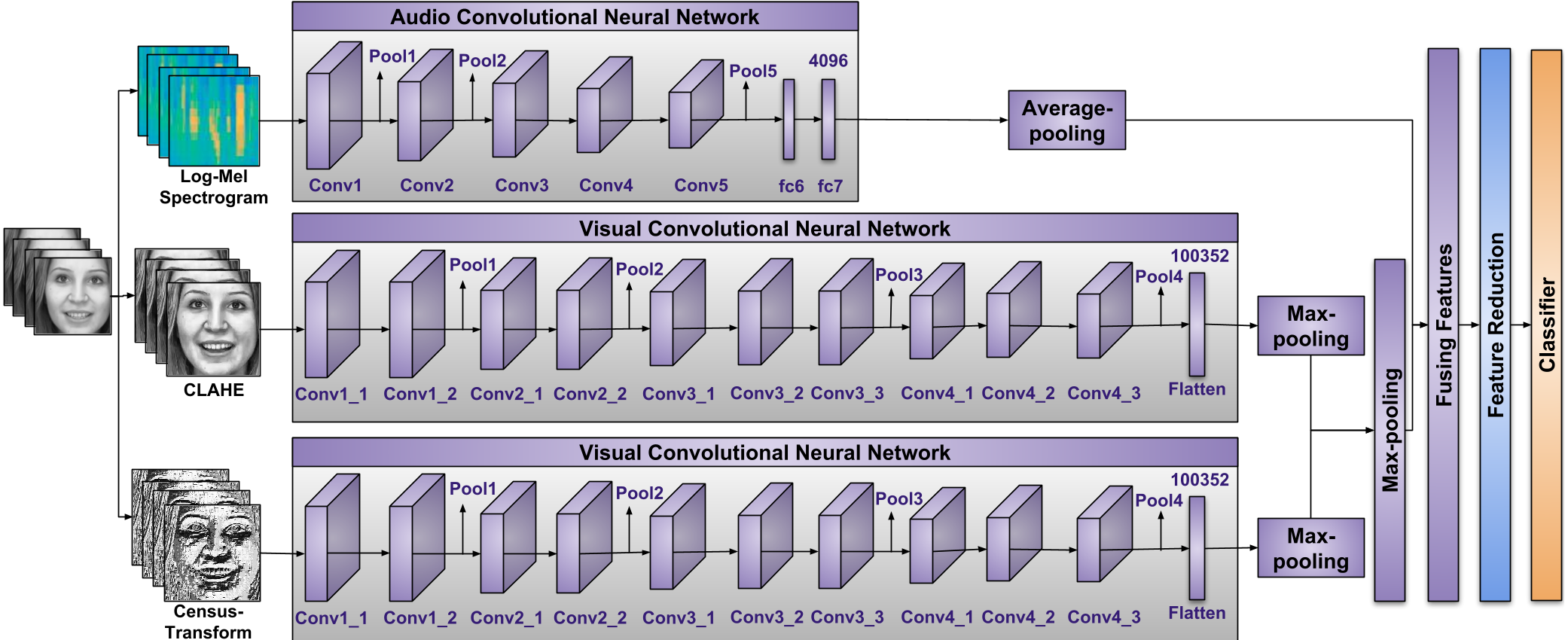 Figure 1: The hybrid pipeline spanning audio-visual capture to final classification.
3. Feature Reduction: PCA + LDA
The fusion of audio (fc7 layer) and video (flatten layer) results in a massive 104,448-dimensional vector. To handle this, the authors employ:
- PCA: To reduce dimensionality while retaining variance.
- LDA: To project data into a space that maximizes the distance between different emotion classes.
Experimental Results & Insights
The model was tested across three major datasets: RML, eNTERFACE05, and BAUM-1s.
| Dataset | Audio Only | Visual Only | Fused (Best) |
|---|---|---|---|
| RML | 68.75% | 75.00% | 82.50% |
| eNTERFACE05 | 62.00% | 68.33% | 85.00% |
| BAUM-1s | 46.76% | 59.52% | 59.70% |
Key Takeaway from Results: The Census-Transform visual features outperformed traditional VNet approaches by over 14% on the eNTERFACE05 dataset. This proves that "guiding" a CNN with structural preprocessing like CT is more effective than letting the network learn from raw RGB values alone, especially when data is limited.
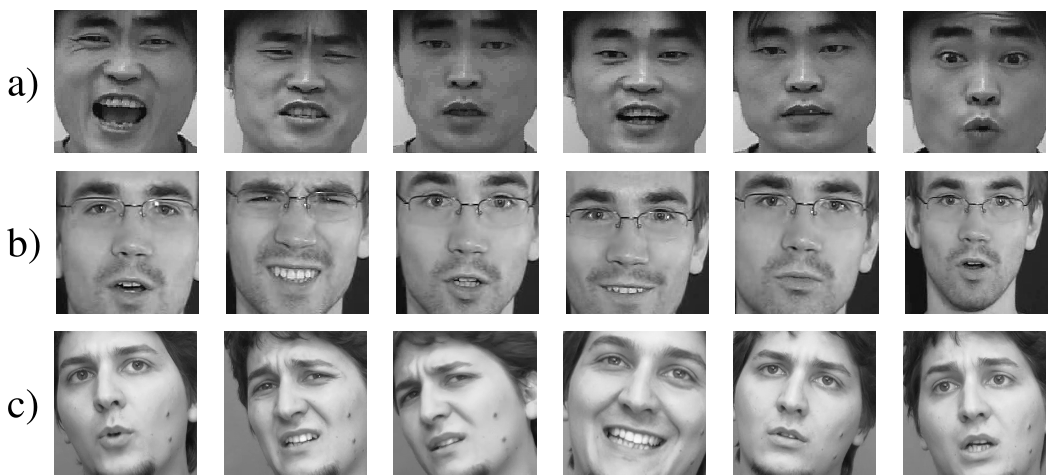 Figure 2: Sample processed facial regions. Note how CT highlights the edges and wrinkles essential for emotion detection.
Critical Analysis & Conclusion
While the results are strong, the paper highlights a common bottleneck: the visual channel is significantly more informative than the audio channel in these architectures. The 5% jump in the spontaneous BAUM-1s dataset is significant, yet the absolute accuracy (59.70%) reminds us that spontaneous emotion recognition remains an "open problem."
Future Outlook: This work sets the stage for more "physically-informed" deep learning. Instead of pure end-to-end models, the success of the Census Transform suggests that integrating classical computer vision descriptors into deep architectures can provide the necessary inductive bias to solve complex human-centric tasks like affect recognition.
Limitations: The reliance on 2D-CNNs means temporal sequence information (the flow of an emotion over seconds) is handled via simple pooling rather than recurrent structures (LSTMs) or Transformers. Future work could likely improve these scores by replacing the pooling layer with a Temporal Shift Module or an Attention mechanism.