
Debunking the Satisfaction Myth: A Multi-Method Audit of Demographic Bias in Search
Auditing Search Engines for Differential Satisfaction Across Demographics
This paper introduces a robust framework for auditing search engines to detect "differential satisfaction" across demographics like age and gender. Using Bing and comScore data, the authors propose three distinct methodologies—context matching, multilevel modeling, and pairwise latent difference estimation—to disentangle true user satisfaction from confounding behavioral biases.
TL;DR
Do search engines serve everyone equally? While "objective" metrics like click rates suggest they might not, this paper reveals that the metrics themselves are often biased. By applying causal inference and multilevel modeling to 32 million search impressions, the researchers demonstrate that while gender parity is largely achieved, subtle satisfaction gaps persist across generations—not because of the algorithm's failure, but due to fundamental differences in search behavior.
The "Dwell Time" Trap: Why Raw Data Lies
In the world of Information Retrieval (IR), we often treat "Dwell Time" (how long a user stays on a page) as a gold standard for satisfaction. But there is a latent pitfall: Demographics correlate with behavior.
If an older user takes 40 seconds to read a snippet that a teenager scans in 10, a naive algorithm marks the older user as "more satisfied." Furthermore, different groups search for different things—younger users frequent the "long tail" of complex queries, while older users issue more navigational head queries. Without controlling for these factors, any "audit" of a search engine is merely a measurement of demographic habits, not system performance.
Methodology: The Triple-Prism Approach
The authors propose a rigorous framework to strip away these confounders through three increasingly sophisticated lenses:
1. Context Matching (The Causal Lens)
Inspired by medical trials, this method matches "twins." It compares a male and female user only if they:
- Issued the exact same navigational query.
- Saw the exact same results page.
- Clicked the exact same final result.
This eliminates nearly all context bias but limits the sample size to "head" queries.
2. Multilevel Modeling (The Statistical Lens)
To generalize across all queries, the authors built a multilevel model where satisfaction is a function of query difficulty and topic.

By treating demographics as varying intercepts and slopes, the model asks: "Given a query of difficulty, how much does being 65 years old contribute to the observed metric?"
3. Pairwise Latent Estimation (The High-Precision Lens)
The final method uses a "High-Precision, Low-Recall" logic. It only flags a difference in satisfaction if the gap between two users is so large that it exceeds the predicted "noise" of demographic variation.

Key Insights & Experimental Results
The audit of Bing data (and subsequent external audit of comScore data) yielded surprising results:
- Gender Neutrality: Across all three methods, there was no statistically significant difference in satisfaction between men and women.
- The Age Gap: Even after controlling for query difficulty, older users (Baby Boomers) appear slightly more satisfied than Millennials and Gen Z.
- Difficulty Scaling: The satisfaction gap between ages widens as queries become more "difficult" (tail queries), suggesting that search engines might be optimized for the search patterns of older, more established demographics.
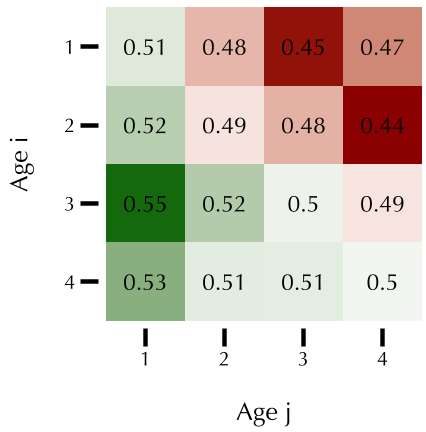 Figure: Pairwise comparison showing older age groups (closer to the right/bottom) consistently have higher latent satisfaction probabilities.
Critical Analysis: A Call for Demographic-Aware Metrics
The core takeaway is profound for the industry: We cannot have a "fair" search engine if our "thermometers" (metrics) are broken.
The fact that the same "age satisfaction" trend appeared across two independent search engines (Bing and its competitor) suggests that the issue might lie in the Dwell-Time-to-Satisfaction mapping itself. If the industry standard of "30 seconds = success" is fundamentally tuned to a specific demographic's reading speed, we are introducing a systemic bias into our optimization loops.
Conclusion
This work sets a new bar for "Internal Auditing." It moves the conversation from simple "group averages" to complex causal modeling. For future researchers, the challenge is now to develop Demographic-Agnostic Metrics—signals of success that remain stable whether the user is 15 or 75. Until then, our "SOTA" achievements in search might just be artifacts of who is doing the clicking.