
Augmented Reality in Health Care: Breaking the "Hands-Free" Barrier in Service Innovation
Digital Transformation in Health Care: Augmented Reality for Hands-Free Service Innovation
The paper presents a hands-free Augmented Reality (AR) solution for wound documentation using the Microsoft HoloLens. By employing a Design Science Research (DSR) approach, the authors developed a prototype that allows healthcare professionals to measure wounds and checklists documentation via gaze-based interactions, achieving significantly higher user satisfaction and efficiency compared to traditional manual methods.
TL;DR
Healthcare professionals are often "hands-bound" by sterile requirements and manual tasks, making traditional tablets and smartphones impractical for real-time documentation. This research introduces a Microsoft HoloLens-based AR prototype for wound management that allows nurses to measure wounds and fill checklists using nothing but gaze and eye-blinking. The result? A 31% increase in documentation speed and a massive leap in user satisfaction over traditional voice-command systems.
The "Sterile Hands" Dilemma: Why Tablets Fail in the Ward
In the world of wound care—a sector affecting millions in Germany alone—accuracy and hygiene are paramount. The authors' ethnographic fieldwork revealed a frustrating reality:
- The Germ Factor: Touching a camera or tablet during a procedure risks cross-contamination.
- The Memory Gap: Because they can't document mid-procedure, nurses rely on memory or "hand-scrawled notes," leading to "inaccurate and incomplete" medical records.
- The Resource Drain: Current scales require a second person to hold a ruler or take a photo, doubling the labor cost of a single task.
Methodology: Designing for the Point of Care (POC)
Using a Design Science Research (DSR) framework, the team iteratively built low-fidelity prototypes before settling on the Microsoft HoloLens. The core innovation lies in the Multimodal 3D User Interface:
- Indication: A white cursor follows the user's gaze to select wound edges or menu items.
- Confirmation: The study pitted Voice Commands against Eye Blinking (simulated via a Wizard of Oz setup) to see which "hands-free" method won in the field.
- Measurement: Leveraging the HoloLens's depth sensors, the system calculates wound dimensions without requiring a physical ruler.
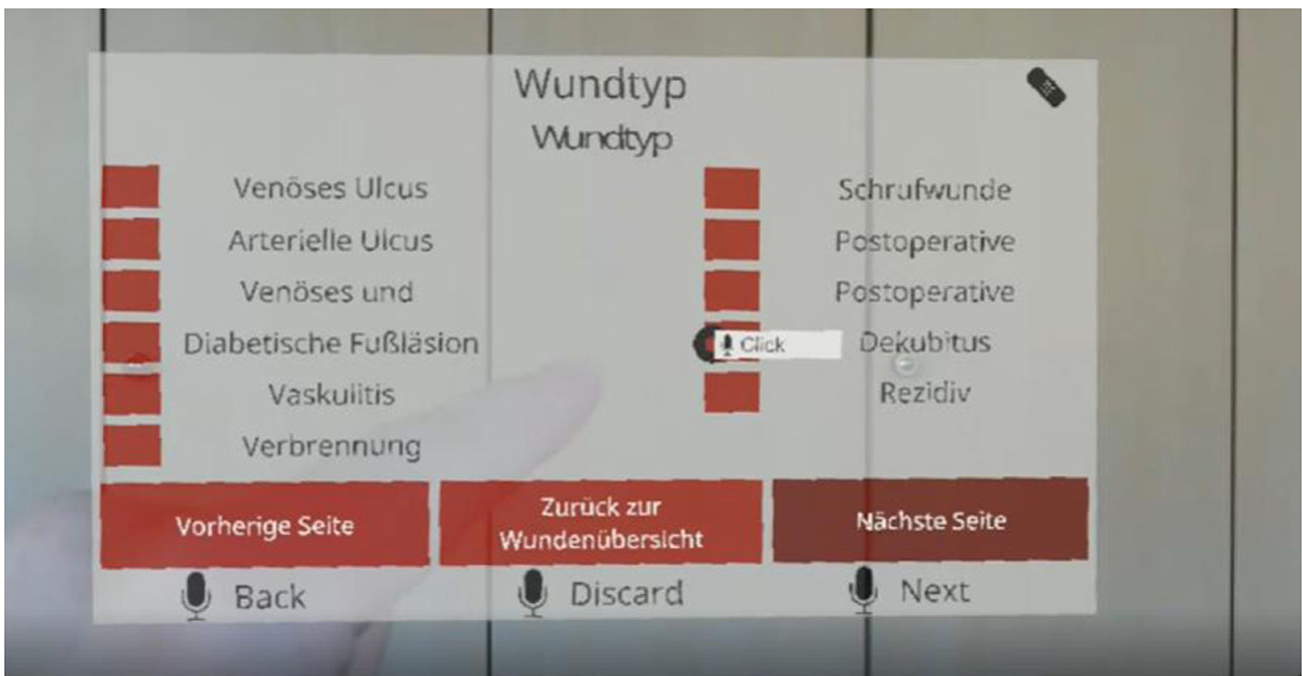 Above: The user interface showing checklist selection using gaze indication.
Experimental Results: The Triumph of the "Blink"
The study involved 45 professional wound managers. While both AR methods were preferred over current manual processes, the comparison between Voice and Blink interaction yielded a clear winner:
- Efficiency: Eye blinking was 31% faster than voice commands. Participants found it "tiring" to look up specific voice prompts, whereas a double-blink felt more intuitive.
- Acceptance: Per the UTAUT (Unified Theory of Acceptance and Use of Technology) model, both AR treatments scored significantly higher in "Performance Expectancy" and "Behavioral Intention" compared to the status quo.
- The Satisfaction Gap: Users reported significantly higher satisfaction with blinking (5.63) over voice (5.09).
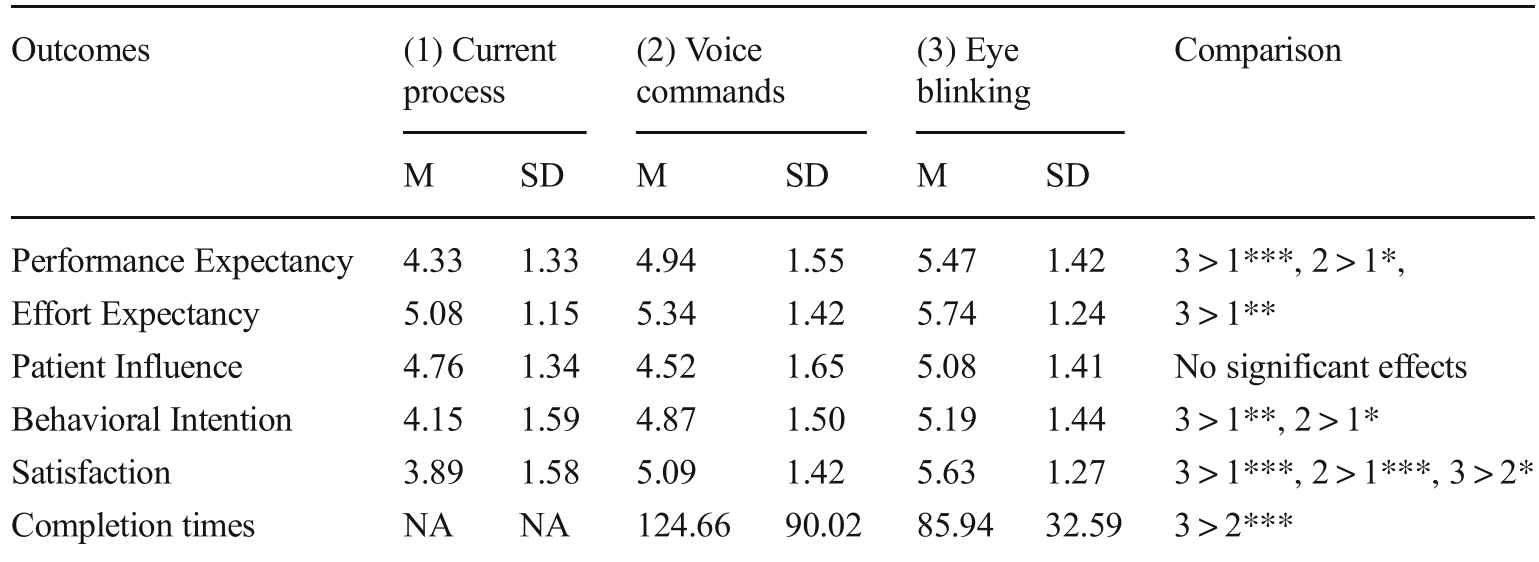 Table: Quantitative comparison across Performance Expectancy, Effort, and Satisfaction.
Deep Insight: Beyond Just "New Tech"
The value of this paper isn't just in the hardware—it's in the Digital Transformation of Service. By turning a passive device into an "active actor" in the service system, AR smart glasses solve the consistency problem. In traditional care, different nurses apply different standards; the AR prototype enforces a standardized, data-driven workflow that is documented as it happens.
Critical Analysis & Limitations
While the results are promising, the study notes two key hurdles:
- Individual Preference: Some users (especially those with contact lenses) found repeated blinking uncomfortable, suggesting that "one-size-fits-all" interaction is a mistake.
- The Patient Factor: The study focused on the caregiver. How a patient reacts to a nurse wearing a bulky AR headset—privacy concerns and the "uncanny valley"—remains an open research question.
Conclusion: The Future of Smart Services
This work moves AR from a "gimmick" to a legitimate tool for Service Innovation. For practitioners, it highlights a massive business opportunity in specialized medical software. For researchers, it proves that in high-stakes environments, physical interaction (blinking/gaze) often trumps audio interaction (speech) due to the high cognitive load of remembering commands.
Key Takeaway: To digitally transform healthcare, we must free the hands. AR smart glasses are the most viable candidate for bridging the gap between sterile medical environments and digital information systems.