
Beyond the Screen: Augmenting Education through Web 2.0 and 3D Social Spaces
An Augmented Social Interactive Learning Approach through Web2.0
This paper introduces an augmented social interactive learning approach that integrates Web 2.0 services and 3D virtual worlds into Higher Education. By combining traditional Virtual Learning Environments (VLE) like Blackboard with platforms such as Second Life, YouTube, and Wikis, the authors establish a multi-modal blended learning framework that enhances student engagement and collaborative knowledge creation.
TL;DR
This research pioneers an augmented social interactive learning approach that transforms the traditional, static Virtual Learning Environment (VLE) into a dynamic, "always-on" social platform. By synthesizing Web 2.0 tools (YouTube, Wikis) with immersive 3D virtual worlds (Second Life), the authors provide a blueprint for blended learning that prioritizes student-generated content and real-time social presence over passive consumption.
The "Top-Down" Bottleneck
For decades, e-learning was restricted by a "read-only" architecture. Traditional systems functioned as digital filing cabinets—site owners uploaded content, and students downloaded it. This top-down approach ignored the fundamental social nature of learning. The authors identify a critical gap: while social networking exploded in the personal sphere, formal Higher Education (HE) struggled to incorporate these "bottom-up" dynamics without losing the rigor of an explicit curriculum.
The Proposed Architecture: A Structure of Participation
The core innovation lies in the Augmented Social Learning Platform, which acts as a bridge between formal management and social engagement.
- The Core (Blackboard): Handles the "Heavy Lifting"—assignments, assessments, and structured course materials.
- The Support System (Web 2.0): Uses YouTube for video-based tutorials and Wikis/Blogs for collaborative knowledge building, allowing students to move from consumers to creators.
- The Visual Interface (Second Life): Provides the "Social Glue." Through 3D avatars, students experience non-verbal communication, posture, and spatial presence—phenomena typically lost in distance learning.
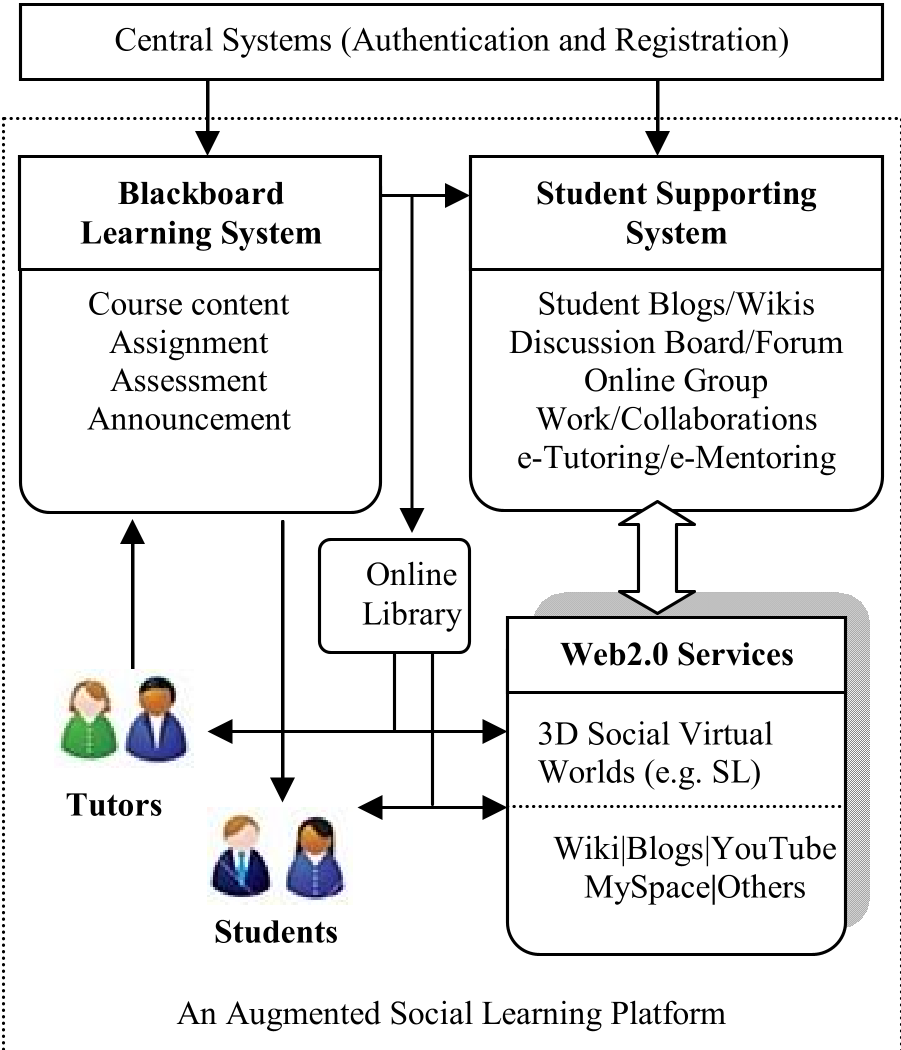 Figure 1: The proposed hybrid architecture combining VLE with social and 3D layers.
Real-World Prototypes: From E-Tutoring to Virtual Degree Shows
The paper validates this approach through several high-impact use cases:
- E-Tutoring & E-Mentoring: Students navigate to a virtual campus lab to discuss work with tutors. Unlike text-based chats, the use of voice, IM, and gestures within a spatial environment reduces the "loneliness" of distance learning.
- Role-Playing Simulations: The researchers built virtual clinics and sales rooms where students enact professional scenarios, preparing them for real-world interactions in a risk-free, immersive environment.
- Social Events: A virtual "Computer Animation Degree Show" was hosted in a digital gallery. This removed temporal and geographical barriers, allowing a global audience to interact with student work at a fraction of the cost of a physical exhibition.
 Figure 2: Prototyped systems for (a) E-tutoring and (b) Virtual Gallery exhibitions.
Critical Analysis & Future Horizons
The authors' insight that "learning is socially grounded" remains more relevant than ever in our post-pandemic world. By identifying the Structure of Participation, they shifted the focus from what is being taught to how the community interacts around the subject matter.
Current Limitations & Challenges:
- Cognitive Load: Higher-level cognitive interaction is still difficult to sustain in purely virtual environments.
- Ethics and Identity: As we move toward digital campuses, questions of privacy, identity theft in 3D spaces, and Intellectual Property (IP) regarding student-generated content become paramount.
- Sustainability: Building rich 3D media requires significant maintenance and development costs compared to simple text-based wikis.
Conclusion
This paper serves as an early cornerstone for what we now call the "Metaverse for Education." It argues convincingly that the future of pedagogy isn't just about digitizing textbooks, but about building vibrant, self-organized communities where students-centered participation is the primary driver of success.