
Hybrid Intelligence: Bridging BDI Agency and Machine Learning for Safer Trauma Management
Augmenting BDI Agency with a Cognitive Service: Architecture and Validation in Healthcare Domain
This paper introduces an integration architecture that augments Belief-Desire-Intention (BDI) agents with machine learning-based "Cognitive Services" to improve clinical decision-making. Validated in a trauma management context, the hybrid system combines logic-based expert rules with sub-symbolic predictive modeling to significantly reduce medical over-triage.
Executive Summary
TL;DR: The paper tackles the clinical inefficiency of "over-triage"—where too many patients are classified as "major trauma" cases—by merging the logical rigor of BDI (Belief-Desire-Intention) agents with the predictive power of scikit-learn models. The resulting system uses a "Trauma Agent" that listens to a machine learning "Cognitive Service" but retains the final authority to override predictions based on expert-defined safety rules.
Background: This work represents a sophisticated "Neuro-Symbolic" bridge. In the academic coordinate system, it moves beyond theoretical BDI-ML integration by providing a validated, technological implementation using the JaCaMo platform within a real-world, high-stakes medical environment.
The "Over-Triage" Crisis in ER
Current clinical practice often relies on rigid, rule-based systems. In the authors' study of 1,330 reports, the traditional rule-based approach led to a staggering amount of over-triage. While safe, this creates resource exhaustion—trauma teams are activated for patients who don't actually need them.
Conversely, pure Machine Learning (sub-symbolic) models can optimize resources but suffer from under-triage (missing a life-threatening injury), which is unacceptable in medicine. The researchers identified that neither experts nor algorithms should work in isolation.
Methodology: The Architecture of Cooperation
The core innovation is an architecture where a Jason agent (Symbolic) and a Cognitive Service (Sub-symbolic) interact through the A&A (Agents & Artifacts) meta-model.
The Interaction Flow
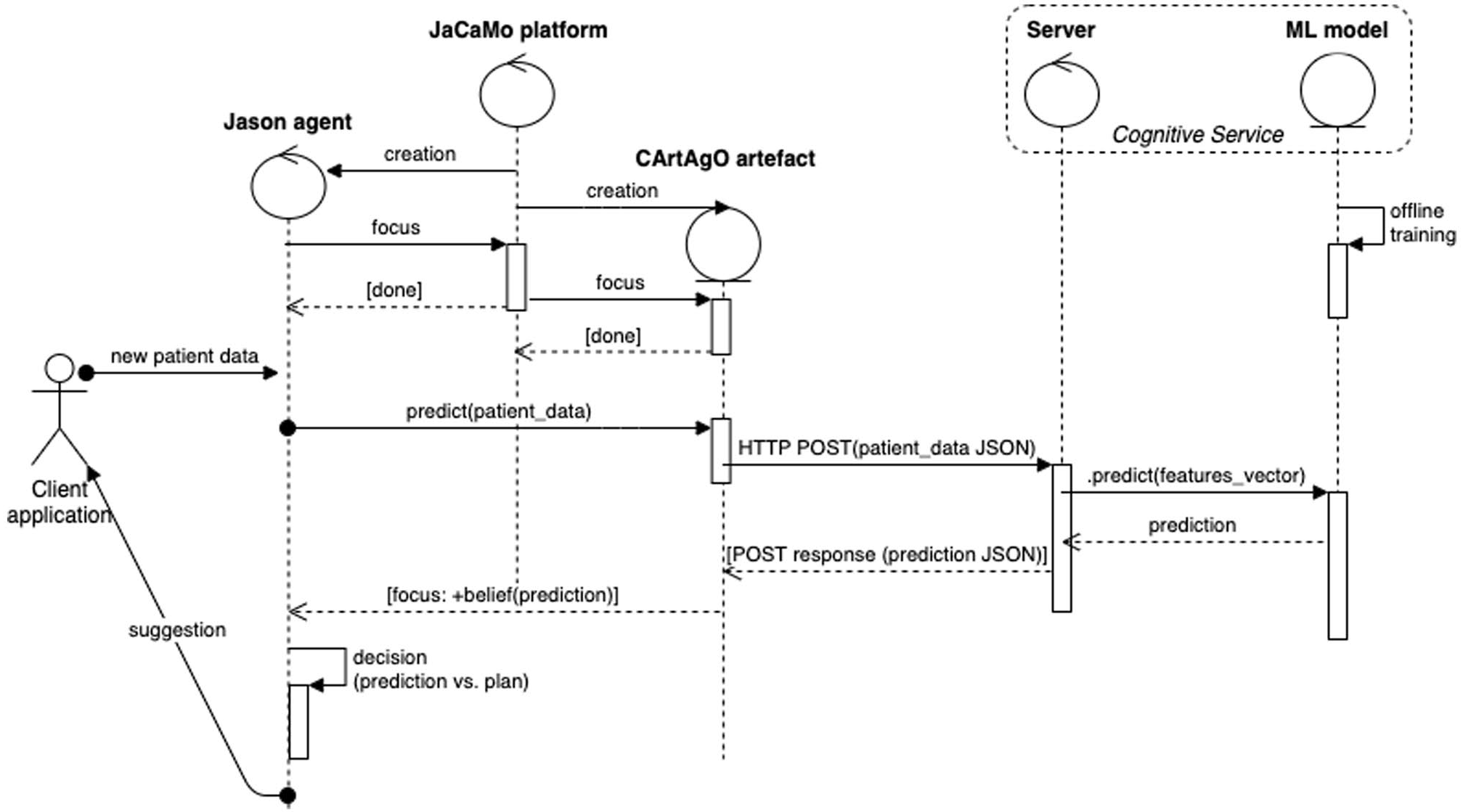
Instead of embedding ML directly into the agent’s logic (which makes the agent heavy and hard to update), they use a CArtAgO artifact as a bridge. This allows a Java-based agent to talk to a Python-based ML script asynchronously.
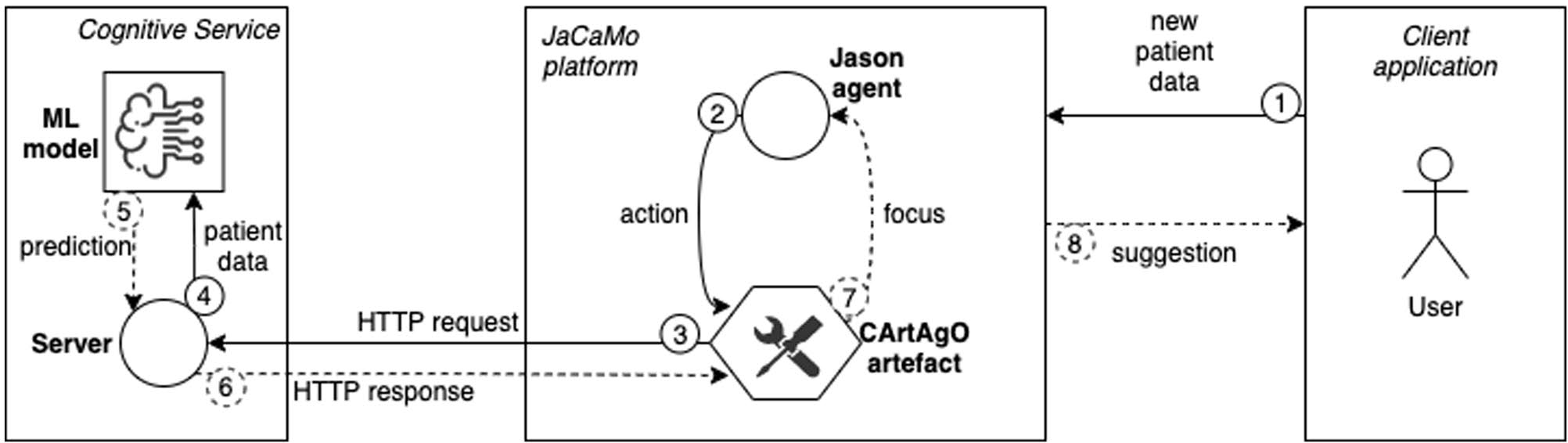
- Observation: Clinical data (GCS, blood pressure, etc.) enters the system.
- Insight Generation: The agent triggers the ML model via the artifact.
- Belief Update: The ML prediction (e.g., "Patient is Minor") is added to the agent's belief base.
- Arbitration: The agent checks if the prediction violates critical expert rules (e.g., "If GCS < 14, always alert Major Trauma"). If it violates safety, the agent overrides the ML.
Experimental Results: Tuning the Human-Machine Dial
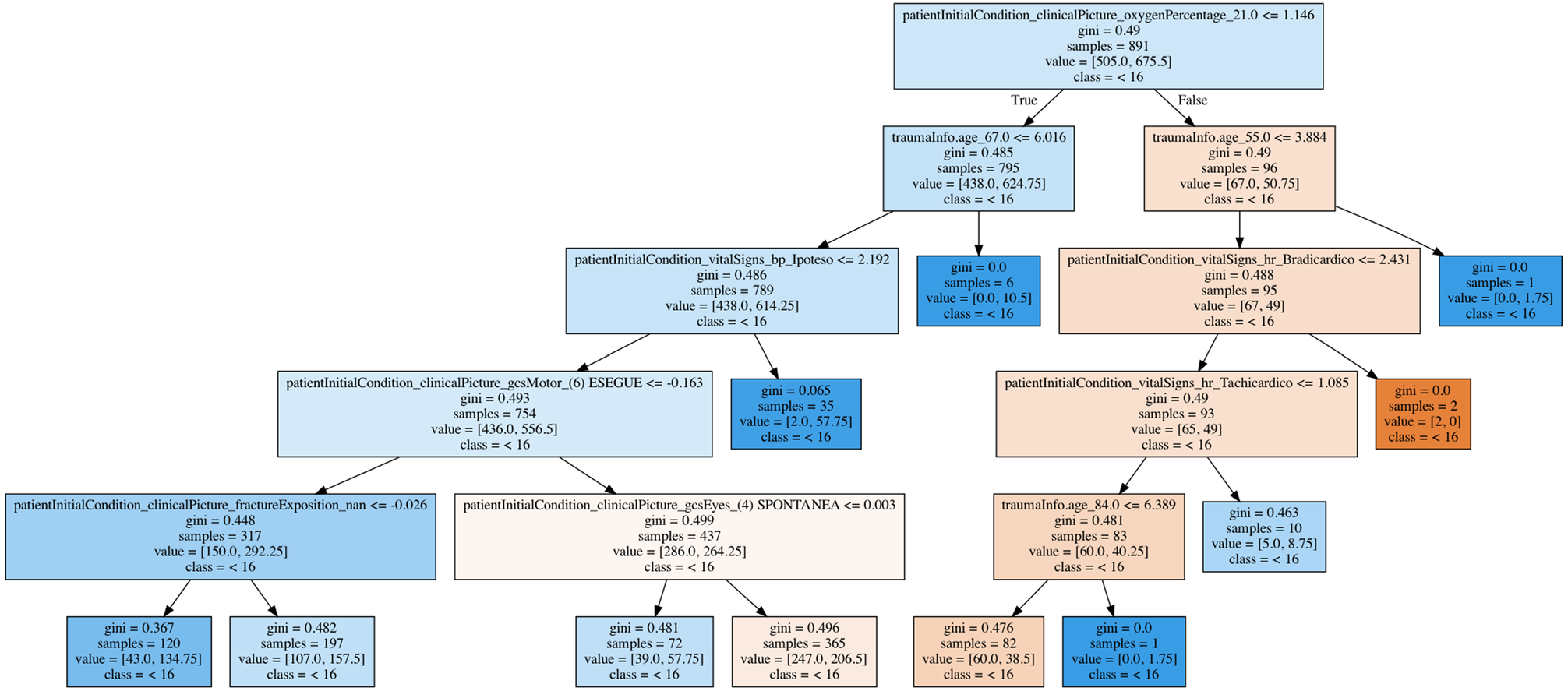
The team tested several models, eventually settling on a Decision Tree (pruned to depth 5) for its explainability.
| Comparison | Over-Triage Rate | Under-Triage Risk | F1-Score |
|---|---|---|---|
| Rules Alone | Extremely High | Very Low | Low |
| ML Alone | Low (46%) | Moderate (35%) | 0.62 |
| Integrated Prototype | Moderate (49.7%) | Low (31.1%) | 0.63 |
The integration represents a "sweet spot": it reduces the wasted resources of the rule-only approach while providing a safety net for the ML model's errors.
Critical Insight: The Arbiter is Key
The takeaway from this research isn't just that ML works in hospitals; it's that BDI agents are excellent managers for ML. By treating the ML model as an "external service" (an Artifact) rather than a master controller, clinicians can maintain the "human-in-the-loop" feel while benefiting from big-data patterns.
Limitations & Future Work
- Static Models: Currently, the ML model is trained offline. The authors aim to enable online training so the agent learns from current hospital outcomes in real-time.
- Explainability: While decision trees are transparent, the integration with more complex "black box" models (like Neural Networks) will require more robust XAI (Explainable AI) interfaces within the BDI framework.
Conclusion
This paper provides a blueprint for the next generation of Personal Medical Digital Assistants (PMDAs). It proves that we don't have to choose between "Rules" and "Data"—the synergy of the two significantly outperforms either alone in the chaos of the Emergency Room.