
Augmenting Trust: Can Your Social Circle Secure the Internet of Things?
Augmenting trust establishment in dynamic systems with social networks
The paper proposes the Social Augmentation Framework, a novel approach to bootstrapping trust in dynamic, pervasive computing systems by leveraging social network data. It specifically integrates social relationships (explicit and implicit) into the AREX adaptive security mechanism to accelerate trust convergence in large-scale environments like the Collaborative Virtual Observation (CoVO) system.
TL;DR
Establish trust in a sea of unknown mobile devices is notoriously slow. This paper proposes the Social Augmentation Framework, which uses your social connections and physical habits (implicit social networks) to "seed" trust algorithms. By narrowing down the pool of potential collaborators to those with "social skin in the game," the system achieves the speed necessary for real-time event reconstruction.
The Bottleneck of Distributed Trust
In pervasive computing—think of a smart city where your phone, a bus camera, and a shop's sensor collaborate—security is a nightmare. Most systems either rely on a central authority (which doesn't scale) or adaptive "game-theoretic" models like AREX.
The problem? In a city with 100,000 nodes, an adaptive algorithm takes forever to "learn" who is a liar and who is a truth-teller. By the time the trust is established, the event you were trying to observe (like a car accident) is long over. We need a way to cheat the cold-start problem.
The Insight: Social Behavior as an Implicit Filter
The authors argue that we shouldn't treat every node as a stranger. They categorize social links into two types:
- Explicit: Your contact list, Facebook friends, or professional network.
- Implicit: Your patterns. If a phone is consistently seen in the CS building from 9-5, Monday to Friday, it has a "physical presence" that makes it a more reliable candidate for a localized task than a random passing node.
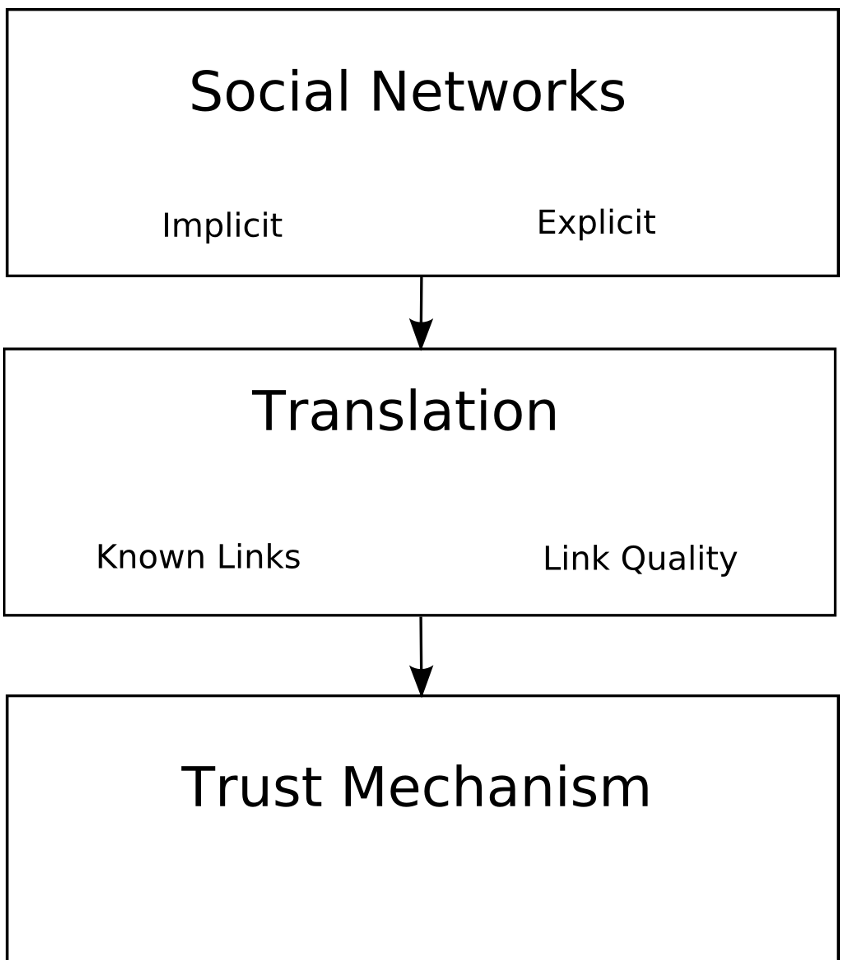
Methodology: The Three Pillars
The framework acts as a middleware between raw social data and the mathematical trust engine:
- Social Networks Layer: Aggregates data from diverse sources—web APIs, Bluetooth logs, or internal databases.
- Translation Layer: This is the "brain." It maps a social identity (e.g., a Facebook ID) to a technical address (e.g., an IP/MAC address) and assigns an initial "reputation weight" based on the strength of the relationship.
- Trust Mechanism (AREX): Instead of starting with a blank slate, the trust algorithm uses these weights to prioritize which nodes to query.
Case Study: Collaborative Virtual Observation (CoVO)
Imagine a crime happens. The fixed infrastructure (CCTV) has a blind spot. CoVO tries to "stitch together" video feeds from the smartphones of people nearby.
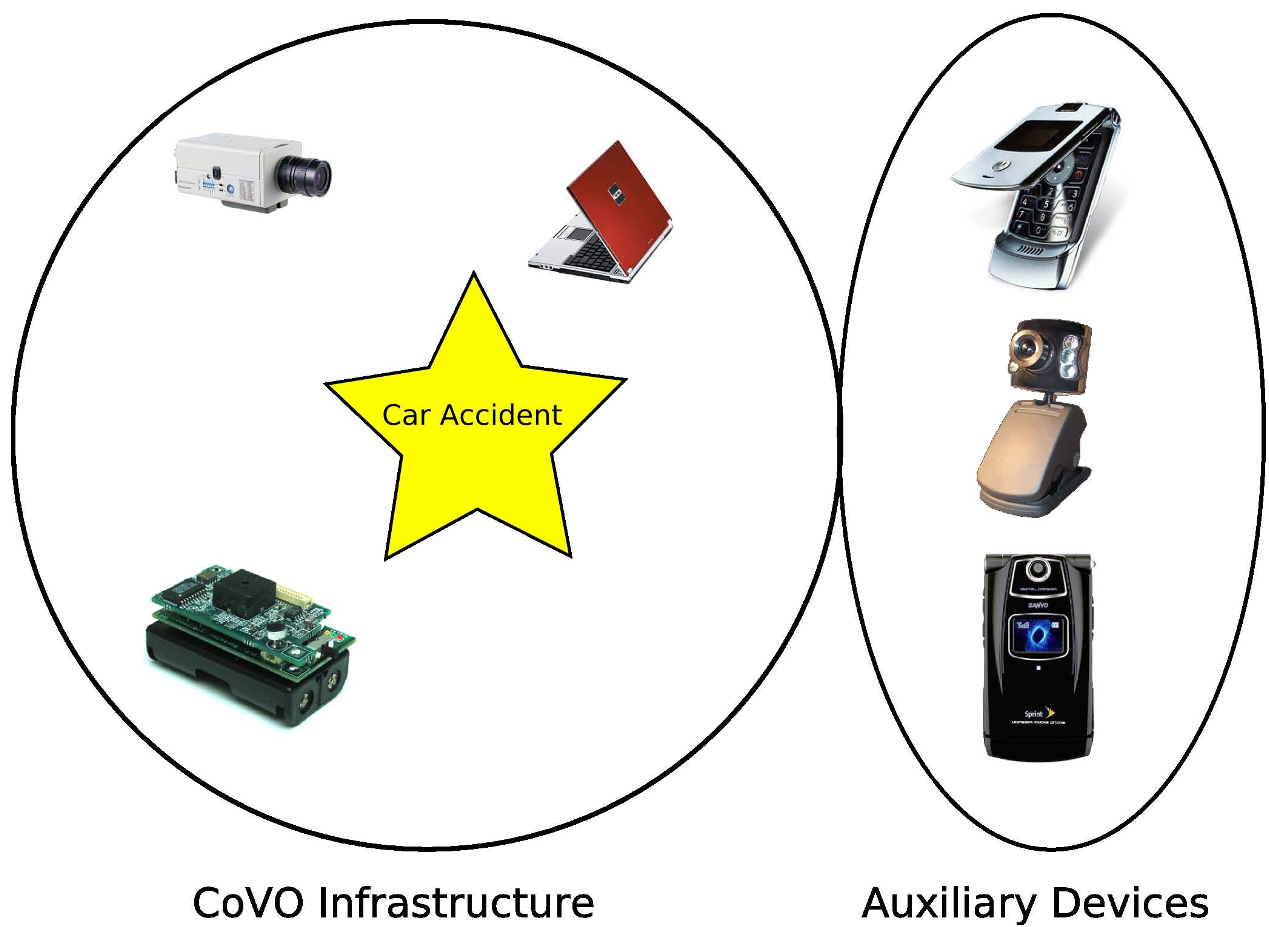
Without social augmentation, the system might try to fetch data from a malicious node designed to feed it "deepfake" or corrupt data. With social augmentation, the system prioritizes nearby phones belonging to people who "regularly frequent" that area, significantly increasing the probability of a successful, real-time reconstruction.
Deep Insight & Conclusion
The brilliance of this work lies in its recognition that security is a social construct. By using social-context-awareness, we can move away from the binary "Trusted vs. Untrusted" world into a more fluid, Bayesian world of "Socially Likely to be Stable."
The Limitation? The paper assumes that an attacker finds it "high cost" to maintain a consistent social pattern. In the era of modern AI and automated botnets, simulating "social consistency" is becoming cheaper. However, as a foundational concept for pervasive security, the Social Augmentation Framework remains a prescient look at how our human lives can be used to anchor our digital security.