
Dynamic Immersion: Augmenting VR through Socially-Driven Music Retrieval
Augmenting virtual-reality environments with social-signal based music content
The paper proposes a novel framework for augmenting Virtual Reality (VR) and gaming environments with personalized music content retrieved via Social Signal Processing (SSP) and Music Information Retrieval (MIR). By integrating user "loved tracks" from social networks like Last.fm and matching them to game-state variables (e.g., movement speed), the system achieves a dynamic, bio-adaptive auditory experience that enhances immersion.
TL;DR
Researchers have developed a framework that replaces generic video game music with your own "favorite tracks" from social media. By analyzing the Tempo (BPM) of your Last.fm library and matching it to the speed of the game in real-time, the system creates a deeply personalized and immersive experience that bridges the gap between Social Signal Processing (SSP) and Music Information Retrieval (MIR).
The Problem: The "Static Audio" Glass Ceiling
In the world of Virtual Reality, visual fidelity has skyrocketed, yet audio often remains a second-class citizen. Most games use a "one-size-fits-all" soundtrack. If you don't like the designer's choice, the immersion breaks.
While Dynamic Audio—music that changes based on game events—exists, it is usually restricted to a small pool of pre-recorded clips. The authors argue that for true immersion, the environment must adapt not just to the game state, but to the user's identity.
Methodology: The Web MIRVRES Framework
The core of this work is the Web MIR for VR Environment Service (Web MIRVRES). It connects three distinct fields:
- Music Information Retrieval (MIR): Extracting features like BPM and genre from raw audio.
- Social Signal Processing (SSP): Using social data (like "loved tracks") to infer what a user finds emotionally resonant.
- Affective Computing (AC): The future goal of mapping these signals to the user's current emotional state.
Process Flow
The system follows a sophisticated pipeline to ensure that the music "fits" the scene without manual intervention:
- Extraction: Accesses the Last.fm API to find the user's high-affinity tracks.
- Analysis: Uses the iTunes and Canoris APIs to download samples and calculate Beats Per Minute (BPM).
- Clustering: Applies K-Means clustering to group the user's library into intensity levels (e.g., 8 clusters for 8 speed levels).
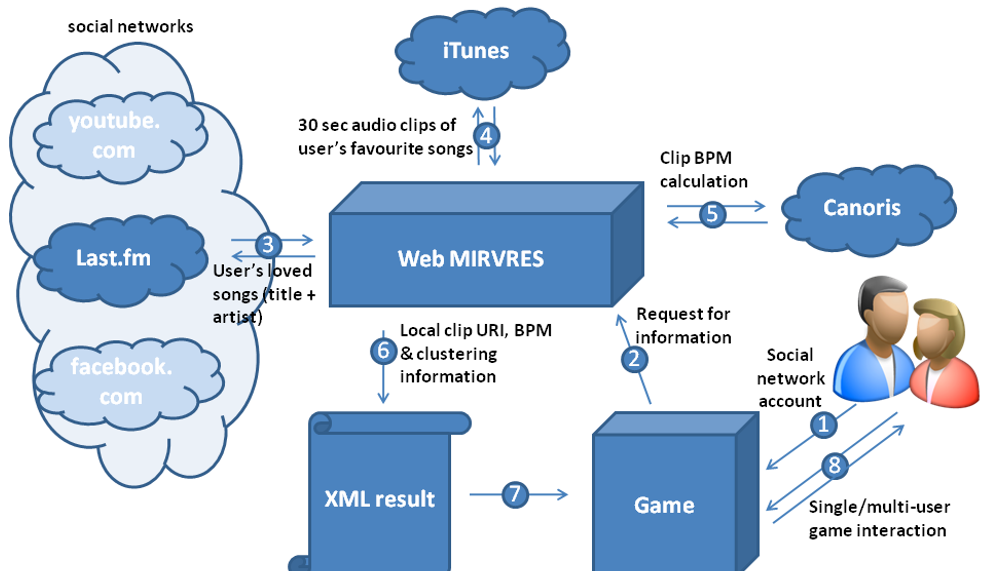 Figure 1: The architecture showing the handshake between the game engine and the Web MIRVRES service.
Proof of Concept: The "Arkanoid" Experiment
To test the theory, the authors adapted an open-source version of the classic game Arkanoid.
- Low Intensity: When the ball moves slowly, the system selects tracks from the low-BPM cluster (e.g., 70 BPM).
- High Intensity: As the score increases and the game speeds up, the system seamlessly transitions to high-energy, high-BPM tracks from the user's own library.
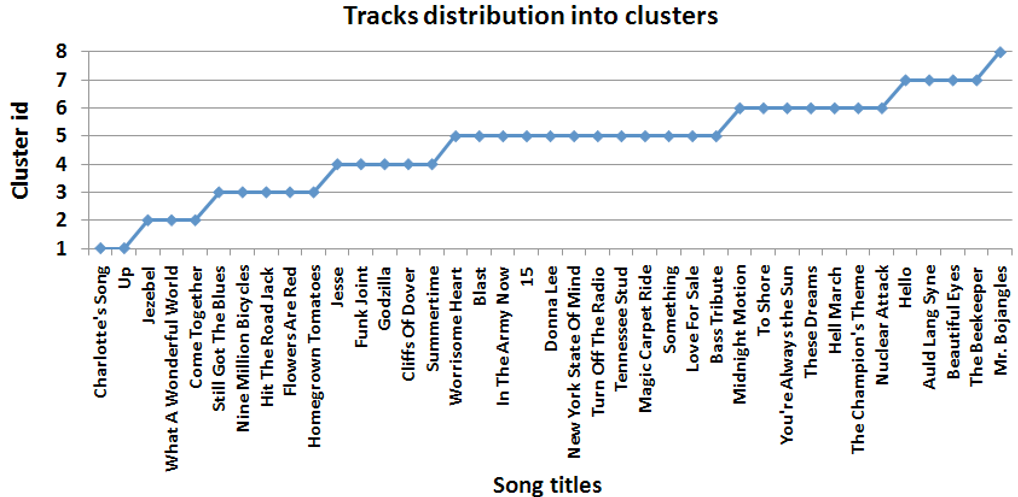 Figure 2: The distribution of user songs into clusters based on BPM for the demo run.
Critical Insight: Why This Works
The "Glass Ceiling" of content-based music similarity is a known issue in MIR—algorithms often fail to capture the "vibe" of a song. By using Social Tags (the "Loved" status in a social network), the framework bypasses the difficulty of objective quality assessment. It leverages the user's pre-existing emotional bond with the music, ensuring that the Inductive Bias of the audio design aligns perfectly with user preference.
Limitations and Future Work
While the proof-of-concept is successful, there are hurdles:
- Copyright & Streaming: Scaling this requires robust legal frameworks for streaming licensed content.
- Multi-user Conflicts: In a shared VR space, whose music do we play? The authors suggest future work will focus on music "negotiation" algorithms for multi-user environments.
Conclusion
This paper serves as a blueprint for the next generation of "Personalized VR." It shifts the role of the sound designer from content creator to rule-setter, where the designer provides the "emotional metadata," and the user's own social footprint provides the soul of the experience.
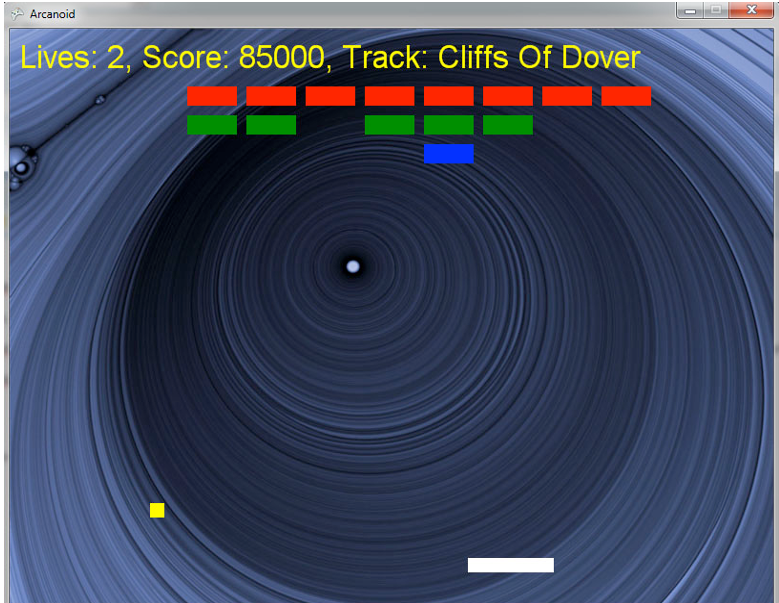 Figure 3: The adapted Arkanoid game selecting Eric Johnson's "Cliffs of Dover" (95 BPM) as game difficulty increases.