
Authenticatr: Bootstrapping App Security via Social Substrates
Authenticated out-of-band communication over social links
This paper introduces Authenticatr, a middleware framework that leverages existing social networking links (e.g., Facebook, Google Talk) as a substrate for authenticating out-of-band communication between host-based applications. It establishes a unified API to bootstrap secure channels for non-social applications like P2P file sharing and network troubleshooting.
TL;DR
Authenticatr is a framework designed to bridge the gap between social networking trust and host-based application security. By providing a unified API, it allows applications like BitTorrent or diagnostic tools to use social links (like friends on Facebook) to perform secure "out-of-band" signaling, key exchange, and peer discovery.
Background: The Balkanization of Trust
Despite the explosion of social networks in the late 2000s, user identities remained locked in digital silos. If you wanted to share a private file with a Facebook friend via a standalone P2P app, the app had no "knowledge" of your friendship. You were forced to manually create new passwords or use insecure public links. Authenticatr was born from a simple insight: Why not treat social networks as a universal authentication substrate?
The "Hourglass" Methodology
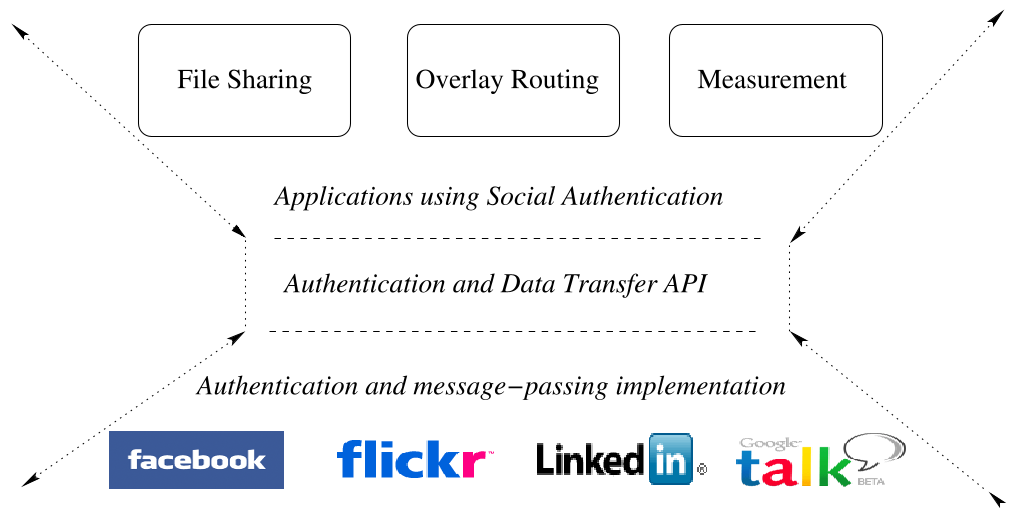
The brilliance of Authenticatr lies in its architectural simplicity. Borrowing from the "hourglass" design of the Internet Protocol, it introduces a middleware layer that sits between diverse social network APIs and diverse user applications.
1. Unified API
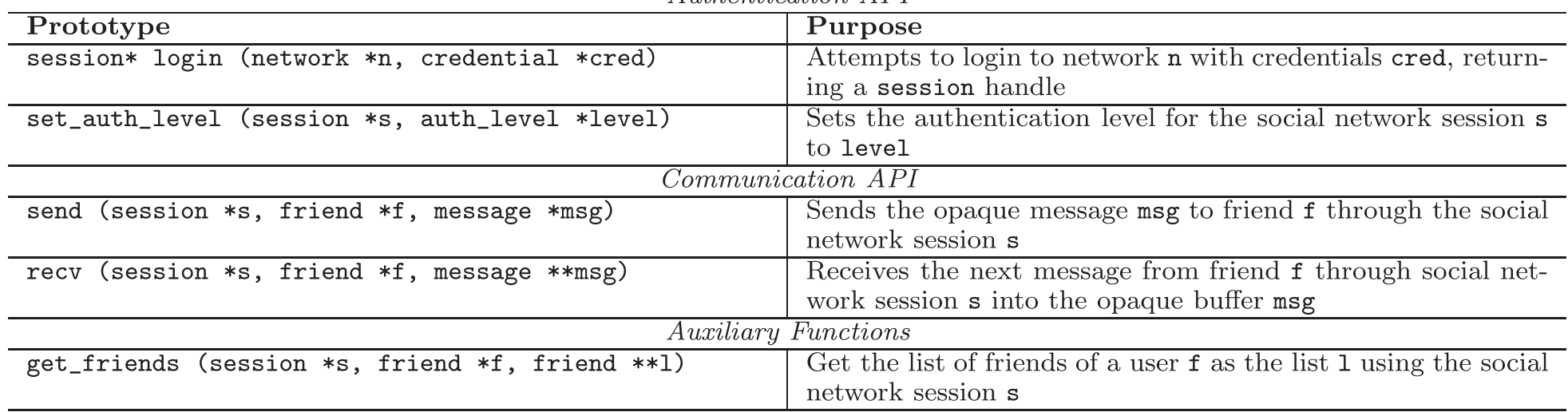
Instead of writing custom code for every social platform, developers use four core primitives:
login(): Authenticates against a provider (Facebook, G-Talk, etc.).set_auth_level(): Manages process-level permissions using bitmasks.send()/recv(): Transmits opaque data packets via the social network's internal messaging system.
2. The Middleware Layer
The middleware handles the heavy lifting of protocol translation (e.g., converting a send call into an XML-RPC request for a specific web service). It manages session tokens and maps them to OS-level process IDs, ensuring that a compromised application cannot easily hijack the entire social connection.
Real-World Utility: From Signaling to Encryption
How does this actually work in practice? The paper highlights two primary use cases:
- Secure Peer Discovery: Most users sit behind NATs with dynamic IPs. Typically, finding a friend's machine involves a third-party "tracker." With Authenticatr, your app can automatically send your current IP/Port to a friend’s "Inbox" on a social network. The friend's app polls the inbox and establishes a direct connection—no central tracker required.
- OOB Key Exchange: Traditional Diffie-Hellman key exchanges are vulnerable to Man-in-the-Middle (MITM) attacks if the communication path is untrusted. By sending the "Hello" and "Secret" messages through a TLS-secured social network (where identities are already verified), the risk of interception is drastically reduced.
Critical Perspective
Strengths
Authenticatr correctly identified that social pressure and authorization (accepting a friend request) are much more intuitive for humans than cryptographic certificate management. By piggybacking on existing SSL/TLS connections provided by social giants, it offers "security for the masses."
Limitations & Evolution
The paper, written in 2008, acknowledges the "single login" limitation—many social networks back then disconnected you if you logged in from a second location. Today, we face a different challenge: Privacy and Data Sovereignty. Modern social networks are more restrictive with their APIs. However, the core concept has evolved into modern "Login with..." buttons and the decentralized identity movement (DID), where the social graph remains a powerful tool for sybil-resistance.
Conclusion
Authenticatr was a visionary attempt to turn social networks into a utility for the broader Internet. Its legacy remains in any application that uses "social proximity" as a metric for trust, proving that the strongest security isn't just about math—it's about the humans behind the screens.