
Beyond Passwords: The Power of Multi-level Social Authentication
Authentication Using Multi-level Social Networks
This paper proposes a multi-level social authentication framework designed as a backup for two-factor systems. By maintaining a hierarchical "helper list" on a central server, it automates the vouching process and achieves high robustness through a progressive fallback mechanism ending in self-authentication via life questions.
TL;DR
When you lose your hardware token or forget a complex password, who do you turn to? This paper introduces an automated Multi-level Social Authentication Framework. It moves social vouching from a manual "call a friend" process to an automated, server-side system that leverages your social hierarchy—from family to acquaintances—to verify your identity through mobile-encrypted feedbacks.
The "Lost Token" Crisis: Why Traditional Factors Fail
Security is usually a trade-off. Two-factor authentication (2FA) is secure but fragile:
- Hardware Tokens: Easily lost or broken.
- Biometrics: Temporarily hindered by a sore throat or a bandaged finger.
- Static Passwords: Socially "hackable" or or simply forgotten.
Previous "Social Authentication" attempts required users to manually collect tokens from friends. This paper identifies the core problem: Unreliability. If your one designated helper is sleeping or busy, you are locked out.
The Solution: A Hierarchical Human Network
The authors propose a Multi-level Helper List stored securely on an Authentication Server (AS). The core "Insight" is that not all social ties are equal. They categorize helpers into levels based on Affinity:
- Level 1 (Self): Life questions (The ultimate fallback).
- Level 2 (Relatives): High affinity, providing high "credential magnitude."
- Level 3 (Buddies): Close friends.
- Level 4 (General Friends): Lower affinity, requiring more participants to reach a quorum.
System Architecture & Protocol
The framework involves a four-party dance: the User, the Authentication Server, a Mobile Phone Server, and the Helpers.
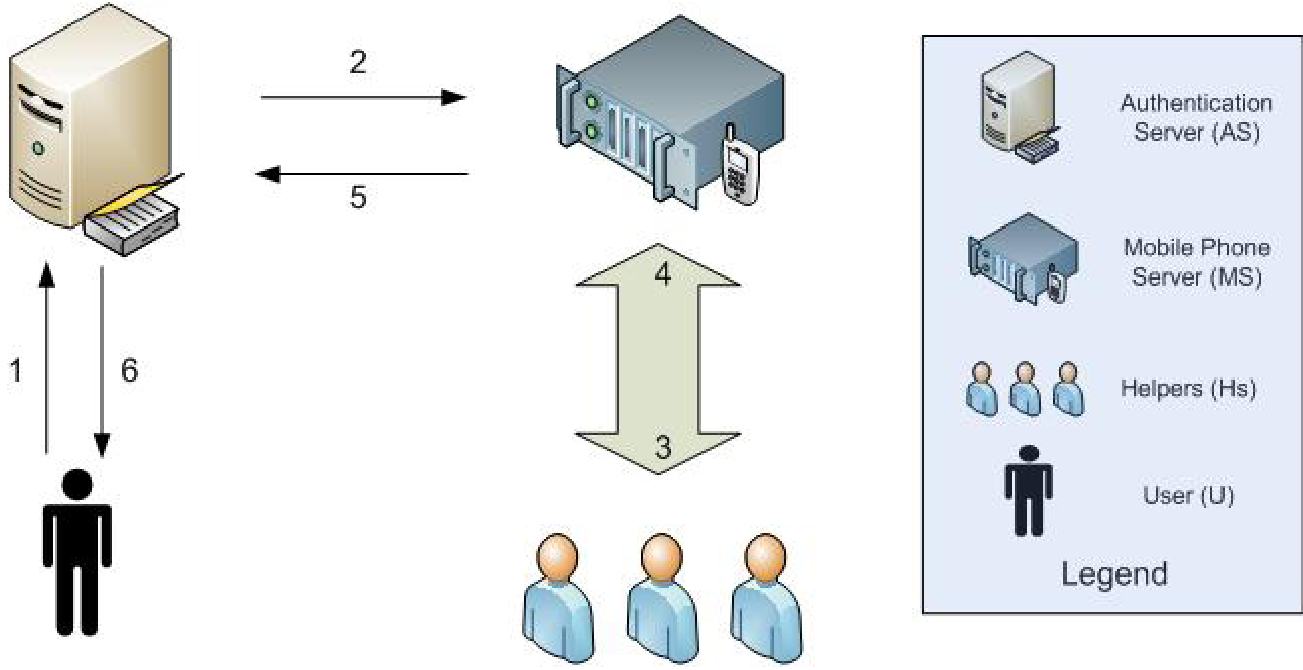
The protocol uses Asymmetric Encryption to ensure that helpers can only vouch for a user they truly identify, and that the "feedback" cannot be intercepted or spoofed.
Methodology: The Math of Trust
The system doesn't just count heads; it weights them. The authors introduce authentication functions to calculate if a user has met the "trust threshold."
For example, if Level 4 (General Friends) fails after a few tries, the server automatically moves up the hierarchy. This "Majority Vote" logic ensures that even if some friends ignore their phones, a subset of responses can still unlock the account.
| Level | Selection Count | Trust Logic |
|---|---|---|
| Level 2 | 2 Helpers | High magnitude per person |
| Level 4 | 4 Helpers | Requires 3/4 majority |
Real-World Performance & Optimization
The most critical metric for any authentication system is Latency. How long does the user wait?
The authors analyzed three situations:
- Single Level Success: User is verified at the first level tried.
- Cross-Level Success: Server joins feedbacks from multiple circles.
- Self-Authentication: Fallback to life questions.
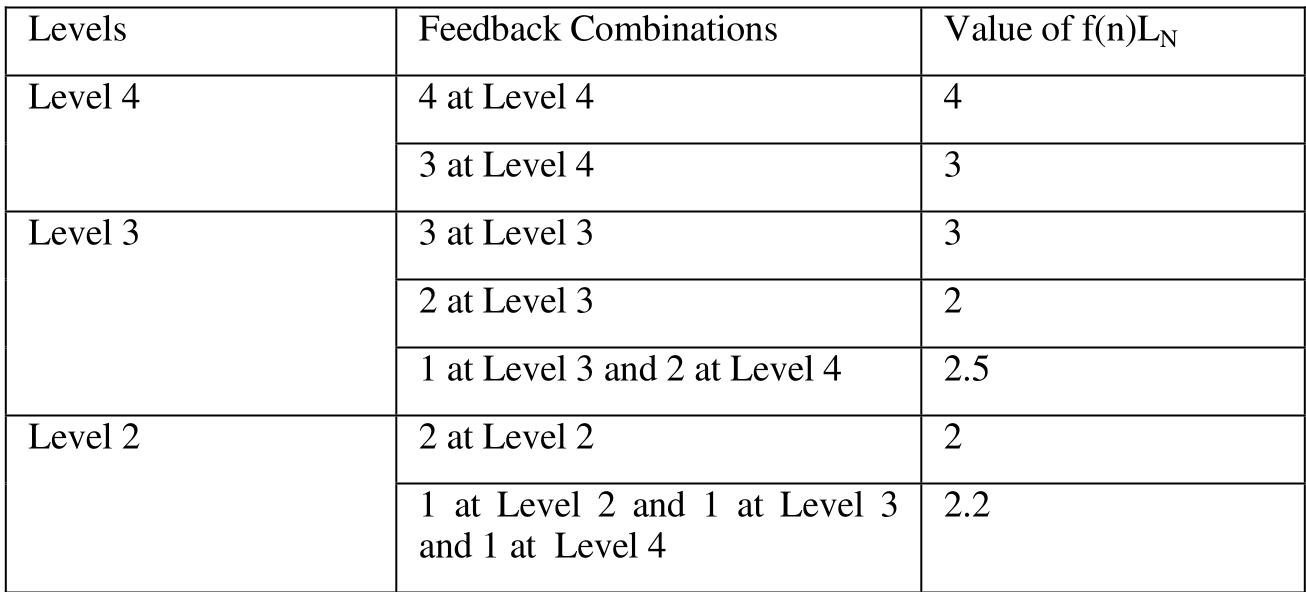
By establishing a relationship where the Waiting Time () is strictly seconds, the authors proved the authentication time could be slashed from a frustrating 8.3 minutes down to just 3.6 minutes.
Critical Analysis: Is it Secure?
The paper tackles several attack vectors:
- Impersonation: An attacker would need the user's phone, PIN, username, and password simultaneously—a mathematical "small probability event" .
- Helper Sabotage: To force someone into the vulnerable "Life Question" mode, an attacker would have to steal or disable at least 25 different phones from the user's helper list.
- Man-in-the-Browser: Mitigated by sending duplicate notifications to the user's mobile device during the vouching process.
Future Outlook
While the framework is robust, its reliance on a central server and SMS/Mobile networks is its Achilles' heel. Future iterations could benefit from Decentralized Identifiers (DIDs). However, as an enterprise or banking recovery solution, this multi-level approach offers a much-needed safety net for the 2FA era.
Takeaway: Your social network is more than just a list of friends; it’s a tiered security asset that can bridge the gap when technology fails.