
Deciphering the Digital Persona: Predicting Gender and Dialect through Deep Learning
Author Profiling: Prediction of Gender and Language Variety from Document
This paper explores Automatic Authorship Identification (AAI) specifically focused on Author Profiling for gender and language variety prediction using the PAN 2017 Twitter dataset. The authors evaluate multiple architectures, identifying Bag-of-Words (BoW) as the superior approach for gender classification and a hybrid LSTM-CNN model for multi-class language variety identification.
Executive Summary
TL;DR: This study tackles the growing complexity of Author Profiling—the art of predicting an author's demographics from their writing style. By utilizing the PAN 2017 Twitter dataset, the researchers demonstrate that while traditional Bag-of-Words (BoW) models still hold ground in gender classification, the intricate nuances of regional language varieties are best captured by a hybrid LSTM-CNN architecture, which achieved an impressive 83.3% accuracy in identifying six English language varieties.
Background: Within the broader field of Automatic Authorship Identification (AAI), Author Profiling stands as a critical tool for forensics and targeted marketing. This work bridges the gap between classic linguistic feature engineering and modern deep learning methodologies.
The Challenge: Noisy Data and Subtle Dialects
Social media data is notoriously "messy." Between hashtags, emojis, URLs, and region-specific slangs, standard NLP tools often fail to capture the underlying patterns of an author's identity. The authors identify two core problems:
- Ambiguity: Human language is unstructured and full of dialects.
- Multiclass Complexity: While gender is a binary task, language variety involves distinguishing between subtle differences (e.g., Great Britain vs. Ireland vs. Canada), requiring models that can perceive both local word patterns and long-range stylistic dependencies.
Methodology: The Architecture of Identity
The authors propose a multi-stage pipeline:
- Custom Preprocessing: Beyond standard tokenization, they implemented a strict filtering process for tweets, including the removal of URLs, mentions, and specific stopword handling to preserve sentence meaning (avoiding the removal of negation words like "not").
- Feature Representation: Transitioning from TF-IDF for machine learning models to word embeddings for deep learning blocks.
- Hybrid Modeling: The standout approach is the LSTM-CNN pipeline. The LSTM layer processes the sequence to understand context, while the subsequent CNN layer acts as a feature extractor to identify "key phrases" or local patterns specific to a dialect.
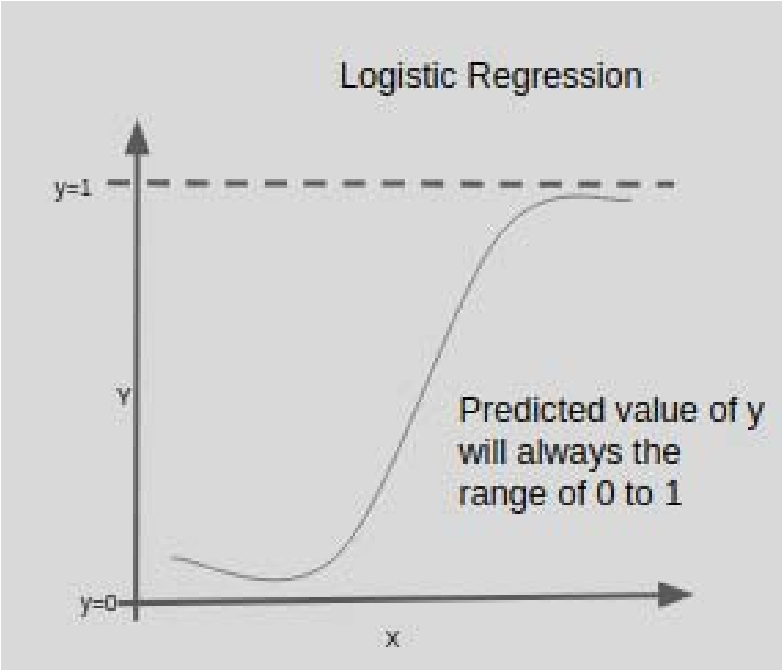 In gender prediction, the simplified Bag-of-Words approach Surprisingly provided the most stable performance.
Experiments and Insights
The research evaluated several models, including Logistic Regression and Random Forest, against Deep Learning variants.
Key Results:
- Gender Prediction: The Bag-of-Words (BoW) model reigned supreme with a test accuracy of 78.89%. This suggests that gendered writing may rely more on specific vocabulary choices rather than complex sequential structures.
- Language Variety: This is where the LSTM-CNN architecture shined. It achieved 83.3% accuracy, nearly doubling the performance of basic Logistic Regression (48.27%).
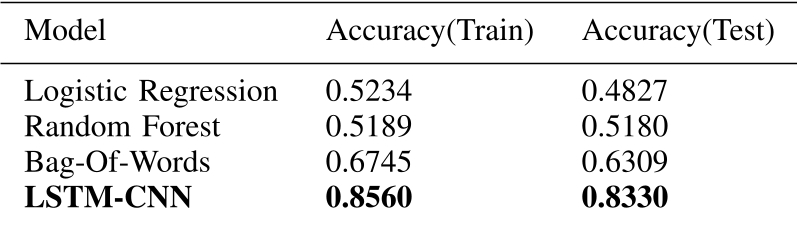 The massive jump in accuracy for LSTM-CNN highlights its superior ability to model the "texture" of regional dialects.
Critical Analysis & Conclusion
This paper reinforces a vital lesson in NLP: Model selection must be task-specific.
- For binary stylistic traits like gender, frequency-based models (BoW) remain robust and computationally efficient.
- For multi-class, high-nuance tasks like regional variety identification, the inductive bias of LSTMs (for sequence) and CNNs (for local features) provides a significant performance "floor" that simple linear models cannot reach.
Future Outlook: While the results are promising, the next frontier involves the use of Large Language Models (LLMs) and Transformers. These models could potentially unify both tasks without specialized pipelines, though the computational cost vs. the efficiency of the LSTM-CNN presented here remains a key trade-off for real-world forensic applications.