
The Lost Match: Why Your Scientific Keywords Are Failing Information Retrieval
Are they a perfect match? Analysis of usage of author suggested keywords, IEEE terms and social tags
This study evaluates the alignment between author-suggested keywords, professional controlled vocabularies (IEEE Thesaurus), and social tags (Mendeley) in technical scientific literature. Focusing on papers from the Faculty of Electrical Engineering and Computing in Zagreb, it identifies a significant disconnect between "freely formed" natural language and standardized indexing terms.
TL;DR
Even in the highly structured world of IEEE publications, a significant "terminology gap" exists. Research shows that authors rarely use the professional controlled vocabularies (Thesauri) recommended by publishers, opting instead for natural language that limits their work's discoverability. Furthermore, social tags on platforms like Mendeley are currently too idiosyncratic to solve this retrieval problem.
Background Positioning
This study serves as a critical audit of the Academic Metadata Pipeline. It sits at the intersection of Information Science and Technical Writing, questioning whether the tools designed for "perfect searchability"—like the IEEE Thesaurus—are actually being used by the scientists they are meant to serve.
The Pain Point: The Chaos of Natural Language
The core problem in information retrieval is the inherent complexity of natural language, characterized by synonyms (different words for one concept) and homonyms (one word for different concepts).
While authors think they are describing their work accurately, their "freely formed" keywords often:
- Lack hierarchy and relational context.
- Fail to include broader terms that would help non-experts find the paper.
- Rely on ephemeral jargon that may not be used in database queries five years later.
Methodology: A Triple Correlation Study
The author, Dina Vrkić, analyzed papers from the University of Zagreb indexed in the IEEE/IET Electronic Library. The study compared three distinct "layers" of metadata:
- Author Suggested Keywords (ASK): The "Natural Language" layer.
- IEEE Terms: The "Controlled Vocabulary" layer (using the IEEE Thesaurus with 9,600+ descriptors).
- Mendeley Tags: The "Social/Folksonomy" layer.
The Comparison Framework
The researcher analyzed the overlap between these layers, specifically looking for identical terms or related terms (singular vs. plural, full name vs. abbreviation).
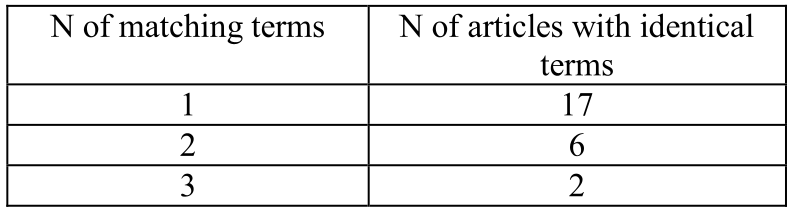 Table: The low number of identical terms between Author Keywords and IEEE Index Terms.
Key Insights: Why the "Perfect Match" Failed
1. The Professional Disconnect
The study found that in 25 papers, the terminology only minorly coincided with suggested IEEE keywords. Most authors are simply unaware of the IEEE Author Digital Toolbox or the specific Taxonomy provided by the publisher.
2. The Failure of Social Tags
One might expect social tagging (folksonomy) to bridge the gap by providing modern, "crowdsourced" keywords. However, the data showed that Mendeley tags were often "meaningless to a wider audience," consisting of personal organization labels like "tech" or "folder 5" rather than scientific descriptors.
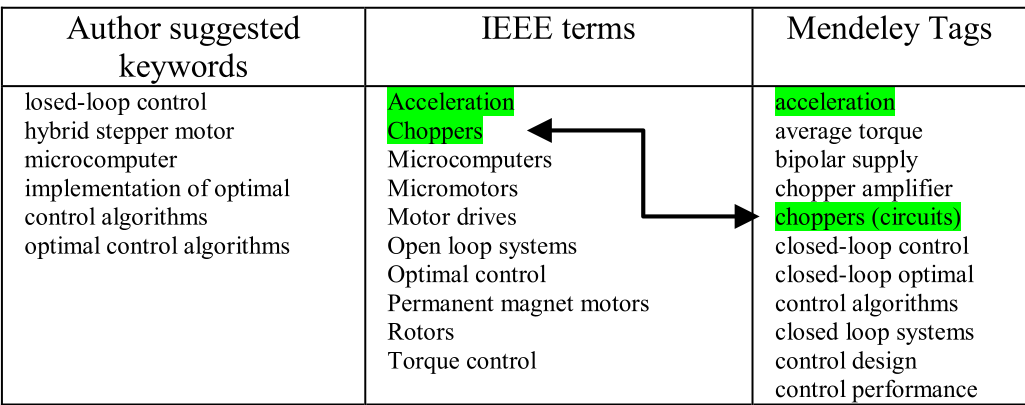 Table: Comparison of terms for a single article (Code N.30) showing the divergence between author intent, professional indexing, and user tagging.
Critical Analysis & Conclusion
Takeaway for Researchers
Visibility is not just about the Impact Factor of a journal; it is about the Indexability of the paper. By ignoring controlled vocabularies, authors are effectively hiding their research from standardized search queries.
Limitations and Future Outlook
While this study provides a clear snapshot of the issue, it focuses on a specific faculty (FER). However, the "jargon-heavy" nature of Electrical Engineering and Computing makes this a representative case study for technical sciences.
Looking Forward: The future of solving this mismatch likely lies in Automated Indexing. If authors won't use thesauri, AI-driven middleware must map their natural language keywords to controlled taxonomies in real-time during the submission process to ensure the "perfect match" finally happens.
Final Thought
Keywords are more than a requirement; they are the "viral part" of a scientific paper. If you want your research to stay relevant, start thinking like an indexer, not just a writer.