
Elevating Tutors via the Crowd: How Student Data Builds Expert Knowledge Bases
Authoring Expert Knowledge Bases for Intelligent Tutors through Crowdsourcing
This paper introduces the Evolving Expert Knowledge Base (EEKB), a methodology for automatically constructing domain models for Intelligent Tutoring Systems (ITS) through crowdsourcing student actions. Applied within the "Rashi" inquiry learning system, the method leverages collective student data to coalesce a probabilistic domain model that rivals human-crafted versions.
TL;DR
Developing the "brain" of an Intelligent Tutoring System (ITS) used to be a grueling manual process involving hundreds of hours of expert interviews. This paper presents a paradigm shift: The Evolving Expert Knowledge Base (EEKB). By treating students as a "distributed sensor network," the authors' algorithm automatically distills high-quality domain models from student actions, achieving 90% precision compared to human experts while slashing development costs.
The Bottleneck of Expertise
The core of any ITS is its Expert Knowledge Base (EKB). In ill-defined domains like Human Biology or Art History, these models act as the compass for coaching. However, building them is a notorious "knowledge engineering bottleneck."
The authors argue that the traditional approach—painstakingly interviewing experts—is not only slow but may produce models that are "too perfect" or out of sync with how students actually explore a problem. Why build 100% of a domain if students only ever interact with 25%?
Methodology: The Power of Collective Intelligence
The authors integrated their knowledge acquisition algorithm into Rashi, a well-vetted inquiry learning system. As students evaluate virtual patients and link evidence to hypotheses, the system monitors their "notebooks."
The Multi-Student Synthesis
The algorithm doesn't just record data; it coalesces it:
- Node/Edge Handlers: Distinct methods analyze evidence for concepts (nodes) and the relationships between them (edges).
- Probabilistic Confidence: Every entry in the EEKB is assigned a confidence score based on the frequency and consistency of student actions.
- Unified Graph Construction: Redundant or related topics are automatically merged to form a single, coherent domain map.
 The mathematical framework for Precision and Recall ensures that the generated model is both accurate (Precision) and comprehensive (Recall) relative to human standards.
Experimental Results: Precision Over Saturation
The study analyzed 5 years of data from four medical cases across a diverse student demographic.
- 90% Precision: The students were remarkably accurate. The knowledge they "created" matched the human expert's model with high fidelity.
- The Saturation Decline: Interestingly, as the knowledge base reached a "saturation point," precision began to dip slightly—suggesting that marginal student input may introduce noise once the core concepts are established.
- The Recall Reality: While 23% recall seems low, the authors provide a vital insight: students typically only explore 15-25% of a human-crafted model anyway. The EEKB is "leaner" and more representative of actual learner pathways.
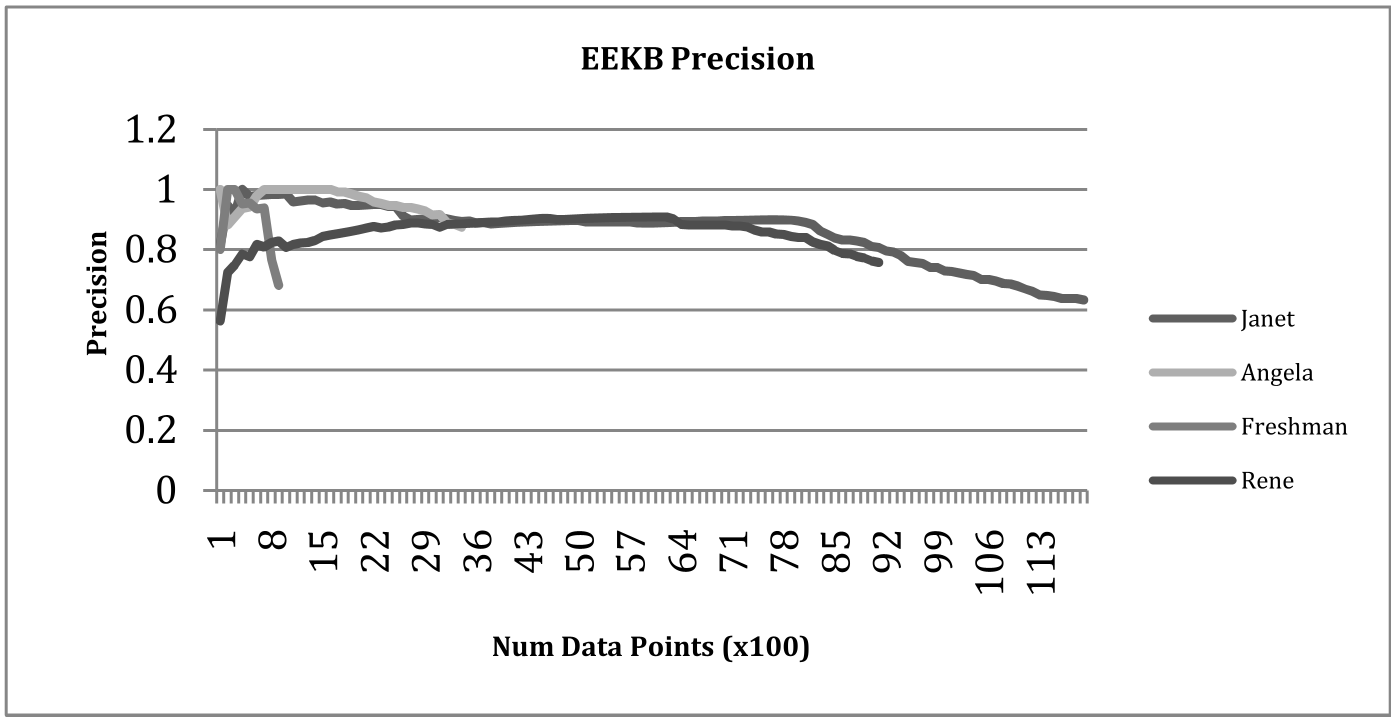 Figure 1: Precision remains high and stable as more student evidence is introduced.
Critical Analysis & Conclusion
The Takeaway: This research proves that we can turn a byproduct of learning (student log data) into a primary resource for system development. By leveraging the high student-to-teacher ratio, we can "parallelize" the creation of complex domain models.
The Hybrid Future: While the authors suggest that EEKB might be the best way to converge on relevant models, a potential limitation is the cold-start problem (you need students to build the model, but you need a model to tutor the students). The most likely future path is a hybrid one: a "seed" model provided by experts that is then expanded and refined autonomously by the student "crowd."
Future Outlook: Transitioning this from medical cases to even more abstract domains (like ethics or creative writing) will be the true test of the EEKB's flexibility. For now, it stands as a major step toward democratizing and accelerating the creation of intelligent educational tools.