
Decoupling Intelligence: Empowering Content Experts to Script the AI of Educational Games
An Authoring Tool for Intelligent Educational Games
This paper presents an AI authoring environment designed for the RENAISSANCE project, featuring a frame-based production rule system as the core "Evaluation Engine." It enables non-programmers to encode complex social behaviors into an educational 3D game using the CLOS-i framework and a modified RETE algorithm.
TL;DR
This paper introduces a specialized AI authoring environment for the RENAISSANCE project, a 3D multi-user game simulating 14th-century social life. By combining frame-based hierarchies with a production rule system, the authors provide a graphical interface that allows non-programmers to "script" complex social behaviors and evaluate player actions in real-time.
Status: This work represents a significant bridge between symbolic AI and interactive entertainment, positioning itself as a pioneer in "Editorial-driven AI."
Problem & Motivation: The Bottleneck of "Hard-Coded" Intelligence
In the realm of educational games, the "intelligence" isn't just about pathfinding or combat; it’s about pedagogy and cultural accuracy. Historically, if a content expert (e.g., a historian) wanted to change the social consequences of a player's action, they had to go through a developer.
The authors identified several key pain points:
- Complexity of Social Rules: Modeling the "Book of Courtier" requires subtle, hierarchical logic (e.g., a "Dinner" is a type of "Activity" with specific attendance rules).
- Lack of Specialized Tools: Most AI systems lacked a clear separation between the game's rendering engine and its semantic evaluation logic.
- The "Naïve User" Gap: Content experts have the knowledge but lack the skills in Lisp or C++ to implement it.
Methodology - The Core: CLOS-i and Rule-Frame Integration
The heart of the system is the Evaluation Engine, built on CLOS-i (a light knowledge representation layer over Common Lisp). Unlike traditional systems (like OPS5) that match rules based on flat symbols, this system performs terminological pattern matching.
The Hybrid Architecture
The system integrates two powerful paradigms:
- Frame System: Handles the "is-a" relationships (e.g., a
courtieris a type ofcharacter). - Production Rules: Handles "if-then" triggers (e.g., if it's 10 AM, schedule a dinner).
By using a modified RETE algorithm capable of traversing frame hierarchies, the engine can fire rules based on specific entity relationships.
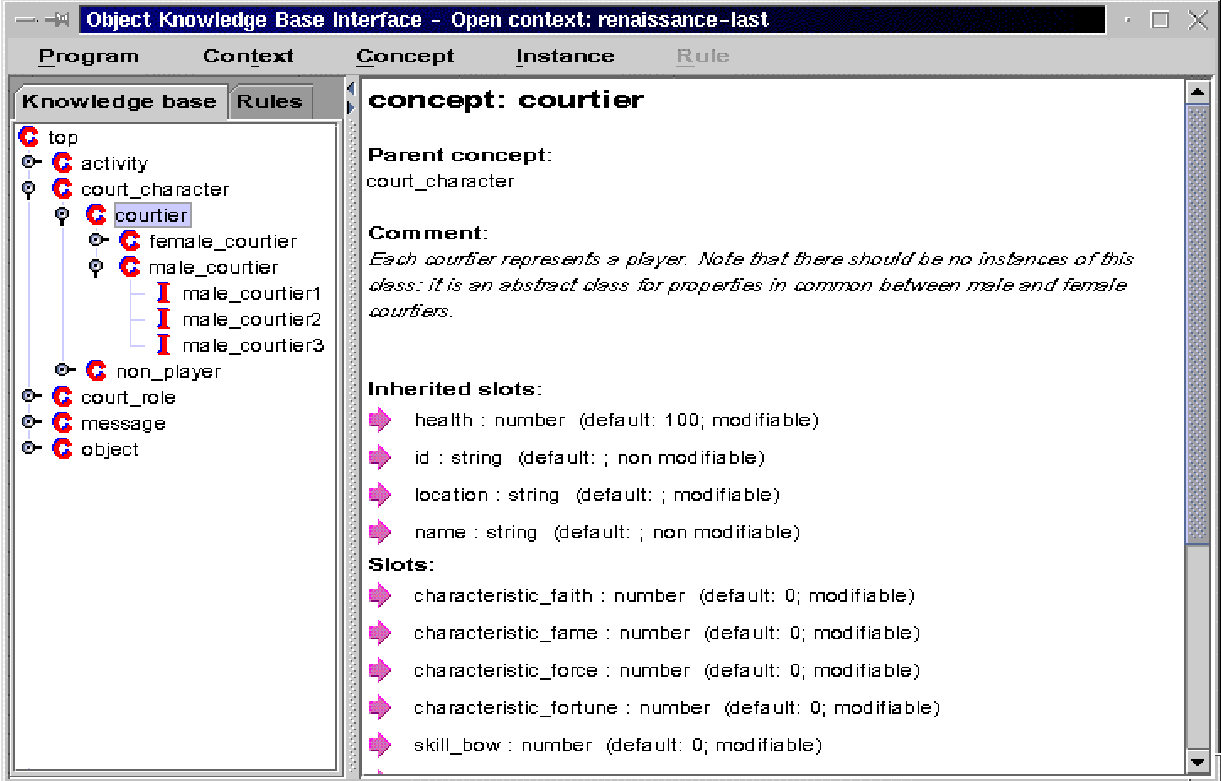 Figure 1: The KBE interface allows editors to define frames (left) and their properties/slots (right) without writing a single line of code.
Communicating via KQML
To maintain independence, the Engine communicates with the Virtual Community Server (VCS) using KQML (Knowledge Query and Manipulation Language). This protocol-based approach ensures that the "semantic world" stays in sync with the "visual world" across the network.
Authoring and Testing: KBE & KBS
The innovation lies in the Authoring Environment, consisting of two primary tools:
- Knowledge Base Editor (KBE): A graphical tool to build the hierarchy. It features automated consistency checks—for example, preventing "dangling frames" by only allowing the creation of children from existing parents.
- Knowledge Base Shell (KBS): Once the rules are written, editors need to see them in action. The KBS acts as a "Game Simulator," allowing users to inject events (like "set_time 10:00") and monitor exactly which rules fire and how the fame/fortune of players change.
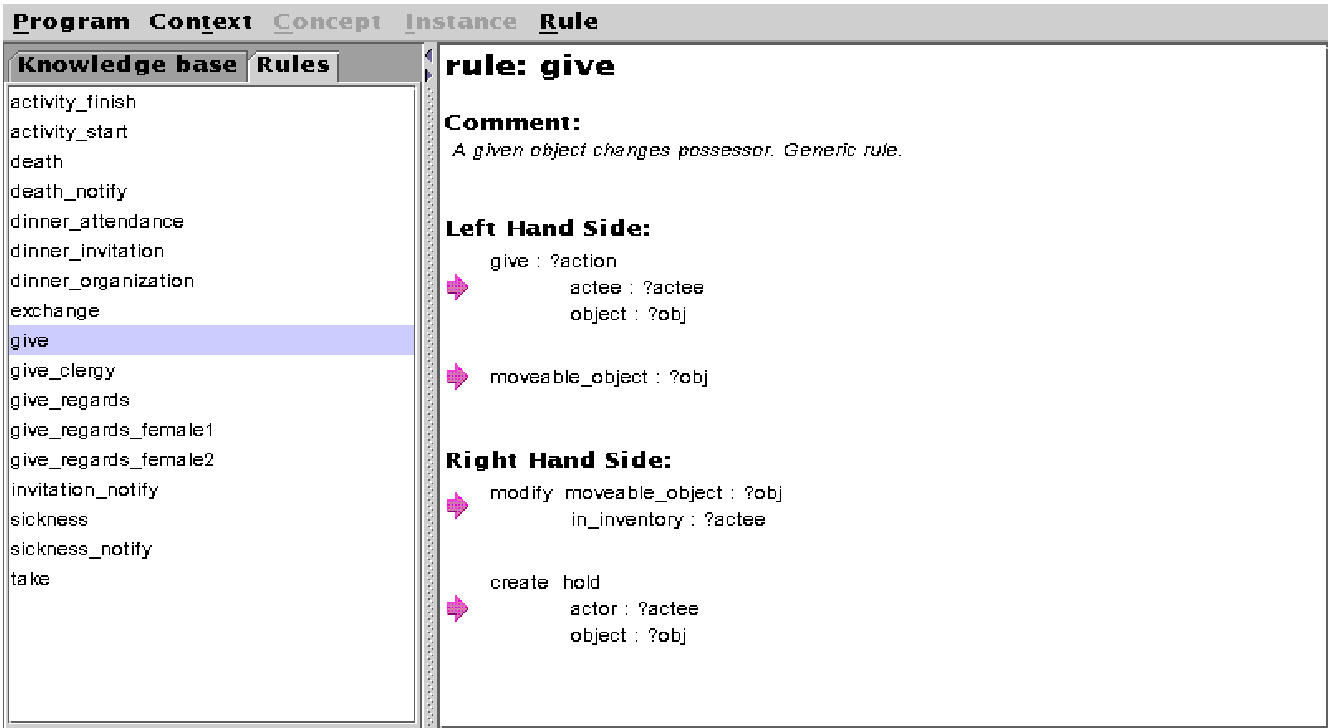 Figure 2: The KBS interface allows technical staff to monitor rule-firing and instance changes in real-time, effectively debugging the game's "social logic."
Experiments & Results: Simulating the Renaissance Court
The authors demonstrated the system's efficacy by modeling specific historical social scenarios, such as the Duke's Evening Dinner.
- The Workflow: An editor defines a
dinnerframe inherited fromactivity. They create a ruledinner_organizationthat triggers at 10 AM, and aninvitationrule for any courtier with >500 fame. - Validation: Through the KBS, editors could verify that courtiers who failed to attend the dinner correctly lost 100 points of fame, proving the engine could handle both event-driven triggers and persistent state management.
The use of the RETE algorithm ensured that even as the number of courtiers and rules grew, the performance remained efficient enough for an online multi-user environment.
Critical Analysis & Conclusion
Takeaway
The RENAISSANCE project proves that Declarative/Symbolic AI is uniquely suited for domains where logic must be human-readable and subject to frequent editorial changes. By providing a "safe" buffer between programmers and content creators, development cycles are shortened, and the resulting game is more semantically rich.
Limitations
- Scaling Cognitive Complexity: While production rules are intuitive for simple triggers, managing hundreds of interacting rules can lead to "rule spaghetti" if not carefully architected.
- Fixed Hierarchies: The rigid inheritance of frames may be too restrictive for more fluid, modern RPG mechanics where characters often defy strict categorization.
Future Outlook
As games move toward procedurally generated narratives, the principles established here—separating the semantic world model from the simulation engine—will become the gold standard. In the future, we may see these frame systems integrated with LLMs to provide both "hard" social rules and "soft" conversational intelligence.