
Who Wrote This? Unmasking Social Media Impostors through Short-Message Stylometry
Authorship Authentication Using Short Messages from Social Networking Sites
The paper presents a framework for authorship authentication of short social media messages (averaging 20.6 words) using Facebook data. By combining 227 traditional stylometric features with 6 social-network-specific features and utilizing a Support Vector Machine (SVM) classifier, the system achieves an average authentication accuracy of 79.6%.
TL;DR
Researchers at Pace University have developed a way to "fingerprint" your writing style on Facebook. Even with messages as short as 20 words, their system can distinguish between a legitimate user and an intruder with nearly 80% accuracy. By shifting focus from what we say to how we type—character patterns, smilies, and even our grammatical laziness—they've turned social media habits into a biometric security layer.
Background: This work addresses the "post-login" security gap. In the era of account hijacking, once a hacker is in, they can post fraud or spam as you. This research treats your writing style as a continuous, non-intrusive authentication tool.
Problem: The Thinning of Language
Traditional stylometry—the statistical study of linguistic style—historically thrived on long-form texts like the Federalist Papers or Victorian novels. However, modern social media creates a "sparsity problem."
- Short Context: Facebook posts are often too brief for complex syntactic analysis.
- Informal Nature: Grammar is frequently abandoned, rendering traditional sentence-based metrics useless.
- The Threat: If a hacker hijacks an account, they can manipulate a user’s social circle easily because there is no secondary check once the session is active.
Methodology: The Digital Fingerprint
The authors analyzed nearly 10,000 posts from 30 users. Their secret sauce lies in the feature fusion of 233 distinct markers:
- Character-based Features (50): Frequency of specific letters and special characters (~, @, #).
- Syntactic/Word Features (177): Use of function words ("and", "but") and word length distributions.
- Social-Network Specific Features (6): The use of "LOL", emoticons, and the tendency to skip uppercase letters or periods.
Architecture Overview
The system processes raw text through an AWK-based extractor, feeds the vectors into an SVM (Support Vector Machine) with a linear kernel, and optimizes the margin (C-parameter) to balance sensitivity and accuracy.
(Note: This diagram illustrates the flow from Facebook post to feature vector to SVM classification)
Key Insights from the Lab
- Characters > Words: For 20-word posts, character-level analysis is much more stable. Word-based features lack the "vocal" volume to be statistically significant in such short bursts.
- The Power of Habits: One user’s frequent use of smilies (smilies were present in 82% of posts) allowed for 99.6% accuracy. Unique "quirks"—like never using "I" or "We"—act as powerful biometric identifiers.
- SVM vs. k-NN: Support Vector Machines proved vastly superior to Nearest Neighbor approaches for this task, handling the high-dimensional feature space (233 features) with much better generalization.
Performance Metrics
The researchers tested various feature subsets to see which "signals" were strongest.
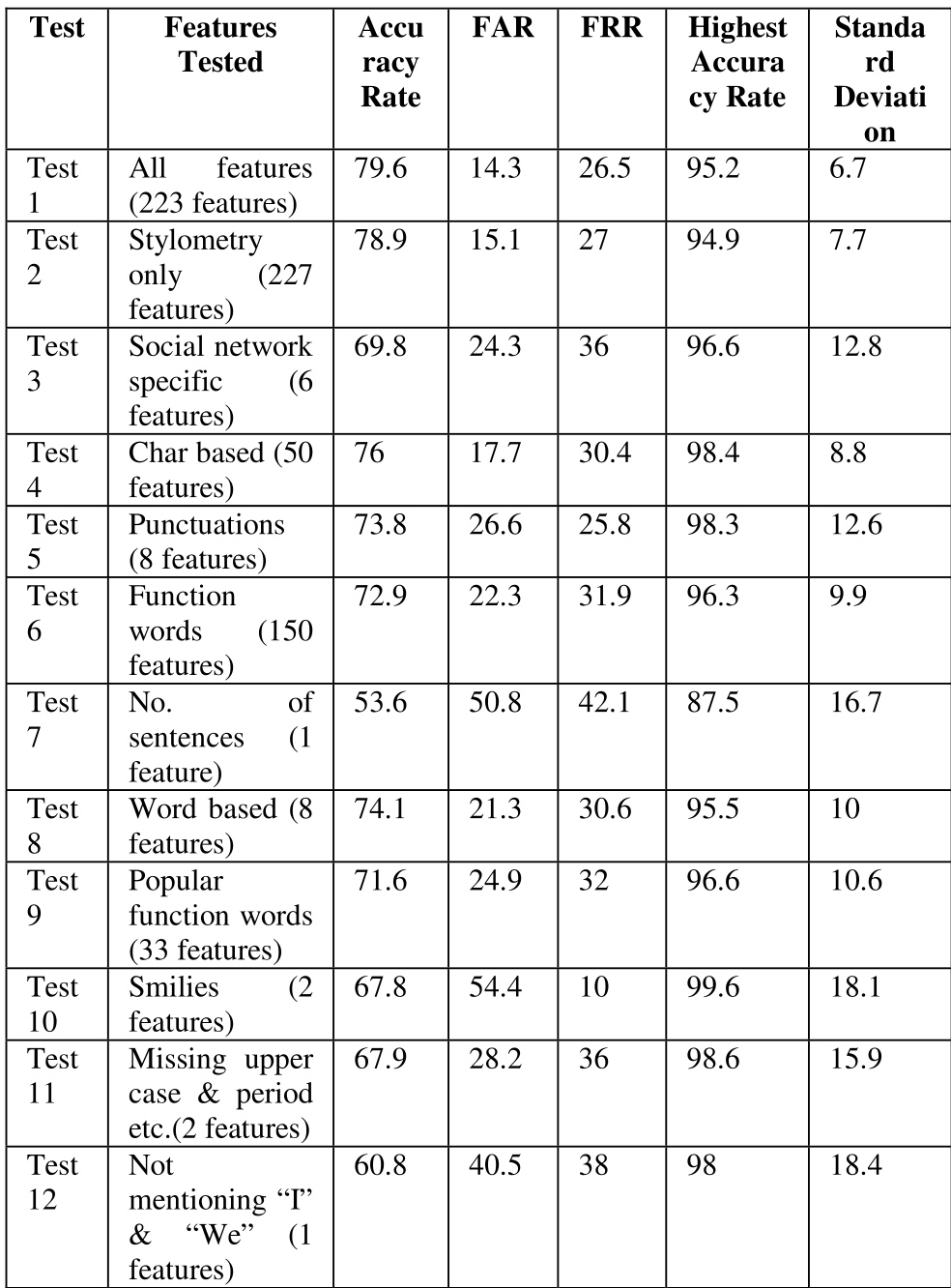 Test 1 (All features) yielded the highest average accuracy, while Test 7 (Sentence count) was almost as random as a coin flip.
Critical Analysis & Future Outlook
The "Impersonation" Vulnerability: The authors honestly note a limitation. If a hacker knows you always use "LOL" and specific smilies, they can mimic you. Thus, "ad hoc" social features should never be used alone; they must be anchored by the more subconscious "stylometric" features (like the frequency of the letter 'e' or specific function words).
The Takeaway: This research proves that even our "lazy" typing—skipping periods or lowercase starts—is part of a unique digital signature. For social media platforms, this technology offers a "silent" security guard that watches for shifts in writing style, potentially flagging a compromised account before the hacker can do serious damage.
Conclusion
As we move toward 2026, the battle against AI-generated content and account takeovers will rely on these "linguistic biometrics." By understanding the subtle patterns in our shortest messages, we can build a more resilient and authentic digital world.
Disclaimer: This analysis is based on early-stage research into Facebook authentication and serves as a foundation for modern behavioral biometrics.