
Decoding the Digital Footprint of Autism: A Multi-Dimensional Analysis of Online Blogs
Autism Blogs: Expressed Emotion, Language Styles and Concerns in Personal and Community Settings
The paper presents a large-scale computational study using machine learning and statistical analysis to distinguish autism-related blogs from control groups. By analyzing topics (LDA), language styles (LIWC), and affective norms (ANEW) across posts and comments, the authors identified distinct digital signatures for individuals with ASD in both personal and community settings.
TL;DR
Can the way you blog reveal a neurological condition? This study analyzes nearly 4,000 members across autism online communities to prove it can. By examining Topics, Language Styles, and Expressed Emotions in both posts and comments, researchers achieved up to 93.3% accuracy in identifying autism-related content. Crucially, the study reveals that individuals with autism "code-switch" between personal diaries and community forums, utilizing different emotional and linguistic markers depending on the audience.
Problem & Motivation: The Gap in Digital Phenotyping
Autism Spectrum Disorder (ASD) is characterized by specific social communication challenges and repetitive behaviors. While the Internet provides a "safe space" for these individuals due to the social-spatial distance it offers, traditional clinical studies are often limited by small sample sizes and observer bias.
Previous research looked at online autism communities but frequently ignored:
- The Role of Comments: Discussions and replies often contain more interpersonal data than the original posts.
- Contextual Behavior: Is a person's "voice" different in a private journal (Personal) compared to a public support group (Community)?
The authors argue that by filling these gaps, we can move toward unobtrusive, web-scale screening and monitoring tools for specialized healthcare.
Methodology: The Three Pillars of Analysis
The researchers adopted a robust data-mining pipeline to analyze content from LiveJournal, focusing on three specific dimensions:
- Topics (What is said?): Using Latent Dirichlet Allocation (LDA), they discovered 50 distinct latent themes.
- Language Styles (How is it said?): Using LIWC, they categorized words into psycholinguistic processes (e.g., social, cognitive, or biological).
- Affective Information (The emotional weight): Using the ANEW lexicon, they measured Valence (pleasantness) and Arousal (intensity).
Model Architecture and Feature Selection
To prevent overfitting, the study utilized Lasso (Least Absolute Shrinkage and Selection Operator). Unlike standard regression, Lasso shrinks irrelevant features to zero, effectively selecting the most "predictive" words or topics for autism.
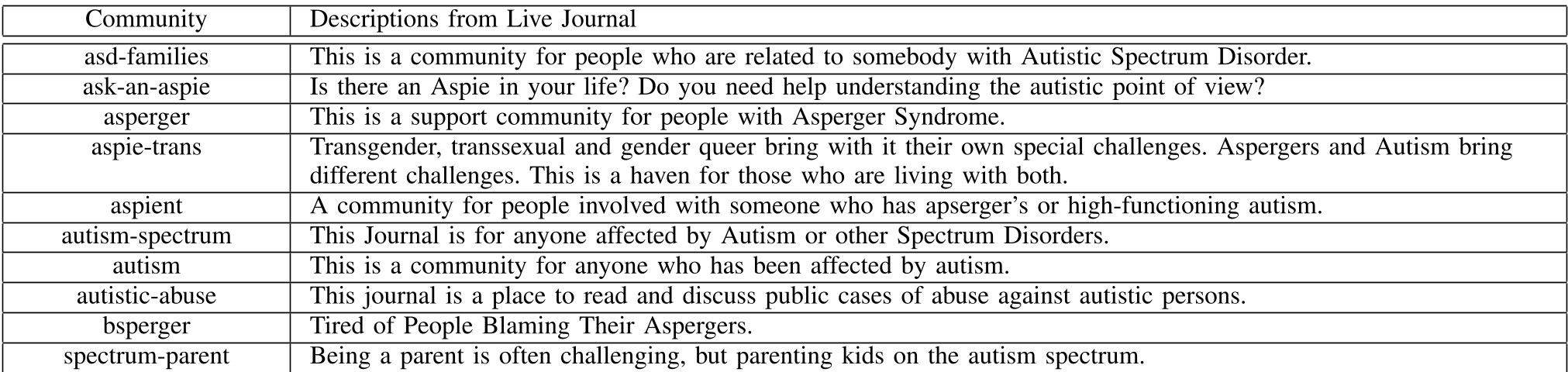 The study utilized a diverse set of autism-focused communities, ranging from family support to specific groups like 'ask-an-aspie'.
Experiments & Results: Distinct Digital Signatures
The findings were statistically significant across almost all metrics.
1. Autism vs. Control
Members of the autism communities frequently discussed "social skills," "diagnosis," and "schooling." Interestingly, they showed a higher usage of words related to Anxiety and Anger. This confirms the high prevalence of anxiety-related challenges within the ASD population. In contrast, the control group focused on "objects" and "leisure"—fashion, food, and pets.
2. Personal vs. Community Blogging
This was the most revelatory part of the study.
- Personal Blogs: Contained more positive emotion, higher valence words, and informal language (fillers like "umm," "blah," and even swear words).
- Community Blogs: Featured more supportive language, longer sentences, and a heavy focus on "health," "medication," and "family."
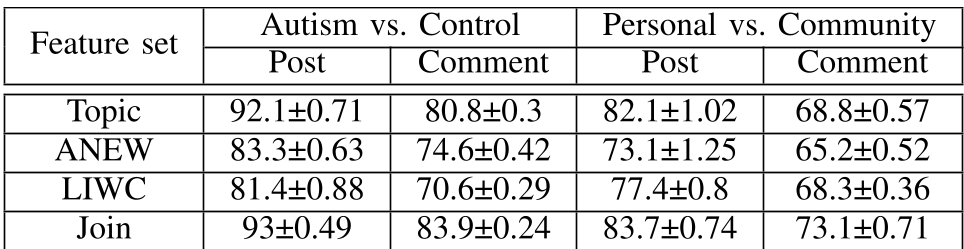 Classification performance across different feature sets. The fusion of topics, LIWC, and ANEW (Join) consistently yielded the highest accuracy.
The lower performance in "Comment" classification compared to "Post" is likely due to the shorter length of comments, providing fewer linguistic cues for the model to latch onto.
Critical Analysis & Conclusion
Takeaway
The study successfully demonstrates that ASD has a quantifiable digital signature. The most powerful predictor isn't just a single word, but a combination of topic-specific focus (social skills/education) and psycholinguistic markers (anxiety/first-person plural).
Limitations
- Ground Truth: Since the data was crawled, the "diagnosis" of authors is inferred by their participation in the communities, not clinical records.
- Temporal Dynamics: The study is a snapshot in time; how these linguistic styles evolve over a person's life remains unexplored.
Future Outlook
This methodology paves the way for "computational sensing" of mental health. Future work combining these textual features with metadata—such as posting frequency (circadian rhythms) and network connectivity—could lead to real-time support systems for neurodivergent individuals, alerting caregivers or therapists when stress-related linguistic markers (like a spike in "anxiety" and "death" topics) begin to trend.
Senior Editor's Note: This paper serves as a foundational example of how NLP can be applied to the "social sensing" of health. It moves beyond simple sentiment analysis into the realm of Pragmatics, capturing the actual behavioral essence of a community.