
[CHI 2025] Auto-Slides: Transforming Dense Papers into Pedagogical Multi-Agent Presentations
Auto-slides: An interactive multi-agent system for creating and customizing research presentations
Auto-Slides is a multi-agent system driven by Large Language Models (LLMs) that transforms academic papers into pedagogically structured, multimodal presentation slides. By integrating specialized agents for parsing, planning, and editing, it achieves a SOTA balance between automated generation and personalized interactive refinement.
TL;DR
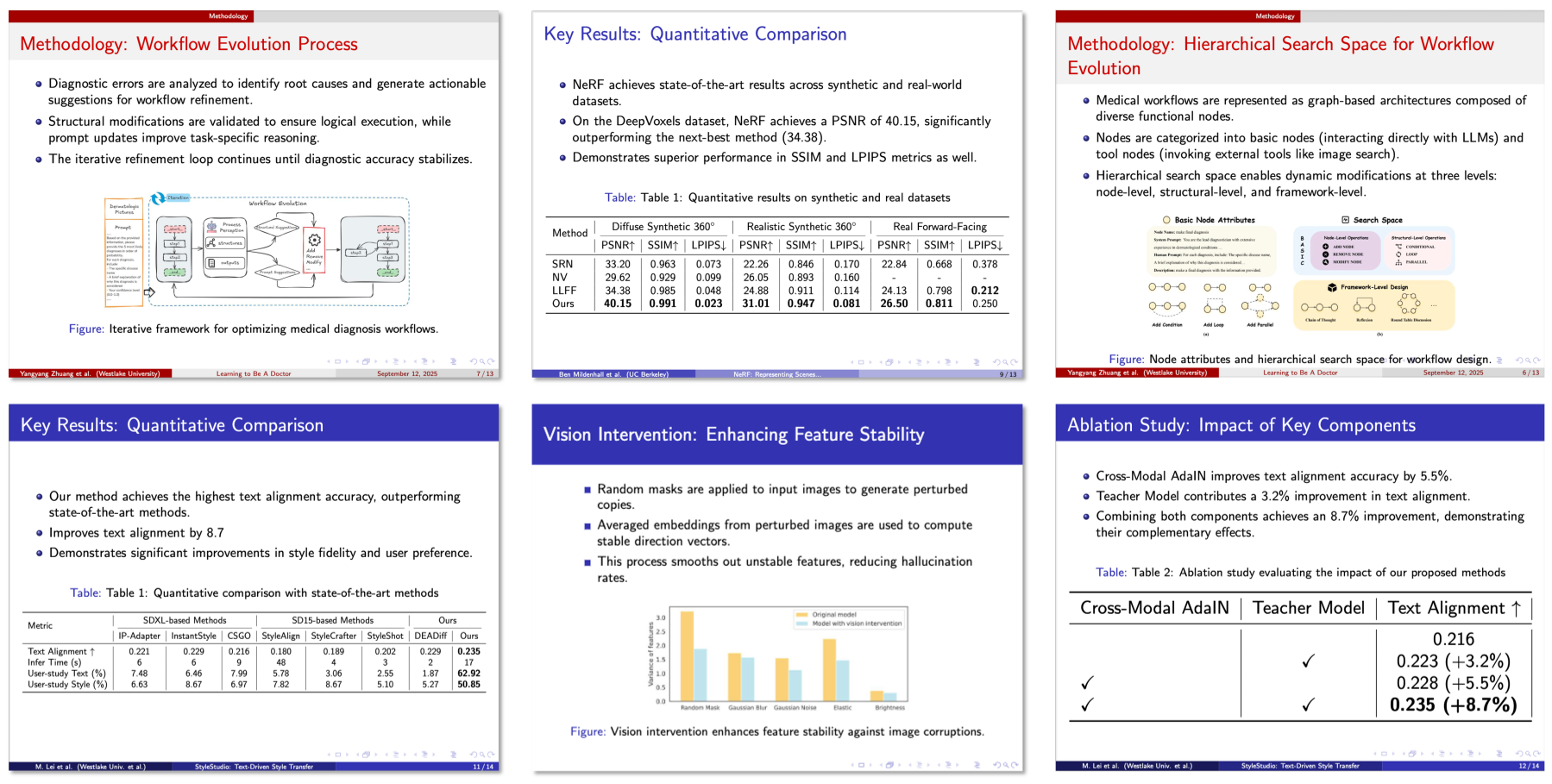
Reading complex research papers is often a high-friction task. Auto-Slides bridges this gap by using a multi-agent LLM framework to turn PDFs into structured, visually-rich LaTeX Beamer slides. Unlike simple summarizers, it employs cognitive science principles to reorganize content into a "teaching-first" narrative and offers a ReAct-based editor for real-time natural language customization.
The Motivation: Why Dialogue Isn't Enough
While LLM-powered chat interfaces (like ChatGPT) allow users to ask questions about papers, they suffer from two major flaws:
- Lack of Structure: Conversations are often piecemeal. Users lose the "big picture" or the logical flow of the original work.
- Text Reliance: Academic comprehension relies heavily on diagrams, tables, and equations—elements that standard chat interfaces often neglect or hallucinate.
Auto-Slides targets the "Interactive Multi-modal Learning" niche, positioning itself as a structural scaffold that supports both an initial overview and deep-dive exploration.
Methodology: The Core Multi-Agent Architecture
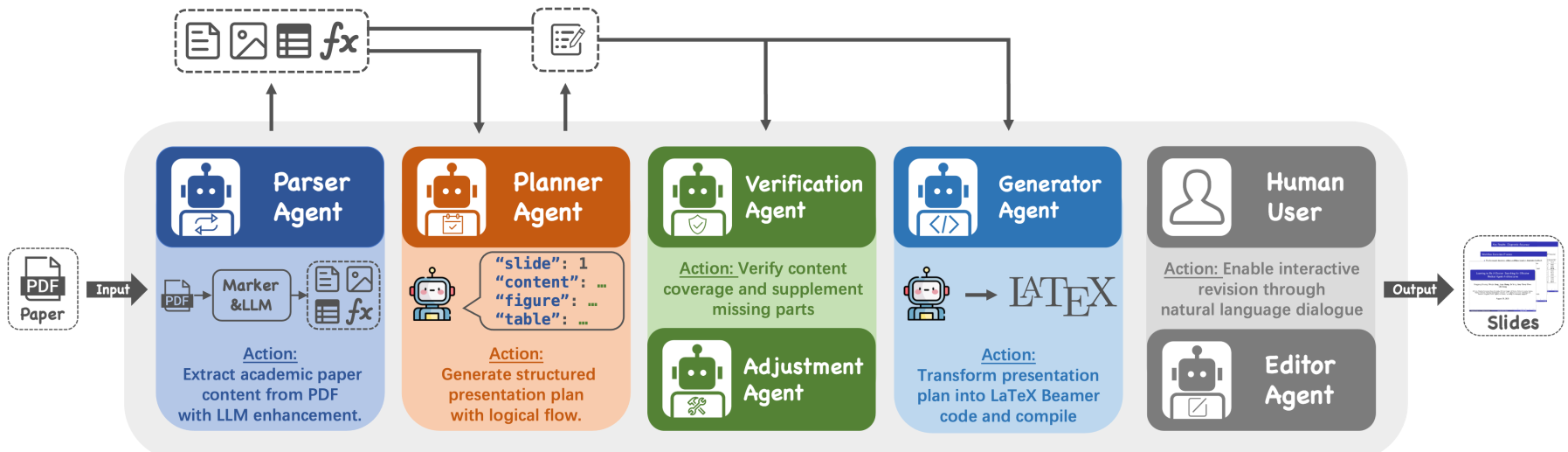
The system is divided into three functional modules that simulate a professional slide production team:
1. High-Fidelity Parsing & Planning
Most parsers fail at complex math. Auto-Slides uses a two-stage strategy: first, Marker converts PDFs to Markdown; then, a secondary LLM-based extraction isolates tables and LaTeX equations to prevent context truncation and structural corruption.
2. The PMRC Narrative Framework
Instead of sticking to the rigid IMRaD (Intro, Method, Results, Discussion) sequence of writing, the Planner Agent adopts the PMRC (Problem, Motivation, Results, Conclusion) flow. This is grounded in Cognitive Load Theory, ensuring that information density increases incrementally to facilitate better retention.
3. Interactive Editor (The ReAct Loop)
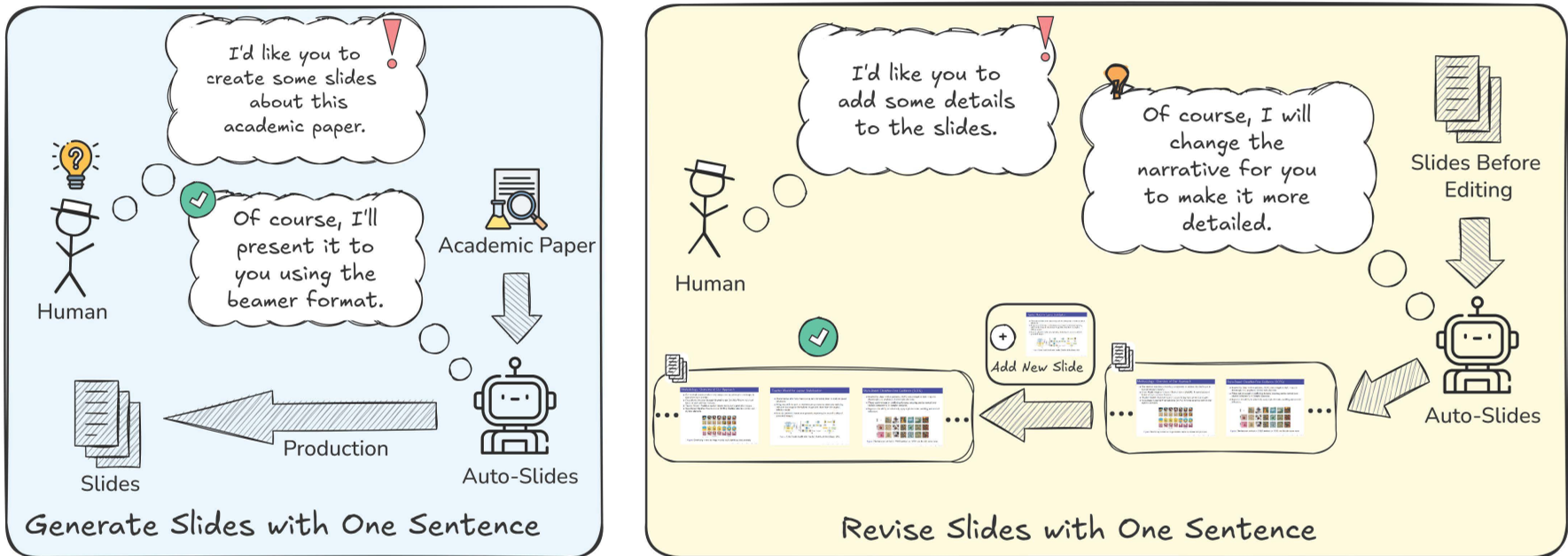
The "Editor Agent" solves the static content problem. If a user says, "Add a slide explaining Attention mechanisms," the agent performs a reasoning-action (ReAct) loop:
- Search: Scans the paper’s references and hits APIs (arXiv/Semantic Scholar) to find context.
- Locate & Modify: Identifies the correct position in the LaTeX source and inserts the new content.
Experiments & Results
The authors conducted rigorous testing, comparing their system against human experts and standard LLM chat baselines.
Quantitative Superiority
The Verification–Adjustment Loop proved essential. By comparing generated plans back against the source PDF, the system identifies omissions. In automated "LLM-as-Judge" tests using GPT-4o, the full Auto-Slides pipeline significantly outperformed ablated versions (without enhanced parsing) in Table Fidelity (67.9% win rate).
Human-Centric Success
In a user study with 24 researchers, Auto-Slides beat standard LLM chat interfaces across almost all metrics:
- Visual Clarity: 6.10 vs 5.05
- Structural Organization: 5.90 vs 5.00
- Support for Memory: 5.50 vs 5.10
Critical Insight: The "Teaching" Agent
The true value of Auto-Slides isn't just in "making slides"; it's in the pedagogical shift. By treating the LLM as a teacher (who reorganizes information) rather than a secretary (who just summarizes it), the system reduces the "extraneous cognitive load" for the learner.
Future Outlook: The researchers plan to move beyond static PDFs to include dynamic media like embedded videos and interactive code blocks, potentially turning the system into a "living" research document.
Conclusion
Auto-Slides represents a significant step forward in AI-Human Interaction (HCI). It demonstrates that by combining specialized agent roles with established cognitive theories, LLMs can do more than just process text—they can curate knowledge.