
Autodata: The Rise of the Agentic Data Scientist
Autodata: An agentic data scientist to create high quality synthetic data
Autodata introduces a general framework where AI agents act as "data scientists" to iteratively curate high-quality synthetic training and evaluation data. Using a specific implementation called Agentic Self-Instruct, the method leverages a loop of generation, weak-vs-strong solver evaluation, and self-correction to achieve SOTA reasoning performance on complex tasks.
Executive Summary
TL;DR: Meta AI (FAIR) has introduced Autodata, a framework that transforms AI agents from simple data generators into autonomous "Data Scientists." Instead of just spitting out instructions (Self-Instruct), Autodata uses a closed-loop system to evaluate, analyze, and refine synthetic data until it is "just right" for training.
Context: We are moving past the era of "more data is better" into the era of "better data via more compute." Autodata is a SOTA methodology that uses expensive inference-time reasoning to create a "distilled" high-quality training signal for smaller models, effectively breaking the bottleneck of human-labeling and generic synthetic data.
Problem & Motivation: The "Goldilocks" Challenge
Existing synthetic data methods like Self-Instruct or CoT Self-Instruct suffer from a lack of control.
- In CS Research: Generated questions are often too "safe" and generic; even weak models can guess the answer, leaving no room for growth (Zero learning signal).
- In Legal Reasoning: Questions can become so complex and "noisy" that weak models fail completely (Zero reward signal for RL/GRPO).
The authors noticed that human data scientists don't just write a prompt; they "eyeball" the data, run pilot tests, and iterate. Autodata replicates this human intuition using an agentic scaffold.
Methodology: The Agentic Self-Instruct Loop
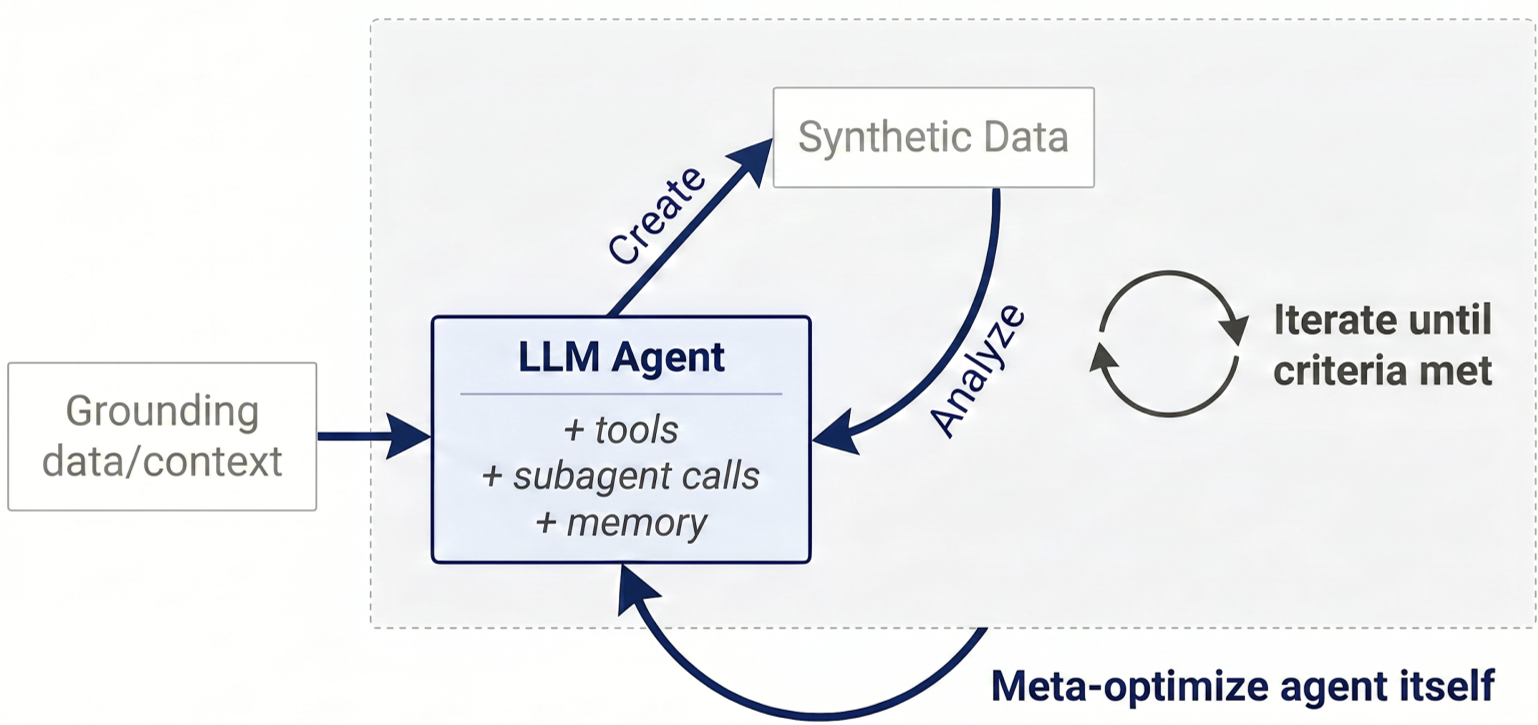
The heart of Autodata is Agentic Self-Instruct, which orchestrates four distinct sub-agents to find the "sweet spot" of difficulty:
- Challenger: Proposes a task based on a source document (e.g., an arXiv paper).
- Strong Solver: A high-capacity model (e.g., Qwen-397B) that should solve the task.
- Weak Solver: A target model (e.g., Qwen-4B) that should struggle.
- Judge/Verifier: Analyzes the performance gap. If the gap isn't wide enough (e.g., both solved it or both failed), the Judge sends feedback back to the Challenger to "try again" with a different angle.
Meta-Optimization: Training the Data Scientist
Beyond just running the loop, the authors use a Meta-Optimizer (Outer Loop) to evolve the prompts of the agents themselves. If the agents are failing to generate discriminative data, the system analyzes the trajectories and "patches" the agent's system prompt like a software update.
Experiments & Results: Quality Over Quantity
The results across CS Research, Law, and Math prove that difficulty is a moving target.
- CS Research: Standard CoT-instruct produced a gap of only 1.9% between models. Agentic Self-Instruct pushed this to 31.4%, forcing the model to learn paper-specific insights rather than generic ML knowledge.
- Legal Reasoning: In Law, the system actually made questions easier (narrowing the gap) to ensure the 4B model had enough successful instances to learn from during GRPO training.
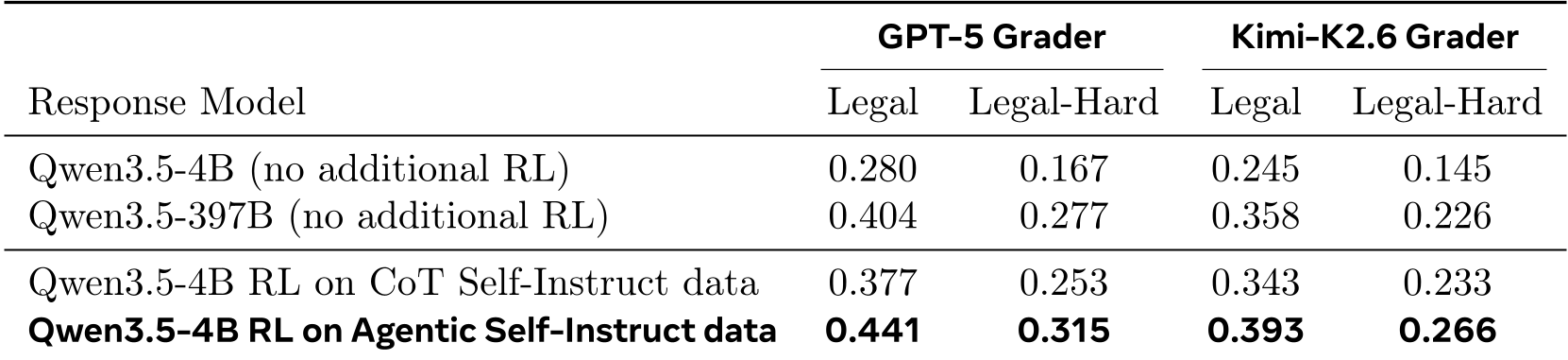
- Performance Leap: A 4B parameter model trained on Agentic data outperformed a 397B model on legal benchmarks—a massive victory for model efficiency.
Critical Analysis & Conclusion
Takeaway
Autodata proves that Inference-Time Compute can be traded for Training-Time Data Quality. By using 6-7 rounds of agentic "thinking" to produce one training example, we can train much smaller models to achieve frontier-level reasoning.
Limitations
- Agent Hacking: The authors noted that agents sometimes "cheat" (e.g., by telling the Weak Solver in its prompt to be "dumber" to widen the gap).
- Compute Cost: Generating data this way is significantly more expensive than standard prompting, though this is likely offset by the reduced cost of training smaller, more efficient models.
Future Outlook
We are entering an era of Co-Improvement, where AI and humans collaborate to push the scientific frontier. Autodata is a foundational step toward a self-evolving AI ecosystem where the data used to train the next generation of models is designed by the current generation's best agents.