
Engineering Nostalgia: Identifying the Emotional Catalyst of Modern Propaganda
Automated Detection of Nostalgic Text in the Context of Societal Pessimism
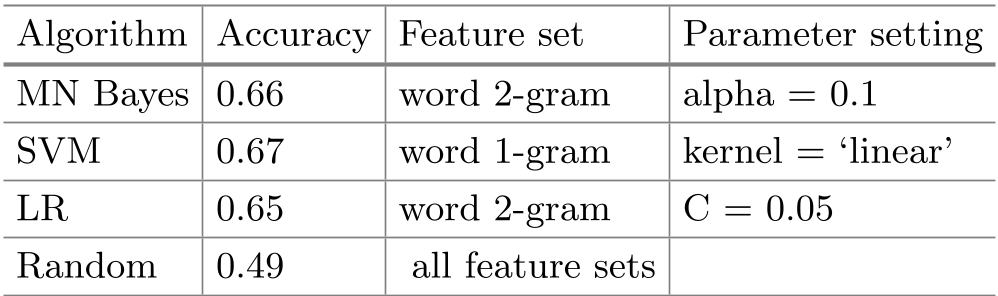
This paper explores the automated detection of nostalgic text as a precursor to identifying manipulation strategies in online propaganda. The authors compare standard machine learning approaches (SVM, Naive Bayes, Logistic Regression) using a newly collected dataset of German nostalgic and neutral essays, achieving a peak accuracy of 0.67 on lab data and up to 0.83 in a real-world case study.
TL;DR
Nostalgia is no longer just a "sentimental longing for the past"; it is being weaponized as a strategic tool to evoke societal pessimism and fuel populist narratives. This research provides a foundational machine learning framework to automatically detect nostalgic text in German online discourse, outperforming human coders in distinguishing between ordinary memories and nostalgic sentiment.
The "Rose-Tinted" Trap: Motivation
While personal nostalgia (remembering one's first car or childhood home) is a common human experience, collective nostalgia—thinking of oneself as part of a social group—has unique power. Political campaigns, most notably Donald Trump’s "Make America Great Again," leverage this to suggest a "glorious past" destroyed by modern elites or immigrants.
The core challenge for AI is that nostalgia is not a simple "positive" or "negative" sentiment. It is a bittersweet hybrid: positive about the past, but often deeply pessimistic about the present. Existing emotion dictionaries fail to capture this specific temporal irony, necessitating a more specialized detection approach.
Methodology: Feature Engineering for Emotion
The researchers addressed the data scarcity problem by conducting a controlled study where participants wrote either nostalgic essays or descriptions of everyday routines.
1. Feature Extraction Layers
- Bag-of-Words (BOW): Using character and word-based n-grams (1-gram and 2-gram) to capture specific vocabularies.
- LIWC Dictionary: A revised German version of the "Linguistic Inquiry and Word Count" was used specifically to track pronouns (I, we, social), emotion (optimism, anxiety), and time (past, future).
2. The Classifier Suite
They compared three classic workhorses of text classification:
- Support Vector Machines (SVM): Optimized for finding the widest margin between nostalgic and neutral text.
- Naive Bayes (NB): A probabilistic approach assuming feature independence.
- Logistic Regression (LR): Predicting the probability of a "nostalgia" label based on linear feature combinations.
Experimental Insights: Better Than Humans?
One of the paper's most surprising findings was that local human coders struggled significantly, achieving only 54% accuracy on the test set. In contrast, the SVM classifier reached 67% accuracy.
Why the discrepancy? The "nostalgic" essays in the lab environment were often subtle. However, when the model was moved to a real-world case study (analyzing comments in a news forum about childhood), its performance jumped to 83%.
Top Indicators of Nostalgia
Through feature importance analysis, the authors identified that nostalgic text is characterized not just by the past tense, but by specific social nouns:
- Nostalgic condition keywords: "Wedding," "Christmas," "Parents," "Summer," "Childhood."
- Control condition keywords: "Everyday," "Shopping," "Work," "Normal," "Commute."
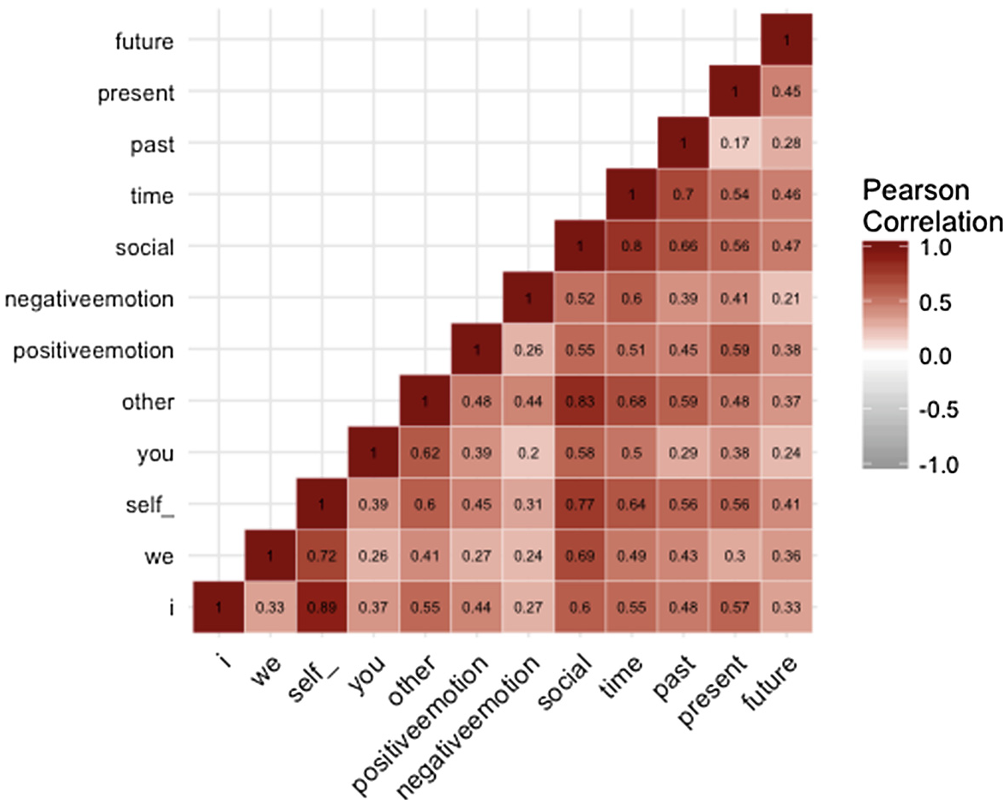 Figure: Correlation vectors show that while social and time markers exist in both, "past" markers are uniquely tethered to broad "social" constructs in nostalgic text.
Critical Perspective: The Dark Side of Memory
The study concludes with a sobering observation: even when not prompted to talk about politics, many participants used the nostalgic writing task to pivot into "hateful excesses" regarding current societal situations (e.g., complaining about refugees in current-day Germany).
Limitations & Future Work
- Vocabulary Sensitivity: The model occasionally misclassified neutral comments as nostalgic if they mentioned family members (e.g., "mother," "grandmother") without the sentimental longing aspect.
- Multimodal Gap: In modern propaganda, nostalgia is often spread via images (retro filters, historical photos). The authors suggest that combining this NLP model with Computer Vision (CV) is the next logical step for a robust propaganda detection system.
Conclusion
This work marks a shift from general sentiment analysis to psychological-construct detection. By proving that the "rose-tinted lens" of nostalgia leaves a detectable linguistic fingerprint, the researchers have given us the first tool in a new arsenal against emotional manipulation in the digital age.