
Automated Metadata Generation: Breaking the Authoring Bottleneck in Adaptive E-Learning
Automated Educational Course Metadata Generation Based on Semantics Discovery
The paper proposes an unsupervised method for the automated generation of educational course metadata (concepts and relationships) from raw text. Using a combination of Vector Space Models (VSM), TF-IDF variants, and graph-based discovery algorithms like PageRank, it creates a domain model for adaptive e-learning systems, achieving a F*-measure of 0.652.
TL;DR
Creating personalized learning experiences usually requires teachers to manually map out thousands of relationships between concepts—a Herculean task. This paper introduces an unsupervised framework that extracts "pseudoconcepts" from course materials and uses graph algorithms like PageRank to automatically build a semantic domain model, achieving high alignment with human-made structures with minimal manual effort.
The "Complexity Bottleneck" in Personalized Education
Adaptive educational systems are only as good as their Domain Model. For a system to recommend a specific explanation of "Recursion" to a student, it must know that "Recursion" is related to "Factorials," "Stack Frames," and "Termination Conditions."
The problem? Modern courses contain thousands of fragments—explanations, animations, and questions. Manually defining every link in this "Concept Space" isn't just tedious; it’s practically impossible for a human being to maintain consistency across such a scale. Most existing solutions fail because they require heavy linguistic machinery (Natural Language Processing tools) or pre-existing "Universal Ontologies" that simply don't exist for niche academic subjects.
Methodology: From Raw Text to Semantic Graphs
The authors propose a purely statistical, unsupervised approach that "listens" to the structure of the course material rather than needing a dictionary.
1. Smart Preprocessing
Instead of treating all words equally, the system boosts the "Relevance Score" of a term if it appears in a course index or if it is formatted prominently (e.g., Bold or Large Header).
2. Pseudoconcept Extraction
The method identifies "Relevant Domain Terms" (RDTs) using an extended TF-IDF formula that correlates terms to specific Learning Objects (LOs).
 The relatedness formula incorporates term relevance (rel) and inverse document frequency (idf) to filter the wheat from the chaff.
3. The Secret Sauce: Relationship Discovery
Once concepts are identified, how do we link them? The authors experimented with three methods:
- Vector Space Similarity: Simple overlap of words.
- Spreading Activation: Simulating how "energy" flows through a network.
- PageRank-based Analysis: Treating concepts like web pages and analyzing their "authority" and connectivity.
Experiments: Testing on Functional Programming
The team applied their tool, CourseDesigner, to a real-world Functional Programming course (70+ learning objects in Lisp). They compared the AI-generated map against a "Gold Standard" created by 20 students.
Performance Metrics
The graph-based PageRank approach was the clear winner. Interestingly, while the F*-measure (a balance of precision and recall) hit 0.652, the authors noted that many relationships identified by the algorithm were actually correct—the human students just hadn't noticed them!
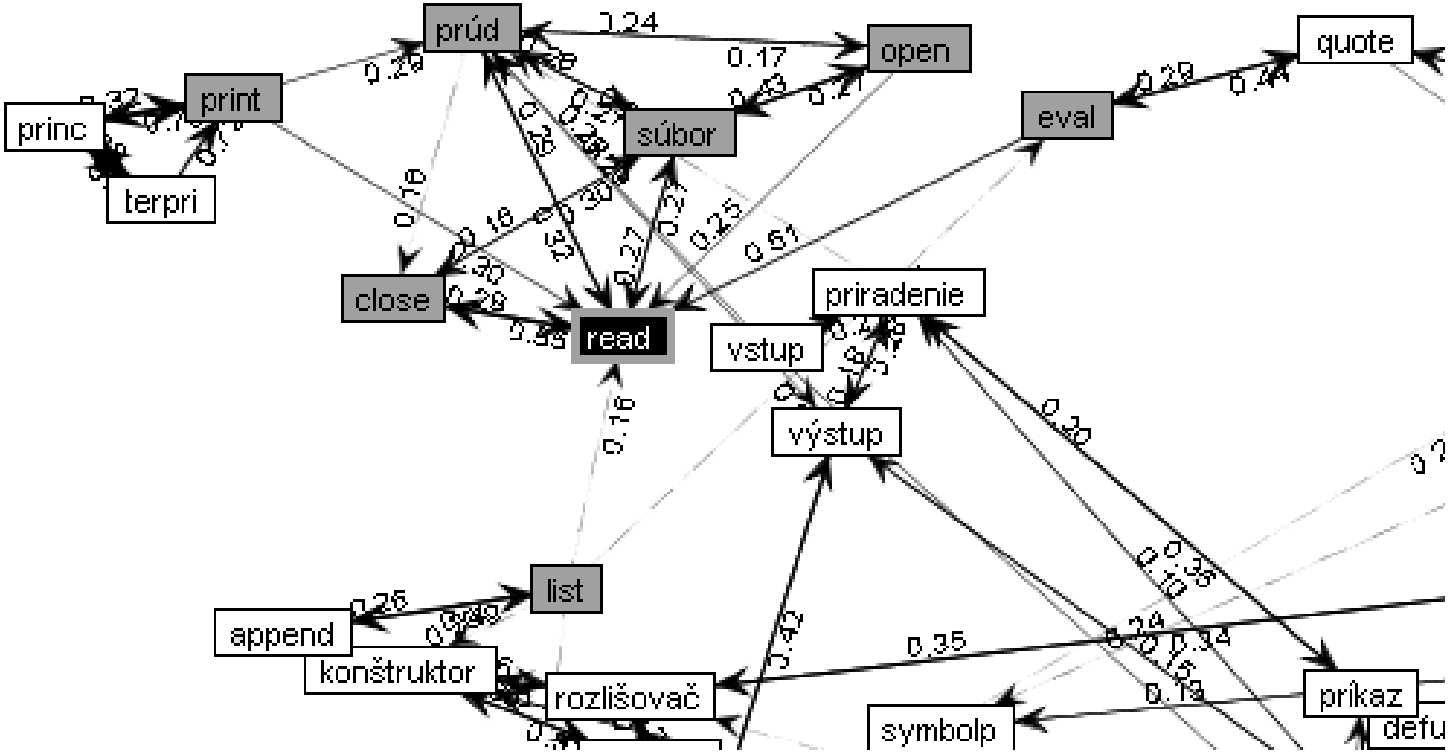 Comparison of different discovery variants showing the strength of the PageRank approach.
Critical Insight: Why This Matters
The real value of this work is its Inductive Bias. By assuming that "Semantics" is hidden in the statistical structure of a text, the authors bypass the need for human-annotated datasets.
Limitations: The system still struggles with Ambiguity (words with multiple meanings) and "Sparse Concepts" (important ideas that only appear in a small, isolated section of the course). These are classic Natural Language Processing (NLP) hurdles that likely require modern Large Language Models (LLMs) to fully solve.
Conclusion
This paper proves that we don't need a "Global Brain" or a massive WordNet database to build smart educational tools. By using unsupervised graph discovery, we can unburden teachers and move toward a future where "Adaptive Learning" is the default, not a luxury reserved for courses with massive budgets.