
A Tweet of the Mind: Bridging Neural Patterns and Social Media via BCI
A Tweet of the Mind: Automated Emotion Detection for Social Media Using Brain Wave Pattern Analysis
The paper introduces a novel end-to-end BCI (Brain-Computer Interface) system that automates social media posting by analyzing EEG signals to detect emotions. Utilizing the Emotiv EEG headset paired with GPS data, the system successfully translates neural patterns into real-time "Tweets" without manual user input.
TL;DR
Researchers have developed a proof-of-concept system that eliminates the need for typing or speaking when posting to social media. By combining Brain-Computer Interface (BCI) technology with GPS data, the system detects a user’s internal emotional state (Excitement, Frustration, Boredom) via brainwaves and automatically broadcasts it to Twitter. This "passive" sharing aims to increase the authenticity and "truthfulness" of digital experiences.
Background: The Authenticity Gap in Social Media
In the current social media landscape, posts are curated. Text can be manipulated, and the "emotion" expressed in a tweet often reflects the author’s intent rather than their genuine physiological state at the time of an event. Furthermore, physical constraints—such as the "fat finger" problem on mobile keyboards or the privacy risks of voice-to-text—often prevent users from sharing experiences in real-time.
The authors argue that by bypassing the "conscious filter" of typing and using direct neural feedback, we can achieve a higher level of Social Media Truthfulness.
Methodology: From Neurons to Tweets
The proposed architecture is a three-tier system:
- Signal Acquisition: An Emotiv EEG device captures multi-channel brainwave patterns.
- Affective Computing: A mobile/PC interface processes these patterns to identify specific emotions using pre-validated EEG analysis algorithms.
- Automated Publication: When an emotional intensity crosses a specific threshold, a "Tweet" is generated via API, combining the emotion name with Google Maps geo-data.
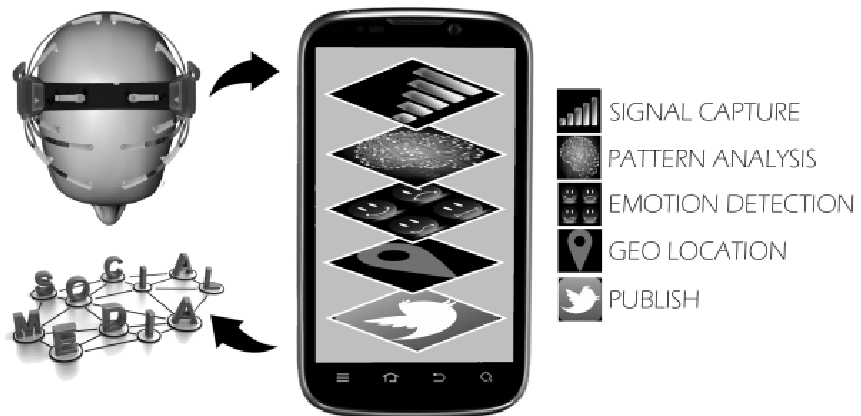
The Threshold Logic
To prevent a constant stream of "brain spam," the authors introduced a dual-threshold mechanism:
- Upper Threshold (90%): The emotion must reach peak intensity to trigger a post.
- Lower Threshold (40%): The emotion must subside before a new distinct event can be recorded.

Experimental Validation: Driving and Decaf
To test the system, a subject wore the EEG headset while driving to a coffee shop. The system successfully captured high-intensity Frustration when a police car passed and Excitement upon arrival.
The resulting "Tweets" (shown below) represent a raw, unfiltered log of the user’s mental journey, providing context that traditional text-based posts often miss.

Deep Insight: Beyond Social Tweeting
While the "Twitter" application is a proof-of-concept, the implications for Anonymous Data Aggregation are profound:
- Emotional Cartography: Cities could monitor real-time "fear" or "comfort" zones to optimize police patrols or urban planning.
- Workflow Optimization: Corporations can identify specific points in a facility that trigger employee frustration, allowing for data-driven management.
- Accessibility: For individuals with motor impairments, this represents a significant leap in social connectivity without requiring physical dexterity.
Critical Analysis & Conclusion
The research successfully demonstrates that BCI is no longer confined to the lab. However, two major hurdles remain:
- Hardware Form Factor: Even with the transition from 14-channel to 5-channel devices (like the Emotiv Insight), wearing an EEG headset in public remains socially conspicuous.
- Privacy: The "direct-to-brain" link raises massive ethical questions. If we automate our emotional output, do we lose control over our "inner" privacy? The authors suggest rigorous access control policies, but the "truthfulness" the system seeks to provide may come at the cost of personal digital boundaries.
In conclusion, "A Tweet of the Mind" offers a fascinating glimpse into a future of ubiquitous BCI computing, where our digital footprint is not just what we say, but what we sincerely feel.