
Decoding Geopolitics: Automated Strategic Mapping via NLP and Game Theory
Automated extraction of a game model using natural language processing: National strategies of the Asian Infrastructure Investment Bank
This paper introduces an automated framework for extracting strategic relations from Japanese news corpora using Natural Language Processing (NLP) and supervised machine learning. By identifying "clue expressions" and applying the Graph Model for Conflict Resolution (GMCR), the authors visualize complex geopolitical interdependencies, specifically regarding the Asian Infrastructure Investment Bank (AIIB).
TL;DR
In an era of information overload, understanding the strategic moves of global powers like China or the US requires more than just reading the news—it requires modeling. This paper presents a novel pipeline that uses Natural Language Processing (NLP) to extract "strategic relations" from news articles and transforms them into formal Graph Models for Conflict Resolution (GMCR). Focused on the Asian Infrastructure Investment Bank (AIIB), the method reveals hidden connections between seemingly disparate events like the annexation of Crimea and trade negotiations.
Problem & Motivation: The Big Data Gap in Strategy
Strategic analysis has traditionally been a manual, "expert-driven" field. However, as the volume of global media expands, human analysts cannot keep pace with the web of interdependent interests.
While modern NLP can identify causal relations (A caused B), it often misses the strategic nuance (If Player A does X, Player B will do Y to maximize their interest). The authors identified a gap: the lack of tools that can automatically parse natural language into the rigorous mathematical structures required for game theoretic analysis.
Methodology: From Syntax to Strategy
The research team developed a workflow to bridge the gap between unstructured Japanese text and formal state-transition models.
1. Clue Expression Extraction
Using tools like MeCab (morphological analysis) and CaboCha (dependency parsing), the system searches for six specific Japanese clue expressions that signal conditional strategic intent, such as:
- Wo-ukete (In response to)
- Sureba (If ~ does...)
- Ni-taikou (Against ~)
2. Machine Learning Classification
Because a clue expression doesn't always imply a strategic move, the authors trained a Support Vector Machine (SVM) using three syntactic features. This allows the system to filter out simple descriptive sentences and focus on those defining a "Player-Action" pair.
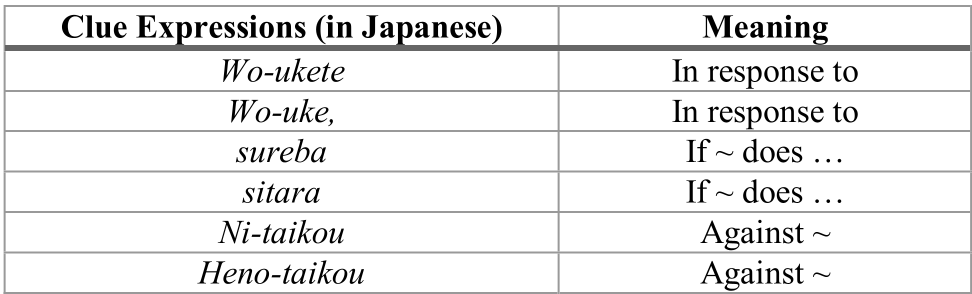 Table 1: The linguistic anchors used to pull strategic intent from raw text.
3. Integrated GMCR Modeling
The extracted relations are converted into a Strategic Map. Each state represents a combination of player choices. By analyzing these, the system can identify Nash Equilibria—outcomes where no player has an incentive to deviate.
Insights from the AIIB Case Study
The researchers applied their tool to a corpus centered on the Asian Infrastructure Investment Bank (AIIB).
The "UK Effect"
A fascinating finding was the visualization of the shift in global power dynamics after the United Kingdom decided to join the AIIB. Before the UK's participation, US pressure kept many western allies at bay. The extracted strategic map clearly visualized how the UK's move changed the "preference rankings" of other countries, triggering a domino effect of participation.
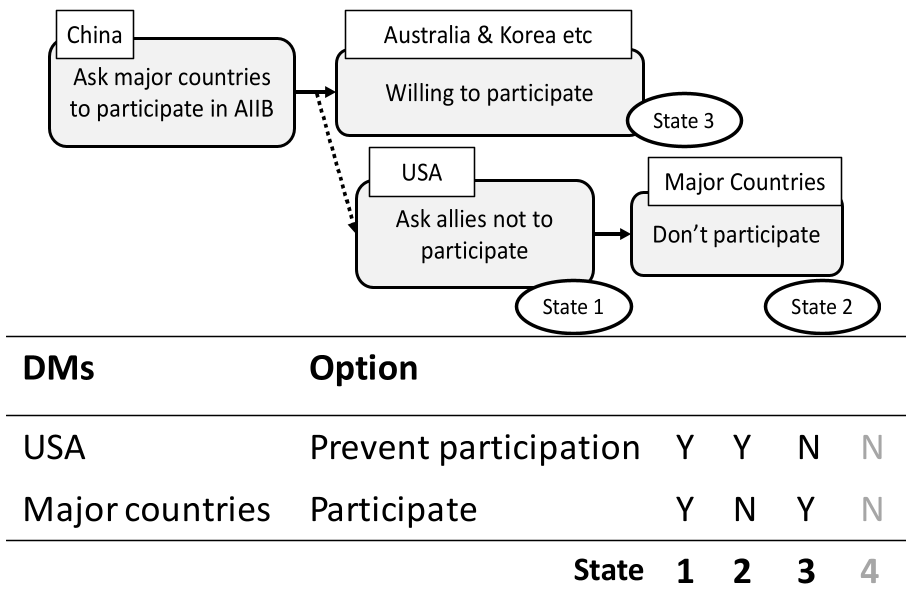 Visualizing the pivot points in global finance through extracted data.
Hidden Geopolitical Links
The system revealed an intuitive but complex link: China’s increased assertiveness in the South China Sea was strategically linked to the US being "preoccupied" with Russia’s annexation of Crimea. The tool mapped these as a singular, interconnected game rather than isolated news stories.
Experimental Performance
The system achieved a solid baseline for a first-of-its-kind attempt:
- Accuracy: 60%
- Coverage: 66.7%
While the volume of perfectly extracted "Player-Action" pairs was modest, the proof-of-concept demonstrates that logical preference information can be programmatically derived from text (e.g., "If A does X, then B does Y" implies B prefers Y over the alternative).
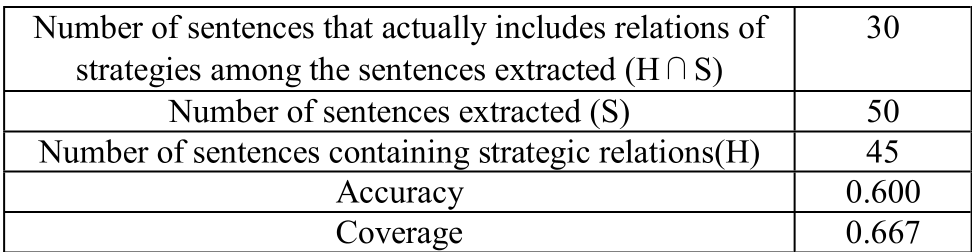 Performance metrics for the extraction of strategic relations.
Critical Analysis & Future Outlook
Takeaway: This research successfully moves conflict analysis from a static "after-the-fact" reporting style to a dynamic, computational modeling approach.
Limitations:
- The current accuracy (60%) suggests that human-in-the-loop verification is still necessary.
- The reliance on fixed "clue expressions" may miss more subtle or metaphor-heavy strategic declarations common in high-level diplomacy.
Future Work: The logical next step is the integration of Large Language Models (LLMs). While this paper used SVMs and rule-based parsing, LLMs could potentially improve the "Coverage" by understanding context-heavy strategic relations without relying on explicit clue expressions.