
Automated Hand Gesture Recognition: Bridging the Gap in Digital Education
Automated hand gesture recognition for educational applications
The paper presents a low-cost, real-time automated hand gesture recognition system designed for educational applications. Using simple camera equipment and a Random Forest classifier, the system recognizes digits and mathematical operators to facilitate interactive learning and e-learning environments.
TL;DR
This research introduces a streamlined, cost-effective framework for recognizing hand gestures to improve Human-Computer Interaction (HCI) in educational settings. By moving away from expensive sensors and focusing on efficient 2D geometric features (convexity defects), the authors achieved an 85% accuracy rate using a standard webcam and the Random Forest algorithm.
Background & Motivation
Despite the proliferation of digital learning, the keyboard and mouse remain "unnatural" intermediaries for expressing mathematical ideas or interacting with virtual whiteboards. While Computer Vision (CV) offers a solution through gesture recognition, most state-of-the-art methods typically fall into two extremes:
- High-cost hardware: Requiring data gloves or depth cameras (Kinect).
- High-computational complexity: Requiring heavy GPU resources for 3D model-based tracking.
The authors’ intuition was to create a "budget-friendly" yet robust system that relies on the shape attributes of a hand rather than its appearance or motion, making it invariant to different lighting and backgrounds.
Methodology: The Geometry of a Gesture
The system follows a classic yet optimized CV pipeline:
- Preprocessing: Conversion to grayscale, followed by a Gaussian Blur to remove noise and simple thresholding to create a binary image.
- Contour & Hull Extraction: Using the Suzuki algorithm for contouring and the Slansky algorithm for finding the "convex hull"—the smallest convex shape that contains the hand.
- Convexity Defects: This is the "secret sauce." The system identifies the space between the fingers and the convex hull. Each defect is characterized by its start, end, and farthest points, as well as its depth.
- Feature Selection: To ensure speed, the authors used Information Gain to prune the dataset from 25 down to the 17 most informative features.
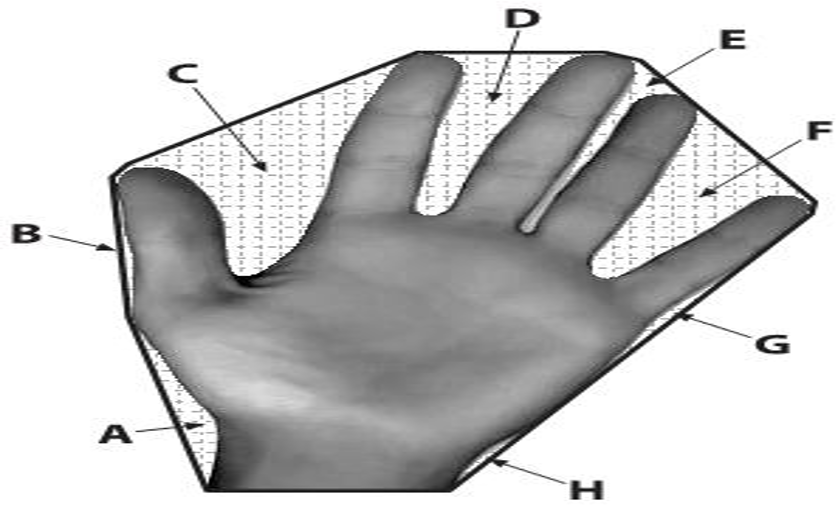 Figure 1: Visualization of the convex hull and the identified defects (regions) used for classification.
Experiments and Results
The authors tested their system on a dataset of 2,036 examples across 16 classes (digits 0-9 and signs like '+', '-', 'derivative', etc.).
They compared the Random Forest learner against several heavyweights in the Machine Learning world, including Multilayer Perceptrons (MLP) and Rotation Forests.
| Selected Learner | Accuracy (%) |
|---|---|
| Random Forest | 85.00 |
| Rotation Forest | 84.00 |
| K-Nearest Neighbors (KNN) | 79.79 |
| MLP (Neural Network) | 76.89 |
| BayesNet | 63.40 |
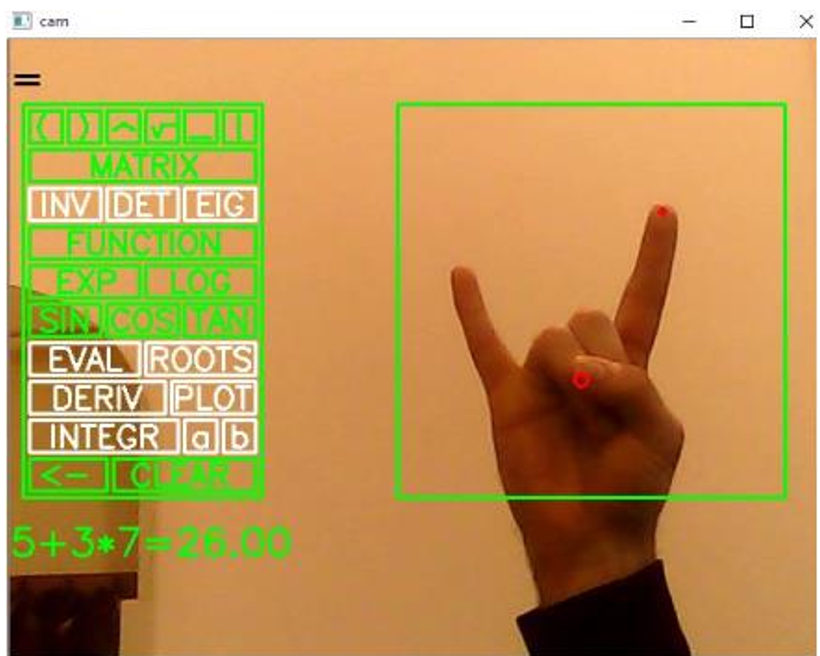 Figure 2: The system interface in action, demonstrating real-time recognition of mathematical symbols.
The Random Forest was the clear winner because it provided the best balance between accuracy and inference speed, which is critical for a "real-time" educational tool.
Conclusion and Insights
The true value of this work lies in its democratization of technology. By proving that a simple webcam and a shallow ensemble learner can effectively interpret complex mathematical gestures, the research opens doors for:
- Accessible E-Learning: Tools for students who may have difficulty with traditional peripherals.
- Interactive Virtual Classrooms: Allowing teachers to "write" in the air to trigger digital functions.
Limitations: The system currently relies on static snapshots of gestures. Future work involving Semi-Supervised Learning could allow the system to learn from unlabeled video streams, further improving accuracy without requiring massive annotated datasets.