
Automated Detection of Still’s Murmur: Reducing Unnecessary Pediatric Referrals through Targeted AI
Automated Identification of Innocent Still's Murmur in Children
This paper presents a specialized machine learning framework for the automated identification of Still’s murmur, the most common innocent heart murmur in children. By combining a robust segmentation algorithm with features like diamond-shaped envelope detection and spectral width analysis, the system achieves 84–93% sensitivity and 91–99% specificity.
TL;DR
Researchers have developed a computer-aided auscultation system specifically designed to identify Still’s murmur—an "innocent" heart sound found in up to 90% of children. By using specialized spectral features and a custom segmentation algorithm, the system achieves diagnostic accuracy comparable to pediatric cardiologists, potentially cutting down thousands of unnecessary specialist referrals.
Background: The "Innocent" Problem
In the pediatric world, Still’s murmur is a clinical paradox. It is incredibly common (affecting 40-90% of healthy children), completely harmless, and requires zero treatment. Yet, because its musical, low-pitched tone can be difficult for non-specialists to distinguish from structural heart defects, it triggers a massive wave of unnecessary echocardiograms and specialist consultations.
While most AI research focuses on finding disease, this paper takes the opposite approach: identifying a specific non-disease to clear the "noise" in the healthcare system.
Methodology: Capturing the "Musical" Signature
The researchers' pipeline addresses the unique challenges of the pediatric heart, which beats faster and more irregularly than the adult heart.
1. Robust Segmentation Without ECG
Traditional heart sound analysis often relies on an ECG lead to find the First (S1) and Second (S2) heart sounds. To make this tool practical for a standard clinic, the authors developed a correlation-based segmentation technique. It uses a Cost Function (Equation 7 in the paper) that balances envelope correlation, cardiac cycle length, and systolic intervals to accurately identify heart sounds even when heart rates fluctuate.
2. Feature Engineering: The Diamond and the Pitch
The "secret sauce" of this paper lies in its 14 specialized features. Unlike deep learning models that learn "black box" features, this team engineered features based on cardiologists' observations:
- Diamond-Shaped Envelope: Still’s murmur has a crescendo-decrescendo shape. The authors used two matched filters (C-D and D-C) to calculate a "Matched Filter Output Ratio."
- Spectral Purity: Because Still’s murmur is "musical," it has a very narrow spectral width compared to the noisy, broad-spectrum sounds of pathological murmurs (like those from a ventricular septal defect).
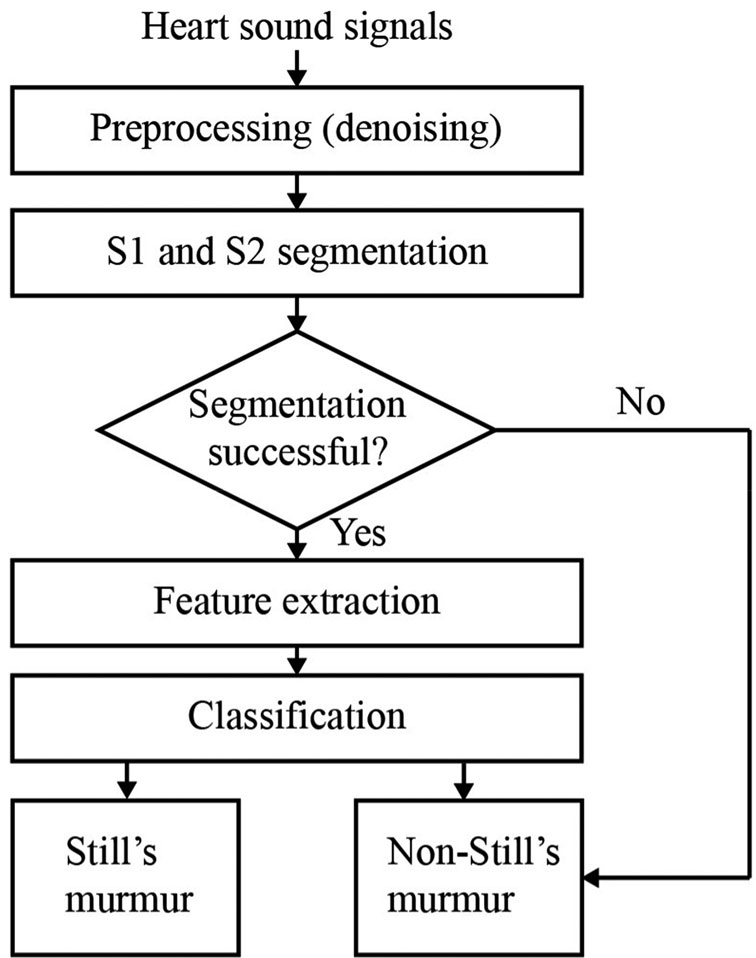 Fig 1: The system workflow—from raw audio to S1/S2 segmentation and final SVM classification.
Experiments and Results
The team tested their algorithm against 257 pediatric patients, a significantly more balanced and realistic dataset than prior studies, which often lacked sufficient "innocent" cases.
Performance Metrics
Comparing Artificial Neural Networks (ANN) and Support Vector Machines (SVM), the SVM with averaged features emerged as the winner:
- Sensitivity: 84–93%
- Specificity: 91–99%
- AUC-ROC: 0.9661
This performance is critical because, in this specific clinical context, Specificity is King. We want to ensure that if the algorithm labels a murmur as "Still’s" (Innocent), it is almost never wrong, so that a sick child isn't accidentally labeled as healthy.
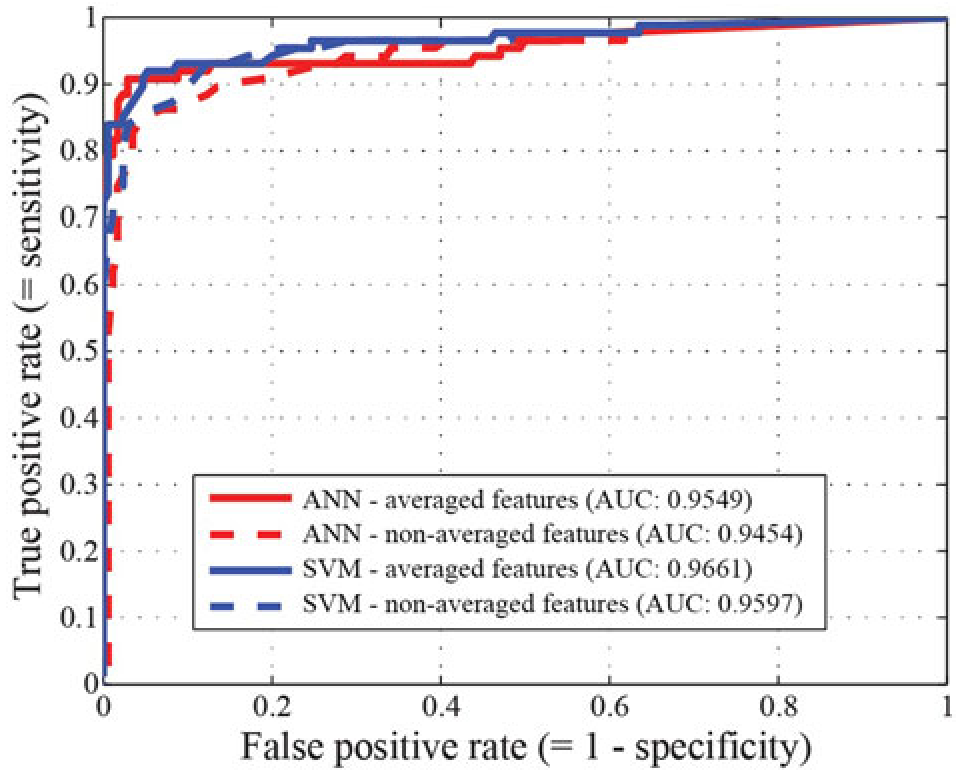 Fig 2: ROC curves comparing ANN and SVM performance. The SVM (top lines) consistently provides better diagnostic separation.
Critical Insight: Why Focus on Still's Murmur?
Most CAD (Computer-Aided Diagnosis) systems fail because they try to be a "catch-all" for every possible pathology. By narrowing the scope to the single most common cause of "false alarm" referrals, the authors created a tool that is more robust and clinically actionable.
The ability to detect Segmentation Failure as a proxy for pathology is also a clever design choice. If the algorithm cannot find the S1/S2 boundaries—often because a pathological murmur is "holosystolic" (spanning the whole cycle)—it defaults to a non-Still's classification. This "fail-safe" mechanism ensures that complex cases are still flagged for human review.
Conclusion & Future Work
This work demonstrates that "Innocent Murmur Identification" is just as valuable as "Pathology Detection." By integrating this algorithm into digital stethoscopes, primary care pediatricians could soon have a "second opinion" in their pocket, saving parents from unnecessary anxiety and the medical system from unnecessary costs.
The next steps involve testing the algorithm across all chest locations (not just the sternal border) and refining the feature set to further reduce False Positives.